Spotlight - Gas price higher, but not back to last year’s peak
Spotlight: Will we face gas shortages in Europe next winter? We take stock of the energy crisis.


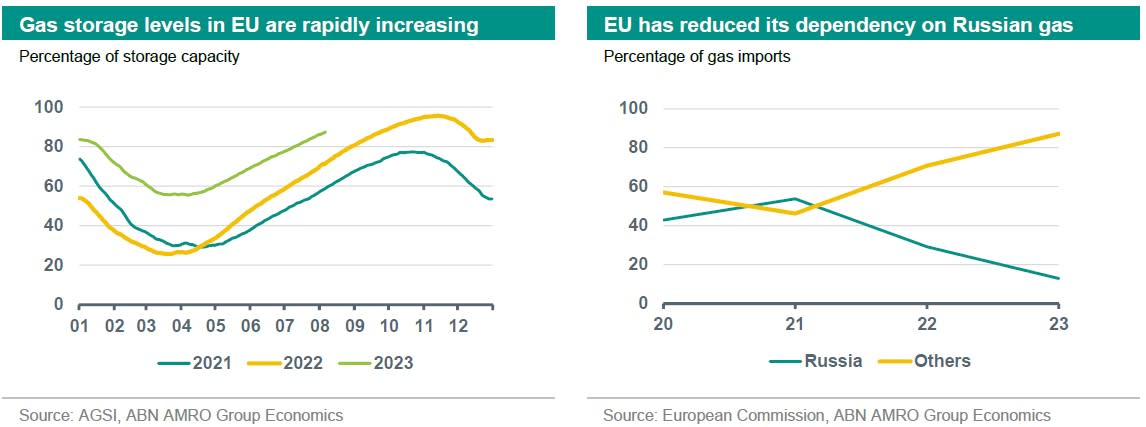
Bigger gas buffers limit the risk of shortages. The gap in gas supply left by Russia has been largely filled by other gas suppliers
Share of renewables in power supply increasing fast, and energy consumption has fallen
Our base case sees gas prices staying higher than before the energy crisis, but even in a negative scenario, we do not expect prices to return to levels we saw at the height of the crisis last summer
REPowerEU plan implemented successfully
The energy crisis triggered by the Russian invasion of Ukraine hit the European economy very hard last year. Surging gas prices following the halt of Russian supplies to the continent raised energy bills to unprecedented levels, pushing up inflation and curbing purchasing power. In this note we revaluate the situation for the upcoming winter. We think Europe has become less vulnerable to gas supply challenges than in early 2022 thanks to a series of measures. The REpowerEU plan is raising gas storage capacity, diversifying gas supplies with a bigger role for Liquified Natural Gas (LNG), and increasing the share of renewable power in the electricity mix along with supporting clean fuels such as hydrogen. Europe has made much progress on these fronts last year. The gap left by the decline in gas imported from Russia has been largely filled by other suppliers. Gas buffers are ample. So ample, that LNG tankers are sometimes turned away to Asia to serve customers there. Furthermore, the amount of energy generated from solar and wind has risen steadily, and gas consumption has fallen as energy is used much more efficiently.
Fears of a repeat of last year’s price spikes are largely unwarranted
Despite the massive progress Europe has made, there is no guarantee that gas prices will remain low. After all, Russia is still responsible for an eighth of the European Union’s imports. Should Moscow suddenly decide to turn off the gas tap, Europe will indeed have a problem. Europe was fortunate last year that gas demand in Asia was relatively low due to lockdown measures in China. With China's economy recovering, demand is rising again. Finally, gas demand last winter was as much as 7% lower than in the previous five years due to relatively mild temperatures. Assuming more normal winter temperatures, gas demand will be higher in the coming winter. By themselves, these concerns are justified. However, there are caveats to this as well. First, it is not in Russia's interest to further restrict exports as long as there is no gas pipeline to China, and given that northern Russian LNG ports are poorly accessible in winter. Second, the latest data from China do not suggest a strong rebound in the economy; on the contrary, the economy continues to languish (see our China story). Third, the hot summer did not cause a price shock this year, despite the increased demand for energy-intensive cooling associated with heat waves.
There are also potential tailwinds for energy supply
Last year's struggles with gas supplies came at a very unfortunate time. For a start, France's nuclear plants were operating at a low level as maintenance work was being carried out. Now that these are largely behind us, France's nuclear plants can once again supply more energy 1). Another potential tailwind for energy supply comes from hydropower. The series of hot summers meant that water levels were low in Europe last year. As a result, hydropower generated a fifth less energy than usual. Periods of drought and heavy rainfall this summer show that climate change is also taking its toll this year. But, assuming weather conditions normalise somewhat, hydropower generation is likely to see a further recovery, which could partially offset any additional gas demand due to a colder winter. Finally, some countries have also resorted to a less desirable alternative from a climate perspective: coal. After the problems with gas supplies from Russia, some European countries decided to keep coal plants open longer than previously planned. This was a relatively simple measure, given the production capacity was already there. There are several reliable producers, so security of supply is guaranteed. And its price is relatively low. Still, it would be unwise to stick with this stopgap measure for long. It is bad for the environment and would damage the international credibility of Europe’s climate ambitions. Other countries could point to this as justification for less ambitious climate goals than they would otherwise have.

Base case sees higher prices than pre-crisis, but no return to last year’s peak – even in a negative scenario
All things considered, we think gas prices will be higher next winter than in the years prior to the energy crisis. With Russia largely out of the supply picture, the gas market is tighter than before. Moreover, precautionary measures in the form of higher buffers also means additional costs and a higher average price level. We assume a TTF average year ahead price of 55 EUR/MWh for the second half of 2023 and 60 EUR/MWh for 2024. Furthermore, LNG has gained a larger share in the overall gas mix. This means that gas prices are more sensitive to global changes in supply and demand. Prices may therefore fluctuate more frequently than prior to the crisis, as we have seen in the past year when maintenance of gas plants in Norway and the US led to short-term price fluctuations. But on a global market the amplitude of price fluctuations will turn out smaller. In global markets there are more available supply alternatives, with more competition among suppliers and higher flexibility in adjusting production and access spare capacities. In a negative scenario where Russia halts all remaining exports to Europe, our estimates put the TTF year ahead average price at 110 EUR/MWh in 2023 and 150 EUR/MWh in 2024 (around 100-150% higher than in our base case). The higher level of gas prices will prop up inflation, albeit to a limited extent. As a rule of thumb a rise in gas prices of 10% raises total HICP inflation by around 0.1 percentage point. This would hit household purchasing power and put a brake on consumption growth. However, the burden of higher gas prices will be shared more evenly. While gas price ceilings and subsidies are about to expire, government support will probably be more focussed on low income households living in houses with a low energy label. Energy-intensive companies and sectors facing foreign competitors with access to cheaper energy sources will also suffer from higher gas prices, which could also lower economic growth somewhat.
1) Traditionally, these plants run mostly on uranium from Niger. Since the military coup in Niamey, their supply is less assured. However, this need not cause immediate problems, as France has spread the risks in recent years by increasingly sourcing uranium from other countries.
This article is part of the Global Monthly of August 23