Spotlight - US Midterms – Trump can veto, Democrats cannot

The upcoming mid-terms are of little importance for the direction of policy, merely the potential speed. Our base case is a divided congress, which implies that Trump will continue to rule by Executive order.

The United States midterm elections are scheduled to be held on November 3rd. All 435 seats of the House of Representatives are up for election, and 35 of the 100 seats in the Senate are contested. With President Trump’s approval ratings at all-time lows, Democrats have a chance of gaining some ground. The Trump administration has passed several policy measures in hopes of swaying the public. Beyond the Big Beautiful Bill, they have proposed several affordability measures, but these are mostly dwarfed by the headwinds from the Iran war and renewed trade tensions with Canada. The various redistricting efforts were mirrored by the Democrats, and as a result, we expect the election to mostly reflect US voters’ assessment of the Trump administration. That means Democrats are likely to gain ground, and potentially a lot. A best case scenario is a couple of angry tweets, but realistically there could be some legal challenges in close races. A successful attempt to overturn the elections is extremely unlikely.
Our base case is that Democrats will win the House, but Republicans keep the Senate, implying a divided Congress. There is a distinct possibility the Democrats might be able to sweep Congress, while a Republican sweep is increasingly unlikely. Still, in either alternative scenario, we do not expect a markedly different path for the US economy. This is because i) The Trump administration has been ruling by executive order, bypassing Congress, making its makeup less relevant, and ii) Trump can veto any policy Congress might put forward, as a veto-proof majority is a near-impossibility. Putting it (perhaps too) bluntly; Trump can stop all, but nothing can stop Trump. Of course, executive orders are not unconstrained, and courts have proved willing to strike them down. Similarly, a Democrat-majority Congress would have some power to enact policy, since in both a divided and Democratic congress, Democrat support would be necessary to fund the government, avoid a shutdown and raise the debt ceiling.
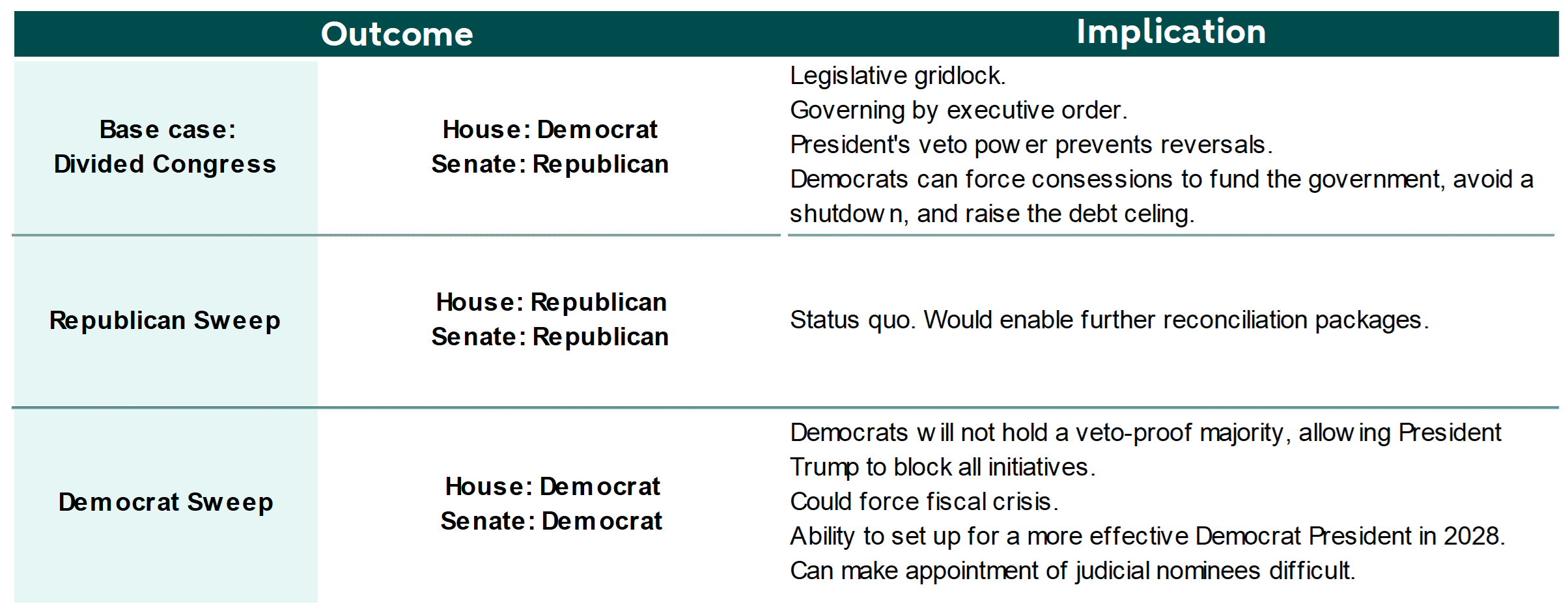
Still, we do not expect any major differences in policy between the three scenarios. Funding will be easier under a Republican sweep scenario, and as a result, we could expect some more reconciliation packages. In case of a (partial) takeover of Congress by Democrats, we could expect some additional congressional oversight of executive agencies. In fact, the impact of a Democrat sweep is likely delayed, as they will be most effective in preparing for a Democrat President in 2028, rather than changing policy now. This could, for instance, be by reinstating some EPA standards, and importantly, making appointments of Trump judicial nominees difficult.
What policy can we expect in the second half of Trump’s term? We continue to expect trade and tariff developments, more immigration and domestic policy, such as the SAVE America Act, more energy and deregulation, and possibly measures to deal with the worsening fiscal trajectory. The primary difference between outcomes is the pace of further fiscal expansion (fastest under a Republican sweep, slowest under a Democratic sweep), the intensity of executive oversight (highest under a Democratic sweep), and the direction of regulatory policy (deregulation accelerates under a Republican sweep; oversight intensifies under a Democratic one). The divided Congress base case is a middle path: gridlock on legislation, continued executive-driven deregulation and trade policy, and increasing partisanship on the debt ceiling and government funding.