SustainaWeekly - Environmental and climate investments slowly gaining ground
The share of environmental investments in industry and energy sector has been rising. With pressure from society due to the climate crisis and pressure on profits emanating from the current energy crisis, environmental investments are becoming more interesting. Companies in sectors have numerous low-carbon technologies and options available at their fingertips to reduce greenhouse gas emissions. However, a deterioration in producer confidence due to an unfavourable economic climate is going to negatively affect investment in industry in the coming quarters.

There is a greater focus in the private sector on sustainable investments and decarbonisation of products and processes. Companies are reacting faster to pressure from society due to the climate crisis and are seeing profits eroded by the current energy crisis. This is when investments in, for instance, renewable energy generation or other low-carbon technologies become increasingly interesting. CBS figures show that these investments have gained ground in recent years. Investments in low-carbon technologies and renewable energy will also need to increase significantly in the coming years to achieve the net-zero scenario by 2050, as described in our analysis from previous editions of this publication (see here and here).
Environmental investments
A recent analysis on the economic impact of heatwaves - published in late October in the journal Science Advances - estimates that global warming caused between USD 5 billion and USD 29 billion in damages to the global economy between 1992 and 2013. In particular, it had a strong negative impact on the national income of many developing countries. The study thus underlined the relevance of climate policies that address environmental injustice on a global basis, but also the importance of significantly increasing environmental investments (including investments in climate measures) to limit further global warming, among other things.
According to Statistics Netherlands (CBS), environmental (or climate transition) investments1) relate to investments in tangible fixed assets whose main motive is to protect, restore or improve the environment. These investments do not necessarily pay for themselves within three years, which is sometimes the case with many other investments. The CBS also points out that environmental investments increased across the business sector in 2021. Of the total investments of companies, 14.2% was intended for environmental investments. Nine years earlier, this was only 3.7%.
This is also reflected in the industry sector (these are the sectors of mineral extraction, manufacturing, energy supply and water extraction together). The share of environmental investments is also gaining ground here.
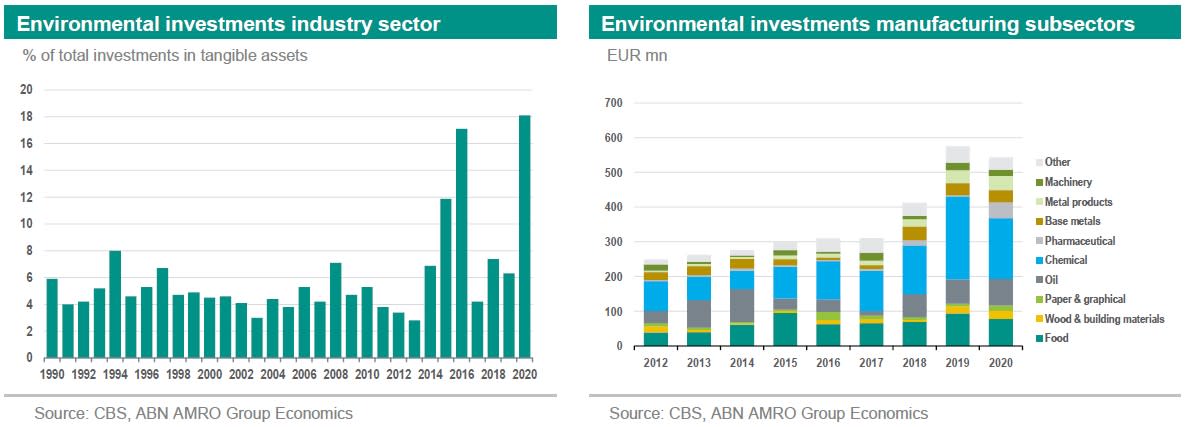
From 2014, the share of environmental investments in total investments increased sharply and reached its first historical peak level in 2016. In the years 2017-2019, the share fell back to its old level, before reaching a new peak level in 2020. In that year, environmental investments had a share of around 18% in total investments. Figures for 2021 are still unknown, but with increasing pressure from the climate and energy crises, it seems very likely that the 2020 level was matched in 2021 and will be beyond. On precondition, of course, that by then the economic climate and business confidence remain up to par. In 2020, environmental investments in manufacturing sector reached EUR 543 million. This refers to investments made by industrial companies with 10 or more employees. The level of climate investment in 2020 was slightly lower than the level in 2019, which is mainly due to a strong decrease in the chemical industry. The strong increase in the share in the left figure is thus entirely due to additional investments by companies in the energy supply sector. In this sector, environmental investments increased by an enourmous 288% in 2020, from a level of EUR 543 million in 2019 to EUR 2,314 million in 2020.
Investments in low carbon technologies
Companies in various sectors are increasingly faced with politics, consumers, end-users, NGOs and (regional) governments putting pressure on them to achieve greater reductions in greenhouse gas (GHG) emissions. Among other things, it also translates into stricter laws and regulations from the EU and the Netherlands. More and more companies are required to monitor their energy consumption and/or make investments in energy-saving solutions if they have a decent return within a set time frame. ABN AMRO recently released a publication on this subject (), which provides low-carbon solution options for companies across a large number of sectors to reduce GHGs. The publication shows that it is not always necessary to invest heavily in low-carbon technologies. There is plenty of low-hanging fruit.
Companies in sectors within the Dutch economy have several opportunities to reduce GHG emissions that yield good results in the short term. For instance, companies can reduce their emissions by introducing energy efficiency measures. This is relatively easy to achieve and, if properly implemented, also effective in reducing GHG. In addition, processes can be electrified, but heat pumps, hybrid boilers and exploiting waste heat also help. These techniques are widely available and face relatively few obstacles.
In the medium term, numerous other decarbonisation options for companies are under development or suitable for further scaling up. To reach the 2030 emissions of GHG target, it is necessary to implement current (demonstration) projects of technologies with known working principles. These include Carbon Capture & Storage (CCS) with high CO2 concentrations, recycling (plastics, scrap, biomass), green fuels and geothermal projects.
In the longer term, an acceleration of the transition is needed, especially for the period between 2030 and 2050. This involves innovative breakthrough techniques and further development of existing technologies, from, for example, process innovations and the deployment of (green) hydrogen.
Confidence versus investments in industry
Firms' confidence about future industrial production has a strong correlation with the economic cycle. During an economic downturn, producer confidence drops. In this case, total investment also tends to weaken. When the economy rebounds, the opposite is true. This can be seen in the left-hand chart below. The links with investment do not always run one-to-one and some lag is visible. This is because investments are sometimes long-term projects and therefore react at a late stage.
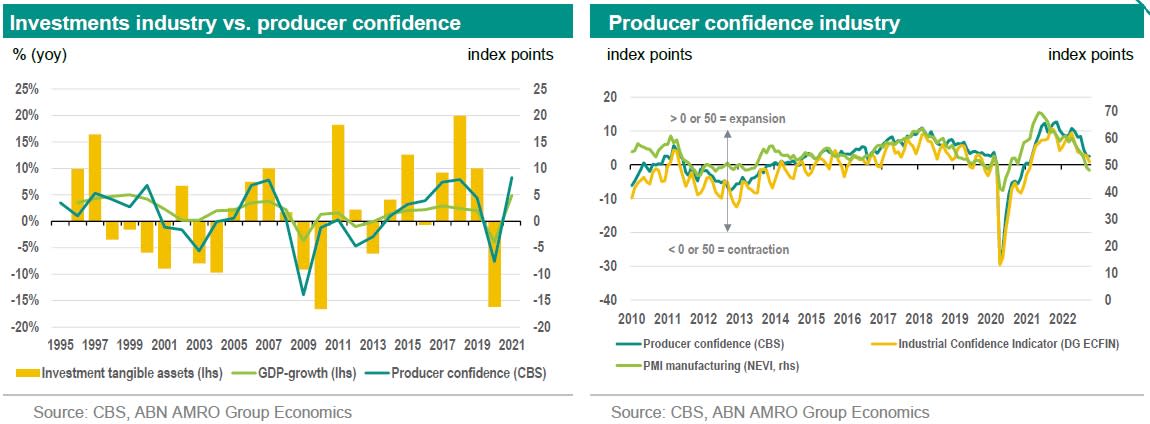
From the second quarter of 2022 onwards, producer confidence declined. We see this trend reflected in several confidence indicators. The purchasing managers' index (PMI) already reached contraction territory in October. This negative stance in confidence is most likely also going to have a negative impact on the investment of industrial companies.
We expect (see here) the eurozone economy to contract by 0.9% in 2023. The Dutch economy is slightly more resilient. Broad government support through the energy price cap and the redistributive effects of this package will cause a smaller decline in consumption next year. As a result, the Dutch economy is capable of showing a slight growth of 0.7% in 2023. But the economic downturn in the eurozone and in particular the 1.8% economic contraction in Germany – the Netherland’s main trading partner - will not do producer confidence - and thus indirectly investment in industry - any good.

This article is part of the SustainaWeekly of 14 November 2022