SustainaWeekly - ESG friendly high yielders hardly affected by sky-rocketing coupons

High yield coupons have reached close to 9%, raising refinancing fears for riskier companies. We investigate whether better rated ESG high yield names could be more affected by the spectacular rise in financing costs. A sample of 54 high yield names first shows that refinancing risks in general are highly manageable. But more importantly, solid ESG issuers are not worse off in terms of interest rate coverage (ICR) today nor are they subject to a larger fall in ICR than weaker ESG names.

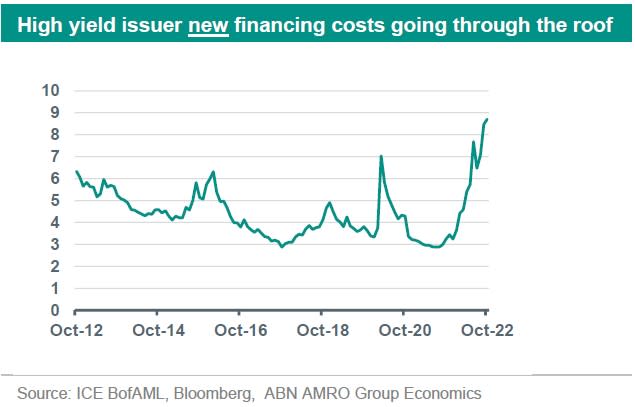
The higher interest rate and credit spread environment has driven the market rate on European high yield debt to 10-year highs. On a broad market basis, the average European high yield company would need to pay even more today than when the Covid-19 pandemic struck us in March 2020. The last time high yield companies faced such escalated levels of financing costs was during the height of the Eurozone debt crisis back in 2011. It is interesting to note that even at that time, these high risk companies (which we shall refer to as high yielders) were not discouraged to issue bonds as the market still grew in size. Fast forward 11 years and today the high yielders are reluctant to bring new transactions to the bond market.
One of the implications of escalating high yield funding cost is the burden it poses on issuers that need to refinance imminently. This week we try to investigate whether today’s market rates are truly posing a risk for the high yielders and in light of our ESG focus, we try to distinguish between the high yielders that have good ESG credentials and those that do not. We take the Sustainalytics ESG risk rating - sub-industry percentile as measure of issuer ESG risk (so the issuers ESG rank within their own sector). The reason why we have opted for an industry approach is to create a level playing field given that investors might still be willing to invest in a well performing high yielder from a disputable industry (such as German steel maker Thyssenkrup) or avoid a disputable high yielder from an industry where ESG risks in general are manageable (such as the heavily scrutinized German real estate issuer Adler Group).
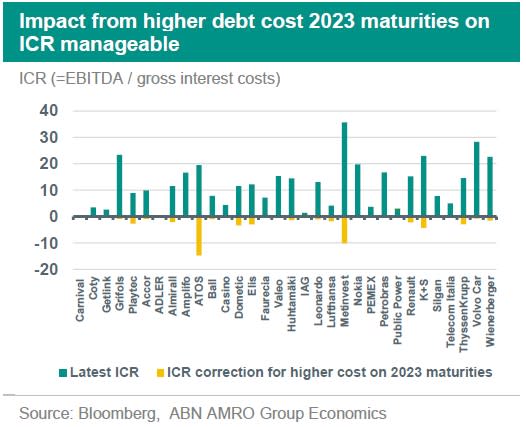
Two points struck us immediately. First, despite ESG rising to the top of investors’ agendas for fixed income (see ), only 54 out of 320 European corporate high yield issuers have been assigned an ESG risk rating by Sustainalytics. While this also narrows the scope of our analysis, we still think 54 issuers coming from a range of industries are a sufficiently large sample to work with. Secondly, refinancing risk in high yield still looks very moderate, at least when judging the outcome of the 54 issuer sample. We basically recalculated each issuer’s interest coverage (ICR) based on how much refinancing 2023 maturities at existing market yields (on the issuer’s 4 to 5 year bond debt) would add to the total interest rate bill as per latest financial filings (largely June 2022). Surprisingly, 22 issuers out of the 55 have no scheduled debt maturities in 2023 and 14 issuers have 2023 maturities that are less than EUR 300mn. This refinancing amount is less than a typical sub-benchmark sized bond and on average, this low refinancing size would only add EUR 46mn to the total interest bill, should these 22 high yielders refinance at today’s rates. The chart below shows the impact on ICR for all issuers in the sample that are up for refinancing, clearly showing that in the majority of cases the drag-down (yellow bar) is limited.
Now for the interesting part. Is there a difference between names that have a high ESG scores and those that have a low one and how does the changing yield environment change this? The scatter plots below shows the distribution of ICR’s ranging from very low ESG risk high yielders (dark green colour – ESG risk rating percentile outcome between 1 and 10) to high ESG risk high yielders (dark grey colour - ESG risk rating percentile outcome between 70 and 100). What stands out immediately is that our sample is largely populated with a solid ESG profile high yielders (dark and light green) given the skew of the distribution is to the left (69% of all issuers in the sample are low risk ESG issuers). More importantly, the solid ESG names are not suffering from a lower existing ICR profile in comparison to disputable ESG names, as shown in the left hand chart. Therefore, having a high ESG standing does not mean lower profitability or a levered balance sheet (or vice-versa).
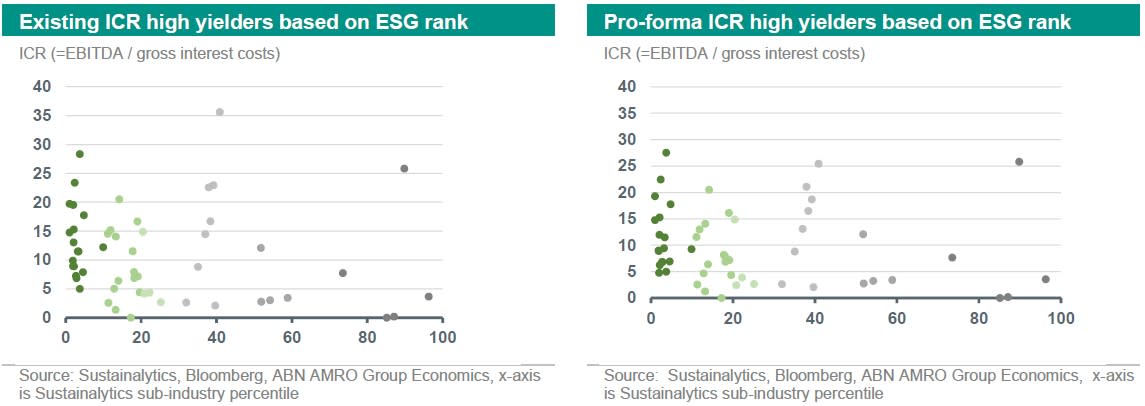
Secondly, the right chart on the previous page shows that neither in the case of the solid ESG names nor issuers with weaker ESG scores do we see a vast deterioration on the ICR level taking place when we account for the higher financing cost on their 2023 maturities. This means that ESG focussed investors would not need to make big shifts out of the ESG friendly high yielders in fear of lower coverage levels amid potential refinancing risks. Overall, we therefore conclude that investors do not necessarily need to give up their ESG focus in order to invest in high yielders with stronger ICR, and that in fact, those two can even go hand in hand.
This article is part of the Sustainaweekly of 17 October 2022