Sustainaweekly - Green investment up…but not enough

In this edition of the SustainaWeekly, we take a closer look at the IEA’s World Energy Investment 2023 publication and data, which was released recently. We assess recent trends in energy investment and to what extent they are consistent with a net zero scenario. We highlight some worrying trends in clean energy investment on the basis of the organisation’s early estimates for this year. We go on to look at issuance of ESG bonds this month. Finally, we look at trends in emissions in the mobility sector, policies that have been set out to bring down emissions and whether policy targets are likely to be hit.


Economist:
Global clean energy investment levels continue to rise, reaching an estimated USD 1740 bn this year, but the pace of expansion looks set to slow compared to the buoyant pace of last year. At this year’s pace, investment would fall well short of a net zero scenario, and the pace of expansion would need to double next year and remain at that rate to 2030 to reach the levels needed. Strategist:
May saw a pick-up in issuance of ESG bank bonds. Overall, EUR 5.4bn of green bonds and EUR 2bn of social bonds were issued up until 26 May, accounting for 20% of total issuance. ESG bank bonds continue to benefit from stronger demand and lower new issue premiums than non-ESG bank bonds. The first social Tier 2 bond since August 2022 was the most oversubscribed ESG bank bond so far this year. Sector:
Both the Netherlands as the EU are lagging behind in efforts to reduce GHG emissions from road mobility. A step up in pace of transition is needed and indeed they have set ambitious targets. However, we doubt that the target will be hit. The adoption of battery electric vehicles could slow down. Moreover the needed trajectory is substantially steeper compared to the historical trend.
Worrying trends in green investment
Global clean energy investment levels continue to rise, reaching an estimated USD 1740 bn this year, but the pace of growth looks set to slow compared to the buoyant pace of last year
In addition, investment trends remain uneven, with investment modest in emerging and developing countries, which make up a third of global emissions
At this year’s pace, investment would fall well short of a net zero scenario, and the pace of expansion would need to double next year and remain at that rate to 2030 to reach the levels needed
Though numerous policy initiatives – in the US, Europe and China – do signal stronger expansion ahead
We take a closer look at the IEA’s World Energy Investment 2023 (see ), which was released recently. We assess recent trends in energy investment and to what extent they are consistent with a net zero scenario. We highlight some worrying trends in clean energy investment on the basis of the organisation’s early estimates for this year.
Clean energy investment growth looks set to slow
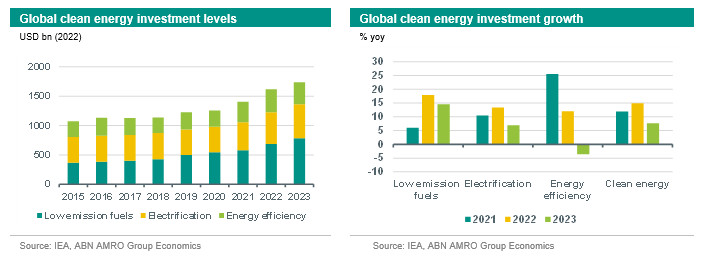
The annual level of global clean energy investment looks likely to continue its upward trend according to the IEA, rising to USD 1740 bn this year from 1617bn in 2022 and compared to USD 1074bn in 2015. That was the good news. The bad news is that this would represent a slowdown in the pace of green investment growth. Following 11.8% annual growth in 2021 and 14.8% in 2022, the expansion of clean investment is estimated to have slowed to 7.6% in 2023. Almost all components of green investment slowed, but there was particular weakness in investment in energy efficiency, which is seen lower this year than last year.
Clean energy investment low in developing countries
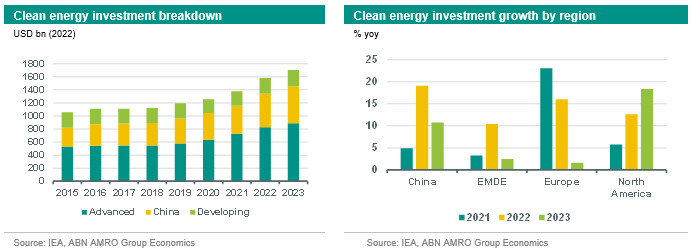
Over the last few years, the level of clean energy investment has increased strongly in the advanced economies and also in China. These economies dominate clean energy investment as shown in the chart on the left below. However, the acceleration as well as the overall levels of green investment is far more modest in emerging and developing countries. Clean investment in these countries is less than 15% of the global total, while their carbon emissions of the amount to around a third of total global emissions. So the decarbonisation of these economies is crucial if we are to see global warming limited to 1.5 degrees. The lack of impetus so far to help these countries finance the energy transition looks to be a major obstacle for the global economy achieving a Net Zero scenario (see our note for more on this).
Growth in green investment estimated to have slowed sharply in Europe
Looking more closely at estimated growth rates for this year (see chart on the right above), it looks like the growth in clean investment continued to accelerate sharply in North America, but it slowed elsewhere. While in China, the pace of growth remained strong, it looks to have slowed sharply in emerging and developing countries, but also in Europe. In the case of Europe, it should be noted that the pace of expansion was particularly buoyant during 2021 and 2022, so there might be some volatility in these numbers. Looking at the details, it seems that there was some fall back in energy efficiency investments, following booming growth over the last two years. The pace of expansion of investment into renewables also slowed, but remained decent. A more concerning trend is that investment in electricity networks slowed to a crawl, and that this was the second successive year of slowing capital spending growth.
Investment falling well short of a net zero scenario
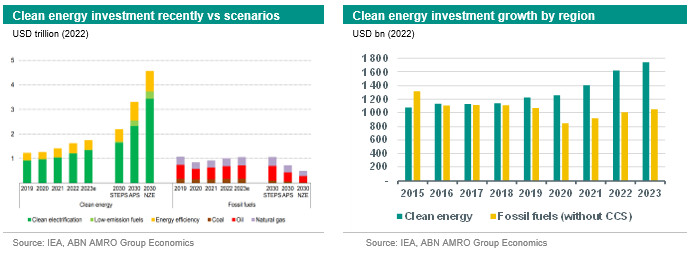
Developments in clean energy investment have been impressive over the last few years and since 2019 they have exceeded fossil fuel investments by an increasing margin (see chart on the right). However, the fact is that these trends will need to become much more impressive for a successful energy transition. The chart on the left shows recent green investment levels compared to IEA estimates of green investment in 2030 in a Stated Policies Scenario (STEPS – based on current policies and targets backed by detailed policies), in an Announced Pledges scenario (APS – based on all climate commitments and targets) and a Net Zero Emissions by 2050 Scenario (NZE). Green investment growth would need to roughly double next year compared to this year’s estimated rate and remain at that pace till 2030 to be consistent with NZE by 2050. To look on the bright side, a number of policy initiatives – in the US, Europe and China – do signal stronger expansion ahead.