The Netherlands - Despite strong Q2 growth we expect a slowdown

Q2 growth (+2.6% q-o-q) surpassed expectations; given headwinds this momentum is unlikely to last. We have revised our forecasts downwards, now including a small recession starting in Q4. We expect 2022 growth to be 4.7% and 2023 growth to slow to 0.5%.


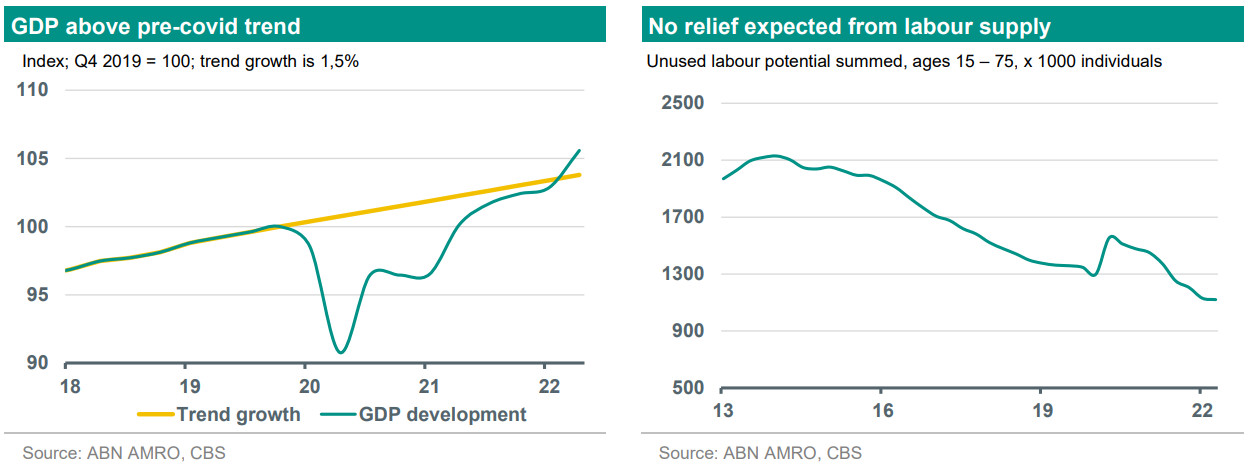
Last week’s Q2 GDP data yielded an upward surprise. Quarterly growth was expected to be positive, but only marginally. Instead, qoq GDP growth came out at a whopping 2.6%. This pushed the level of GDP even above the pre-Covid trend level (see left figure). All subcomponents surprised to the upside, but investment (+5.2% qoq) and exports (+2.7% qoq) stood out in particular. For investment this was a welcome catch-up after it had been lagging GDP growth since mid-2021 when supply bottlenecks intensified. Investment in transport equipment was a particularly strong driver. Exports were driven by a further catch-up in services exports, partially on a return of tourists to the Netherlands, but strength was also visible in machinery and chemicals. Due to Covid-induced economic volatility, the difference between first and final official GDP estimates have been significant in recent quarters. The initial GDP estimate could therefore be revised downwards in future.
This 2nd quarter growth is the highest among eurozone peers as indicated in this month’s Global View, and provides a solid basis for the many headwinds (inflation, margin squeeze, lower external demand) that are intensifying. Indeed, we expect the economy to slow down in the second half of 2022 and to ultimately cause a shallow recession starting in Q4, but to a lesser extent than we expect for the broader eurozone. This is for several reasons. One is already illustrated above: the Dutch economy has higher growth momentum going into the remainder of the year. Secondly, the large swathes of unfilled demand in terms of new orders for businesses but also in the labour market act as cushions. In the labour market, this strong demand faces supply limits as showcased by the very low unused labour potential (see right figure). Sectoral compositions also matter, but given the smaller share of Dutch industry in the economy – which will bear the brunt of ever rising energy prices – we expect the contraction in Q4 and Q1 of 2023 to be less deep than in Germany, for instance.
We expect growth to slowly pick up after a further small contraction in the first quarter of 2023. This should lead to average annual 2022 growth of 4.7%, with 2023 growth slowing to 0.5%. As such, these forecasts incorporate a small recession at the end of 2022 and beginning of 2023. In September, at Prinsjesdag, the governmental budget for next year will be announced. It is planning on implementing a range of measures to boost purchasing power in 2023. High Inflation and the marginal pickup we have seen in wage growth means a sharp drop in purchasing power of roughly 7% is on the cards for 2022. The expected 2023 measures, if sufficient, can lower the negative effects that inflation has on purchasing power and dampen the consumption effect.
On the back of ever rising energy prices and continued rises in food prices we have increased our inflation forecasts from 8.5% for 2022 and 4.3% for 2023 to 10% and 5% (HICP), respectively. This not only reflects rises in headline inflation but also in core inflationary pressures. We see more evidence of the broadening of inflation, especially in core services which are energy intensive and/or rely on food inputs, such as transport services or restaurants.