The Netherlands - Heading for a minority government
We see the Dutch economy’s growth cooling from 1.7% in 2025 to 1.2% in 2026, and slightly recovering to 1.4% in 2027; private and public consumption is expected to contribute significantly. Inflation is expected to moderate to 2.4% in 2026, down from 3.3% in 2025. The Netherlands is likely to have a minority government, led by D66, VVD, and CDA, with Rob Jetten anticipated as Prime Minister. While policy uncertainty may decrease, compromises with opposition parties will remain essential due to the lack of majority in both parliament and senate.


Anne de Clercq Zubli
Group Economics Netherlands
With global events unfolding rapidly, the Netherlands also experienced significant domestic turbulence at the end of 2025 and the start of 2026. For starters, in December 2025, Peter Wennink (former CEO ASML) published his report, commissioned by the Minister of Economic affairs, on improving the Dutch business climate and translating the Draghi report to the Netherlands. The report pushes to improve potential growth to 1.5-2.0%, by tackling key bottlenecks, such as the externalities from nitrogen emittance norms, energy grid congestions, and access to talent, and an extensive investment agenda for the coming decade, totalling €151-187bn investments, targeting digitalisation & AI, energy & climate tech, life sciences & biotech, and security.
On the political front, as it sits currently, the next Dutch government is expected to be a minority government including election winner liberal-progressive D66, centre-right VVD, and Christian Democratic CDA. This setup lacks a majority in parliament and also falls short in the senate, necessitating compromises with opposition parties. As a result, while policy uncertainty is likely to decrease, the minority status will keep it elevated. The next anticipated step is the appointment of Rob Jetten, the expected Prime Minister, as ‘formateur’ - the final step in coalition formation.
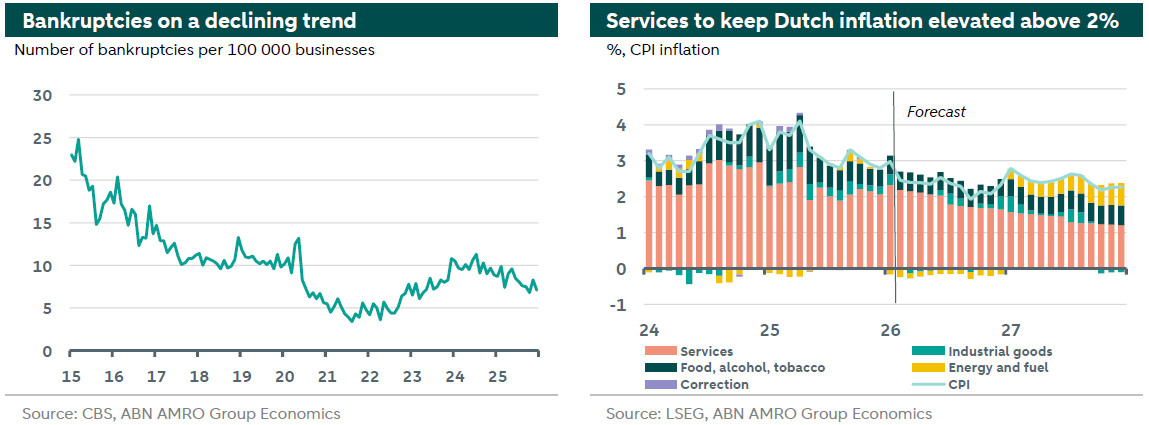
Economically, it is also not all business as usual. Over the past months, the Netherlands attracted an outsized amount of headlines in international financial newspapers, especially for such a small country, due to the pension system reforms. Given the sheer size of Dutch pension fund holdings, this transition has had an impact on financial markets as it changes pension funds’ investment strategy. As of now, one-third of Dutch pension assets have transitioned to the new system, resulting in significant indexation amounts (increases in pension payments) for current pensioners. We expect this, alongside further purchasing power increases due to strong wage growth and lower inflation, to finally outweigh the persistently high savings rate and lead to a sizeable contribution of private consumption to growth in the near term. Private consumption as well as government consumption are the main drivers of GDP growth in 2026. We see growth cooling from 1.7% in 2025 to 1.2% in 2026, and thereafter slightly recovering to 1.4% in 2027, with the slowdown mainly driven by supply-side constraints and the pass-through to activity of tariffs and uncertainty.
Annual inflation (CPI) for 2025 amounted to 3.3%, far exceeding the eurozone average. Looking forward, we expect inflation to slowly moderate, averaging 2.4% in 2026. Main contributions will come from services inflation, fuelled by the ongoing pass-through of elevated wage growth, with 50% of CLA’s set for 2026 indicating wage growth north of 4% again, as well as higher VAT-rates for the hospitality sector. Some easing in inflation is expected from goods as well as moderating energy prices.