The Netherlands - Minority coalition agreement is all about defence
A strong second half of 2025 and strong momentum at the start of the year means we upgrade our growth forecasts to 1.6% for 2026 and 1.4% for 2027. Inflation is expected to moderate to 2.3% in 2026, down from 3.3% in 2025. The incoming minority government is ramping up defence spending, while keeping its finances in check. Plans are nowhere near final though, as they hinge on opposition support.


Max Raatjes
Trainee at ABN AMRO
As expected, the election-winning liberal-progressive D66, the centre-right VVD, and the Christian Democratic CDA have reached an agreement to form a minority government. On the 30th of January the three parties presented their coalition agreement. Central in the government’s plans is the ramping up of defence spending to adhere to the new NATO-target. The incoming government plans spending increases from roughly 2% of GDP now, to 2.8% by 2030 and 3.5% by 2035. This goal is ambitious, particularly when it comes to defence personnel given the very tight labour market. Most of the other measures are designed to support this goal. Spending cuts, particularly in healthcare and social security (cutting unemployment benefits from two to one year), along with higher income taxes, are intended to finance these investments. As a result, as shown by CPB calculations, budget deficits and debt to GDP ratios in the next 4 years are only marginally higher compared to previous policies.
Regarding the structural agenda, it is encouraging that the incoming government intends (1) to reverse – but not expand – the previous coalition’s shift towards more consumptive spending, by undoing cuts to education, and (2) to recognise the numerous supply‑side bottlenecks facing the economy. The plan to address these constraints is convincing when it comes to resolving the nitrogen impasse, but less so in areas such as tackling electricity grid congestion. Indeed, when zooming out, reforms in key domains such as the housing market and taxation are pushed towards the next government. Perhaps most important is that it remains to be seen what parts of the agreement will receive support. The government lacks a majority not only in the House of Representatives, but also in the Senate.
Dutch Q4 GDP came in stronger than anticipated at 0.5% q/q in what has been a very strong second half of 2025. Unsurprising were strong contributions to growth from private consumption and government consumption, factors which are expected to drive growth in 2026 as well. What was surprising was the strong positive contribution from net exports. The drag in 2025 from US tariffs is visible in export values to the US, particularly in value-added heavy exports of Dutch manufactured products, but this has been more than offset by exports to other countries. Stronger growth in Germany, the Netherlands’ main trading partner, may help explain this development. The robust export performance in machinery and higher exports to Taiwan, suggests that Dutch chip‑making equipment has been a contributing factor of the export upswing. We have upgraded our growth forecast for 2026 to 1.6% (was 1.2%); 2027 is unchanged at 1.4%.
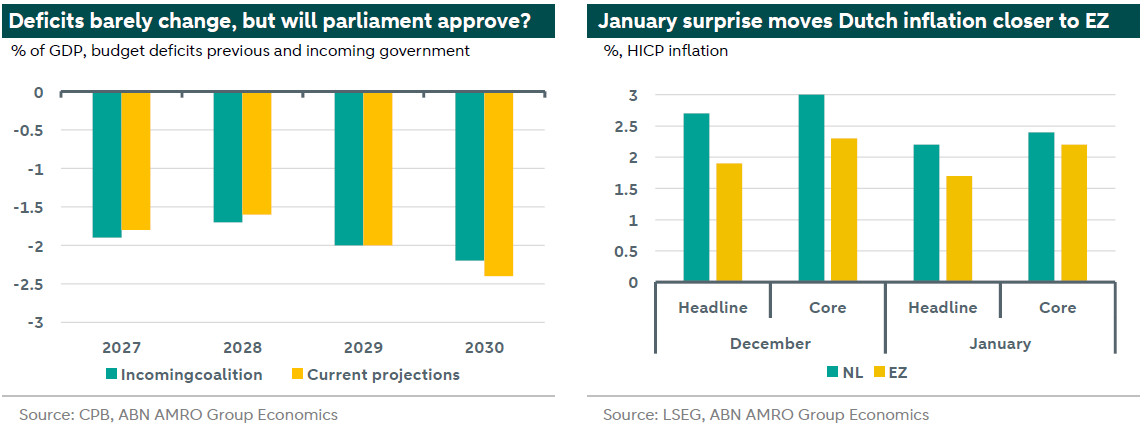
January’s inflation surprise puts downward pressure on our inflation forecasts. HICP inflation in January came in at 2.2% y/y, compared to 2.7% in December. The decline was broad-based across spending categories. Most prominent was food inflation at 2% – for the first time in five years – and services. As a result, Dutch inflation has moved more in line with the eurozone average. We anticipate Dutch CPI inflation to average 2.3% (HICP 2.2%) in 2026.