The Netherlands - Slowdown expected in second half of 2022
High inflation will lower growth from the third quarter of 2022 onwards. Wages are expected to pick up, but not enough to offset the decline in purchasing power. The phasing-out of Covid support marks the end of historically low bankruptcy levels.

Co- author: Nora Neuteboom
Soaring inflation is set to weigh on growth from the second half of 2022 onwards
While inflation (CPI) hit a historic high of 9.7% yoy in March, the effects on growth have not been visible in the data yet. Indeed, we expect growth to slow from the second half of 2022 onwards. First quarter growth is being driven by a rebound in consumption following the end of Covid restrictions earlier in the year. Rising energy prices – responsible for over 70% of current inflation – are not yet felt fully by most consumers, as more than 50% of consumers have fixed prices in their energy contracts. Moreover, we expect the high level of (partly involuntary) savings – built up during the COVID lockdowns – to provide a cushion against initial price rises. With inflation expected to remain high throughout the year, the blow to consumption will materialise eventually, and growth will slow from the second half of 2022 onward. We expect the Dutch economy to expand by 3.1% in 2022, and by 1.3% in 2023.
Wages are expected to pick up, but not enough to match inflation
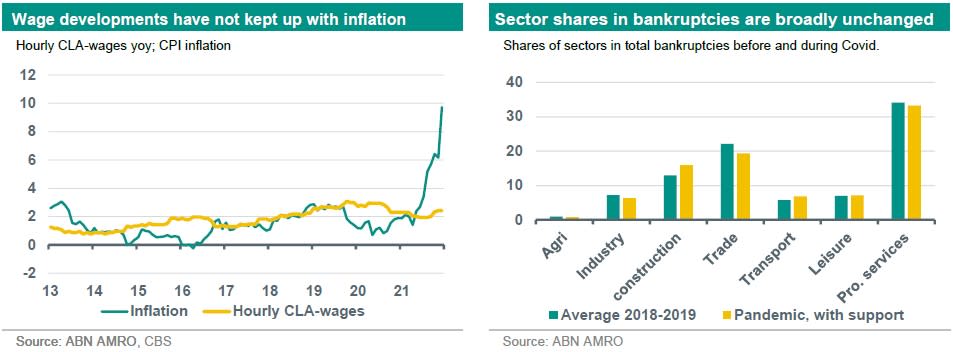
With inflation at very high levels and the labour market exceptionally tight, wage growth is an indicator to closely monitor. The Netherlands has a strong culture of wage moderation. This, together with roughly 55% of employees being part of a multi-year collective labour agreement, means that wages respond only slowly to macro-economic developments. Indeed, in the past when labour markets were tight (for instance in 2019), this was not mirrored by a strong increase in wages. That said, the combination of high inflation and labour market tightness might provide additional ammunition for negotiating labour unions. Recent Collective Labour Agreement (CLA) wages have so far only seen a modest pickup, increasing from an average of 2.1% in 2021 to 2.4% in first quarter of 2022. But there is likely more to come, as newly formed CLAs take into account the latest inflation figures, and thus lead to broader wage pressures. The metals industry is the most recent example, where the CLA settled on an increase in wages of 3.2%. On the back of these signals, we have revised our CLA wage expectation for 2022 upwards, from 2.2% to 2.8% and for 2023 from 2.3% to 3.2%. Despite the pickup, this is not anywhere near enough to prevent a significant reduction in real wages in 2022 and 2023.
As pandemic support ends in April, bankruptcies are expected to increase
April marks the first month since the pandemic without government support. The wage-subsidy scheme (NOW) and the ability to defer taxes have been successful in preventing a large increase in bankruptcies. In fact, bankruptcies declined to the lowest level in thirty years. Despite this, there was relatively little change in the distribution of bankruptcies among sectors. As support is phased out we expect bankruptcies to increase, perhaps significantly – if current levels jump to pre-Covid levels, bankruptcies would double. Moreover, with recent research showing that pandemic-related solvency issues are concentrated in the sectors particularly hard hit during Covid (such as hospitality, retail and travel services), we expect these sectors to be overrepresented in the rise in bankruptcy levels.