Top of Mind - A Q&A on the UK’s political crisis

Rivals move to topple UK prime minister Starmer
The UK political environment has entered another volatile period following the poor local election outcome for the ruling Labour party. PM Keir Starmer has been unpopular with the public almost from the get-go, and a significant number of MPs and other key figures in the party have lost their patience and concluded his time is up. Starmer himself has come out fighting, with repeated statements arguing that the government should avoid the revolving-door-leadership crises of the previous Conservative government.
But this seems to be failing to stem the tide against him. Late last week, Health Secretary Wes Streeting resigned from his Cabinet position. In his resignation letter, he made no mention of a leadership bid, but instead called for a debate on Labour’s future with ‘the best possible field of candidates’. This suggests he favours a later contest also involving Manchester Mayor Andy Burnham. The popular mayor – who is considerably more popular than Reform’s Nigel Farage, as well as most other major UK politicians – is set to contest a by-election by 18 June in order to re-enter UK parliament and run in the leadership contest. Meanwhile the left-leaning Angela Rayner disclosed that she had been cleared of any wrongdoing in a tax-related scandal from last year, seemingly paving the way for her own leadership bid.
Markets are happier with the Starmer government than the UK public
Financial markets have clearly reacted negatively to the prospect of Starmer’s replacement. The Starmer-led government has failed to excite the public with a positive vision for the future, and immigration – particularly small boat crossings of asylum seekers – continues to be a key voter grievance. But in terms of management of its finances, the government has broadly stuck to its fiscal rules, and UK government bond markets – while suffering the occasional bouts of volatility – have been much more stable than during the previous Conservative-led government. The economy has not performed particularly well, but this is in line with the weak performance of the UK’s European peers in the aftermath of the 2022-23 energy crisis. The government’s options to improve economic performance have been limited by fiscal constraints.
In office but not in power
But financial markets are not the only constituent the government needs to answer to, and Starmer’s net -45 approval rating among voters makes it an almost insurmountable battle to turn around his image. Few major politicians in UK political history have been able to pull off such a rehabilitation, and the few examples that did (e.g. Churchill, Thatcher) needed wars to do so. Absent such a national crisis, it seems hard to imagine the catalyst for such a turnaround. With many Labour figures seeing the writing on the wall and with an eye on the (likely) 2029 general election, they are urging an orderly leadership transition. While he is still technically prime minister, Starmer’s authority – and therefore his ability to push for meaningful change – has been significantly weakened by his lack of popularity among the public.
Who might replace Starmer as PM?
There are three main potential contenders to the leadership, with one clear frontrunner: Andy Burnham, Wes Streeting, and Angela Rayner (with a possible fourth contender being Energy Secretary and former Labour leader Ed Miliband, though there are reports he might be a more likely contender for chancellor/finance minister in a new government). Of these, Manchester Mayor Andy Burnham is by far the most popular among the general public, and in YouGov polling he is actually the only major politician in the UK with a net positive approval rating. The problem is that he is not a sitting member of parliament, and in order to do so, and to become an eligible contender he needs to win the upcoming Makerfield by-election on (or around) 18 June. While highly regarded among voters, Burnham winning this by-election is far from being a foregone conclusion. While the sitting Labour MP won a solid majority in Makerfield at the last general election in 2024, Reform won over 50% of the vote in the recent local elections. Turnout is typically much lower in local elections (around 30-35%), and Burnham has much more personal appeal than the broader Labour party at present. But the election is still likely to be fiercely contested.
What if Burnham loses the by-election – what about the alternatives?
The alternatives – Wes Streeting and Angela Rayner – are barely perceived more positively than Starmer among the general public.
In terms of politics, Wes Streeting is very similar to Starmer, being a more centrist and Blairite candidate. In a speech at the weekend, he talked of the need to make much bolder policy choices in order to fight the populist surge, which is eating at Labour’s vote share from both right (Reform) and Left (Greens). His boldest suggestion is that the UK ultimately should rejoin the EU and in the meantime should move much more closely to the EU, though like Starmer he stopped short of clear proposals on how to do so (for instance, joining the customs union or EEA/single market).
Angela Rayner meanwhile is seen – somewhat like Burnham – to be on the ‘soft left’ of the party, likely favouring more redistributive policies. However, she is far more divisive and less popular than Burnham, and tarnished by a tax scandal.
Will a leadership change mean new elections?
Similar to for instance Italy and Japan, it is both legal and has become politically acceptable for the UK leadership to change without it triggering fresh elections. Given Labour’s currently very poor opinion polling, and that it can trigger an election at the timing of its choosing, a general election is highly unlikely to result from a leadership change. Perhaps the only circumstances this would happen is if a new PM were to embark on a radically different policy course, for instance if a new government wanted to make attempts to rejoin the EU (a topic that is clearly becoming less taboo). The next general election currently has to be held by May 2029 at the latest.
Where do we go from here?
Much depends on the outcome of the June Makerfield by-election, but some form of leadership contest looks inevitable regardless. If Burnham wins the by-election, he is likely to go on to win any subsequent leadership contest and to become the next UK prime minister. This could happen potentially very soon in a ‘coronation’ scenario, which would see Keir Starmer stepping down and Burnham immediately gaining the required Labour MP nominees and seeing no challengers to become PM.
Alternatively, a leadership contest over the summer with the new leader coming in place by the time of the next Labour Party conference in late September seems a more likely scenario. This would also give time and opportunity for the fundamental policy debate that Wes Streeting has called for.
What if Burnham does not win the by-election? Starmer’s standing would be strengthened but the Labour party would be deeply wounded by the failure of its most popular candidate to beat Reform in a traditional Labour strong-hold. In this scenario, we expect Starmer to fight any leadership contest, with the most likely outcome being that he either stays or Wes Streeting takes his place. While we would not rule out Angela Rayner winning, she seems like an outlier at present.
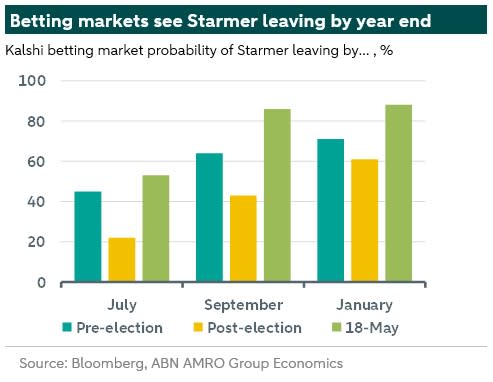
Betting markets odds are currently even for Starmer leaving office by July, while their assessment of his longer term prospects is far bleaker – with around a 90% chance of him leaving by the end of the year.
What would a change of government mean for fiscal policy?
This will naturally depend on who would take over the premiership and perhaps just as importantly, who would take the helm of the Treasury. For instance, Wes Streeting pared with Rachel Reeves probably wouldn’t mean a significant change to fiscal policy.
Angela Rayner and Andy Burnham meanwhile are seen as tilting more to the left. Andy Burnham in particular has said the government should not be ‘in hock’ to gilt markets, and has called for instance for defence spending to receive a carve out from normal government finances and to be funded by debt. However, he also said over the weekend in a TV interview that he “support[s] the fiscal rules” and that “there’s got to be fiscal discipline.” There has also been talk of Ed Miliband taking the role of Chancellor (finance minister), and he is also viewed as being to the left of Rachel Reeves.
Our view is that any new government would not seriously test gilt markets in the way that the ill-fated Liz Truss government did in 2022. While policies could tack more to the left, we expect any significant spending increases to be matched with tax rises, even if this were to mean breaches to manifesto commitments (arguably already broken). This would perhaps put upward pressure on growth and inflation later in our forecast horizon, depending on the timing of a leadership change. However, crucially for markets, we do not in our base case expect major changes to the fiscal rules. The trauma of the Liz Truss period – when surging mortgage rates proved political suicide for the Conservatives – still weighs heavily in the UK political consciousness, and is unlikely in our view to be forgotten any time soon.
While unlikely, we still cannot rule out a serious test of markets in a risk scenario. A new left-leaning leader could come to the conclusion that the only way to deliver meaningful change while remaining popular with voters would be to increase deficit spending. This would probably end in political disaster for Labour, but it could still happen.
And for markets?
Still, in our base case, while uncertainty and speculation of any changes in fiscal policy are likely to fuel volatility in gilt markets – and this would probably intensify as and when a leadership contest actually takes place – we expect this to be short-lived. A new government would probably move swiftly to clarify its stance on the fiscal rules, though it could be that markets need to go through a full budget cycle before they normalise. A factor that would significantly help is if Rachel Reeves keeps her role as chancellor. This would signal continuity and a commitment to her fiscal rules that have kept markets relatively stable.
What about recent gilt market moves?
While gilt yields have moved higher in recent days on worries over a change of leadership, the moves have been fairly contained and yields remain broadly within pre-election ranges. From a longer term perspective, yields have risen considerably this year, but this has been driven largely by the Iran conflict’s impact on inflation and central bank policy rate expectations rather than political/fiscal concerns. Gilts have underperformed German bunds for instance, and this is likely partly linked to UK political uncertainty, but so have other riskier sovereigns such as France and Italy.
Could gilt market pressures force the BoE to stop QT?
The Bank of England has been actively selling off its holdings of UK government bonds in recent years, in contrast to other major central banks that passively allow bonds to ‘roll off’ their balance sheets as they mature. This has added to the upward pressure on bond yields. Under existing plans, the BoE aims to have sold GBP70bn of bonds by September, when the programme of Quantitative Tightening (QT) is next reviewed. By that point, the bank’s holdings of gilts will have reached the upper bound of a range of estimates of the final desired landing zone (the so-called ‘Preferred Minimum Range of Reserves, or PMRR) for the bank’s gilt holdings: GBP365-515bn. At GBP527bn as of April, holdings are already close to that.
With active QT having largely served its purpose, we think in any case the BoE will move to a conventional passive roll-off for the remainder of its QT programme when it is reviewed in September. Any market volatility linked to UK political instability would add to the reasons for this shift, but we do not see that by itself as a reason to stop or pause QT, except in the unlikely scenario of extreme market moves.