Trump’s Greenland tariffs: Impact and possible EU response

President Trump announced new tariffs on European countries in response to their Greenland military exercise. There is substantial uncertainty around implementation of US tariffs, both practically and legally. The EU is preparing its response, and escalation risk is rising, but use of the Anti-Coercion Instrument is unlikely in the very near-term. A ‘backloading’ of EU-US exports could lead to a near-term growth dip in Europe, followed by a rebound. All of this hinges on whether the US actually follows through on its threats, and whether Europe meaningfully responds


Introduction
On Saturday morning, President Trump announced a set of new tariffs targeting European countries that conducted a military exercise in Greenland, in an effort to force a sale of Greenland to the US. Denmark, and a number of other European countries, including Germany, France and the Netherlands (as well as non-EU countries, the UK and Norway) will face an additional 10% tariff on all goods starting 1 February, which will increase to 25% on 1 June if no deal on Greenland is reached. To put those figures into context, following the ‘Turnberry agreement’ in July of last year, the US charges a tariff of 15% on European imports, with many exemptions. Because of that, the effective tariff rate is about 11%. A 10% universal tariff would therefore double the tariff pressure, and an additional 25% would put the tariff higher than even geopolitical rival China, taking the headline rate to 40%. Where previously the threat of withholding the defence umbrella was used to push the tariff agenda, now tariffs are used to push the defence agenda. This is a significant escalation which reflects the Trump administration’s view on projecting power in the wide sense. European leaders are currently considering their response and will likely clarify their plans over the coming days.
Financial markets have clearly reacted negatively to developments, with risky assets under pressure and safe havens outperforming, as worries build over the possible collapse of one of the cornerstones of the post-war era – the transatlantic alliance. In this Q&A – following up on our on Greenland – we lay out our views on how things could progress over the coming weeks and months, including the likely impact of the measures announced (or threatened) so far.
Can the US target individual EU countries?
The US tariff threat affects a subset of EU countries only, which is unusual as the EU negotiates trade agreements collectively. It is also therefore difficult to enforce blanket tariffs on individual EU countries. A blanket tariff would have to be applied through ‘country of origin’ enforcement, which is challenging because of the EU’s tightly interlinked supply chains. Previous episodes that focused on individual EU countries have therefore typically focused on specific goods that would hit them more strongly, such as cars (Germany), wine (France) or olives (Spain). In any case, a common retaliation from the EU could well cause the US to expand its (probably unworkable) targeted tariffs to cover the whole EU.
How will the US Supreme Court decision on IEEPA tariffs impact these Greenland tariffs?
It seems likely that these tariffs would again initially rely on the use of the International Emergency Economic Powers Act (IEEPA). The vast majority of last year’s tariffs were similarly built on the IEEPA, and they were seen as legally dubious from the start. The Supreme Court is set to make a decision on the legality of these tariffs, which include the reciprocal ones and the fentanyl ones. We see a negative ruling as more likely than not, but as time progresses this probability is diminishing marginally. If scrapped by the Supreme Court, most of these tariffs would likely immediately be replaced by so-called Section 122 tariffs, which allow for a 15% maximum rate for 150 days, before relying on Section 232 or Section 301 to build them out more permanently and at higher levels.
This same principle would apply to these new tariff threats. It therefore seems that a negative supreme court ruling would not necessarily stop the initial 10% tariff, but would put the further escalation to 25% in jeopardy given the maximum allowed under the Section 122 tariffs. June seems too short a window for investigations from the formal Sections to complete. Still, these new threats are a new element in the overall IEEPA discussion, and they could even influence the decision, or in a less extreme scenario receive a carveout. The security angle that has been touted for the Greenland acquisition may for instance be acknowledged to require emergency powers, even if the bilateral trade deficits that underpin the reciprocal tariffs do not.
How will Europe respond? Will it derail the existing trade deal between the US-EU?
At least in rhetoric, the European response to US tariffs has so far indicated greater resolve than we saw during last year’s trade war. German finance minister Klingbeil has called Greenland annexation a ‘red line’, and in general, politicians on the more Atlanticist political right have joined those on the left in expressing their dismay at the US’s coercive tactics and calling for a robust response. There are two initial strands of European response: 1) direct retaliatory tariffs of ‘up to’ 30% on EUR93bn of US imports (likely the same package the EU was preparing last year), 2) refusal to implement the EU-US trade deal signed last July, which would have meant ‘zero for zero’ tariffs on a number of key exports such as aircraft.
While US Trade Representative Jamieson Greer suggested the EU would do best to ‘silo’ last year’s EU-US trade deal from the current dispute, Manfred Weber, leader of the centre-right European People’s Party in the EU parliament, said Brussels should refuse to officially approve it, and specifically, that tariffs the EU had agreed to lower to zero “must be put on hold.” This brings the centre-right in line with centrists and the left in the EU parliament.
The call for retaliation is not uniform. Similar to last year, there is a considerable business lobby arguing against it. For instance, Hildegard Müller, president of the German carmakers lobby the VDA, warned “Hasty decisions lead to escalation and a potential spiral that only produces losers.” If the US really goes ahead with its 10% additional tariff on 1 February, some formal EU response is likely, but how aggressive that response is remains unclear.
Could the EU deploy its nuclear option – the Anti-Coercion Instrument (ACI)?
If the above measures aren’t enough to temper the US’s Greenland ambitions, the EU could deploy its nuclear option – hitting US services trade.
The EU runs a significant surplus in goods trade with the US, but when it comes to services, it runs almost as big a deficit thanks to the dominance of US big tech. Even from a Trumpian perspective, then, the EU has considerable retaliatory leverage when it comes to services trade – if it dares to use it. This is where the Anti-Coercion Instrument (ACI) comes in.
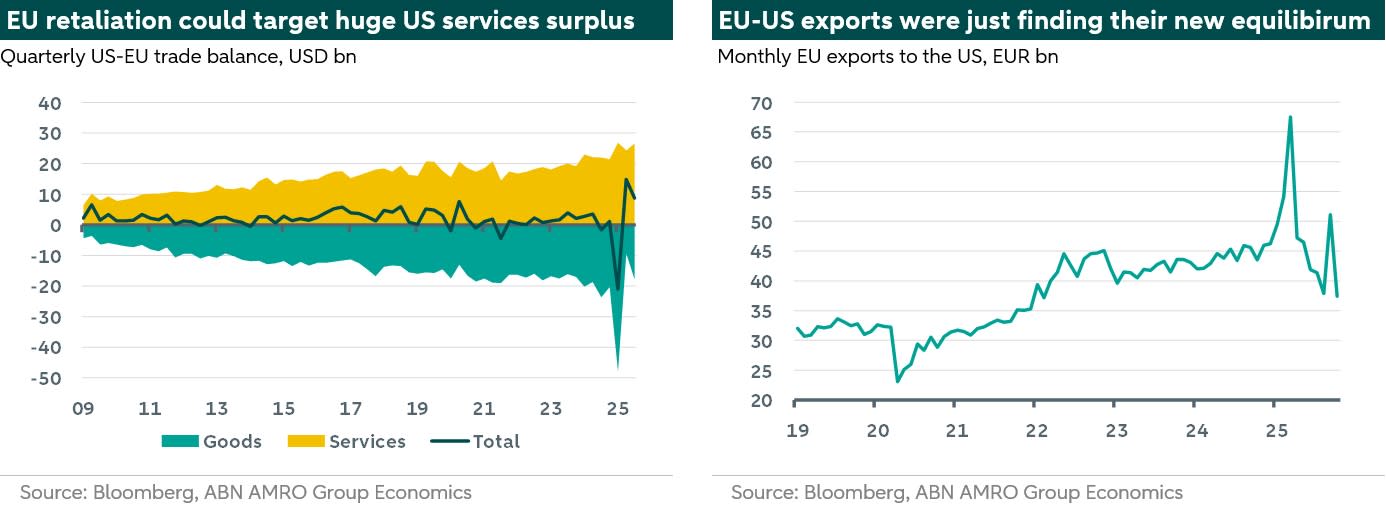
While it’s not possible to levy tariffs on services in the same way as with goods, it is possible to hit services trade with a range of other penalties, restrictions or levies. With the ACI, the EU could: revoke access to the EU market, suspend intellectual property rights (for example allowing free use of software), apply duties to streaming services and other digital platforms, among many other measures. Given the range of measures available, deploying the ACI is not black or white: it could initially involve milder measures, such as excluding US companies from public tenders. Moreover, the EU might not be able to deploy the ACI (1) quickly given the need to consult stakeholders as well as getting political agreement.
Indeed, that last aspect will likely be the most challenging. During last year’s trade war, division among EU member states led the EU to appease Trump and accept a 15% tariff on most of its US exports with no retaliatory measures. Deploying the ACI would open up a new front in this geo-economic conflict between the US and the EU, and it would come with considerable risks. At the same time, moves to annex European territory appear to be eliciting a much more serious response than tariffs on its exports, given the dangerous precedent this would set. And deploying the ACI may be the only surefire way to inflict sufficient pain on the US economy – as China did last year with its rare earth restrictions – in order to temper the Trump administration’s ambitions. To mitigate the risks of escalation, however, one approach the EU could take is to start activating ACI measures, while giving enough lead time for negotiations before measures are implemented.
What nuclear options does the US have?
In terms of economic escalation, a 10% tariff feels like a starting point. Mirroring the play with China, we could see further escalation on tariffs, but also on critical goods. From the EU perspective, one could think about supply restrictions for LNG, advanced chips, and of course defence goods. The US may also expand defence threats, not necessarily in terms of more territory, but in withdrawing the defence umbrella. The US’s support for Ukraine could again become a bargaining chip, and in an extreme scenario, an explicit threat that the US would not defend Europe in case of a Russian incursion could very well embolden Russia to attack. Europe’s defence is still its weak spot, much more than its economy. Finally, if no deal is agreed, the US could decide to actually invade Greenland.
How would these new US tariffs and potential European retaliation affect the economy?
New US tariffs would hit just when European exports to the US were finding their new equilibrium after the tariffs imposed last year. EU exports to the US were down some 20% y/y as of November. Part of the weakness reflects an unwind of the frontloading we saw earlier last year. But there is likely also some permanent damage to exports stemming from the weakened competitive position of the EU, particularly in key sectors such as cars.
The 10% tariff proposed by Trump would layer on top of the existing 15% tariff, and could well apply to sectors currently exempt from tariffs, such as pharmaceuticals and semiconductors (there is a question mark over this given that a blanket tariff would be even less in the US’s interests). We estimate such an additional tariff would – if kept in place over time – lower GDP by around 0.3-0.5pp. This is a big ‘if’ of course, and given how fluid things are right now, we would not rush to make changes to our growth forecast. One reasonable scenario is that the tariffs are implemented briefly, say for a month or two, but ultimately rolled back assuming the US-EU resolve their Greenland dispute.
Could trade get ‘backloaded’ on the expectations of a TACO?
In this scenario, we could see a reverse of the trade frontloading phenomenon we saw last year – a backloading. Given the short lead time to 1 February, exporters would be unable to meaningfully raise exports to beat the tariffs. Instead, they could reduce export volumes after 1 February on the assumption that tariffs later get rolled back. This would mean a near-term dip in exports (and therefore growth), followed by a sharp rebound when the tariffs are later rolled back. This would introduce some volatility to our near-term growth forecasts, which currently foresee a gradual acceleration on the back of fading export weakness and strengthening domestic demand.
What about more negative scenarios, and what about the longer term impact?
It goes without saying that if Trump follows through on raising additional tariffs even further – to 25% from June – that this would have much more damaging consequences, implying a total 40% headline tariff on European exports. As well as the direct hit to competitiveness this would also reduce the EU’s relative competitive advantage with China, which currently faces much higher tariffs into the US market. A 40% tariff would be approaching a level that is essentially prohibitive to trade, and would have much more damaging consequences – possibly driving outright declines in GDP in the near-term. In the longer run things get more murky. As discussed in our two weeks ago, such an escalation between the US-EU would likely also drive defence spending even higher than it is currently projected to rise, but it would also alter the composition of spending. A lot of defence spending currently leaks out in the form of imports, particularly from the US. The US essentially going from friend to foe could lead to a sudden stop in US defence equipment procurement, with spending redirected to domestic industry. This would ultimately lift growth, though the timing of this depends on how quickly industry is able to respond to the increased demand.
What about the Netherlands?
So far, the exemptions in existing tariffs result in the Netherlands having a relatively favourable effective tariff rate at roughly 7% compared to its European counterparts. However, a blanket tariff increase following Trump’s Truth Social Greenland threats - either 10%, or 25% in the case of escalation - would significantly raise the Dutch effective tariff rate, thereby weakening the competitive position of Dutch exporters, alongside adding to new trade uncertainty in the near term. Dutch exports to the US are value-added heavy, with 60% consisting of Dutch-manufactured products rather than re-exports. The imposed tariffs would have varying effects on Dutch exports to the US.
For certain goods within Machinery, which accounts for roughly one-third of Dutch exports to the US, including ASML’s chip machines, the impact on demand may be mitigated by the US’s inability to source these goods from alternative suppliers. A similar dynamic might apply to a portion of chemical exports (approximately one-fifth of exports) to the US, at least temporarily. However, for most goods, the tariff is likely to suppress demand over time, resulting in a drag on exports. Moreover, as a small open economy, the Netherlands is particularly vulnerable to indirect effects, such as diminished demand from other trading partners due to their declining exports to the US. These indirect impacts are anticipated to outweigh the direct effects on Dutch-US trade.
Will escalating trade tensions harm the US economy?
From a US perspective, the 10% duty would add about 1pp to the current average effective US import tariff rate of about 14%. The 25% version would add almost 3pp, raising the average rate to the highest level since the de-escalation in the spring of last year. Expansion of the tariffs to the full EU would make these figures substantially larger. The EU is still the single largest trading partner, accounting for almost 20% of US imports. As a result, these tariffs would certainly hit the US economy, particularly if the EU decides to retaliate. As described above, these higher levels would eliminate trade in all but the most highly demanded goods. Some of the European imports may be sourced from elsewhere, but there is also a substantial part of European goods for which no alternative exists. This would put a downward impulse on the already struggling non-AI-adjacent part of the economy in particular, and put a mild brake on the economy’s strong momentum. There is a reasonable scenario in which this negative shock pushes past the breaking point of the already fragile US economy, with rapidly accelerating unemployment and substantially slower, and possibly contracting, consumption growth.
How could this develop over the coming weeks?
In the very near term, the most immediate concerns are: 1) Europe’s formal response to US tariffs, and 2) whether the US actually follows through on its threats. There is significant uncertainty on both, and moreover, the former will of course depend on the latter. There are two weeks until the initial tariffs may take effect, which leaves room for escalation and de-escalation without material damage. We would not be surprised if Trump were somehow persuaded to pull back from the brink in the meantime. We would also not be surprised if he wasn’t. Much will depend on financial market moves as well as the strength of lobby pressure in both the US and Europe. ‘TACO’ became almost a cliché in 2025, but there were probably just as many instances where Trump chickened out as didn’t.
1 The ACI is actually a broader tool and can be applied to both goods and services. But in this context, services would likely be the focus of any deployment of the ACI, given the US has a lot more to lose in this area.