United States - Old (pandemic) habits die hard
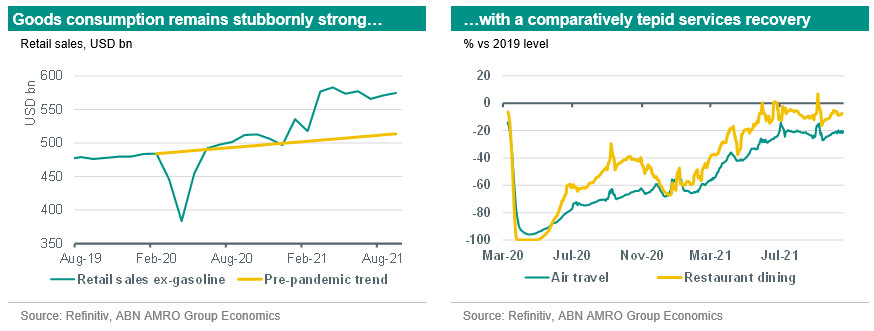
Goods consumption remains well above trend, and services consumption well below trend. The delayed normalisation in consumption patterns poses continued upside risks to inflation. Leading us to bring forward our expectation for interest rate rises to early 2023.

The shift in demand from services to goods since the pandemic is taking longer to normalise than expected. This was confirmed in the September retail sales print, which showed an unexpected rise, with August sales also revised upwards. This came despite continued weakness in consumer sentiment, which suggested a pullback in goods consumption. The details showed renewed gains in autos, recreational goods, and general online sales, with eating out showing only a small gain. Indeed, restaurant dining and air traffic data suggest that the services recovery has stagnated since July, with little sign yet that the easing in the Delta wave is triggering a turn-around. The latest hard data (which runs to August) shows that services consumption remains around 5pp below the pre-pandemic trend, with durable goods consumption 7.6pp above the pre-pandemic trend; the September data is likely to show little change from these numbers when it is released next week. Stubbornly strong goods consumption – alongside supply-side bottlenecks – continues to pose upside risks to inflation. Although the past two CPI reports showed relatively normal price growth, we expect a reacceleration in inflation over the coming months, with persistent pipeline pressures likely making it increasingly difficult for producers to avoid passing on higher costs to consumers, and higher wage growth and a shortage of housing putting further upward pressure on rents. While we do not expect price growth to reach the lofty levels seen earlier this year, it will be enough to keep worries alive of a possible drift upward in inflation expectations. Should inflation be persistent enough to push expectations significantly higher, this would be far more consequential for the medium to longer-run policy outlook than the current price pressures we are seeing. Our base case continues to be that a correction in goods consumption, a comparatively tepid services recovery, and a recovery in labour supply will help return core inflation back to near 2% by late 2022. However, the probability of more persistent above-2% inflation has continued to rise.
We now expect the Fed to start raising rates in early 2023
Continued upside risks to inflation caused us to bring forward our expectation for the start of Fed rate hikes. We now expect the Fed to have fulfilled its dual inflation and employment mandate by the end of 2022, paving the way for a first hike in the fed funds rate in early 2023. Previously, we expected lift-off to happen in late 2023. We continue to expect only a gradual rise in rates following the first hike, with rates initially rising once every six months, compared to once per quarter in the previous 2015-2018 hiking cycle. The timing of lift-off naturally depends significantly on inflation developments over the coming year. Should inflation re-accelerate more significantly than we currently expect, we would have cause to revisit our view. Another trigger to revisit our view is a shift in inflation expectations. At present, expectations remain well-anchored. If we start to see inflation expectations drifting beyond levels seen in the post-GFC period, this would be a major warning sign that a more forceful policy response would be required. See our Fed Watch for more.