US - Actions have consequences

Outside direct and indirect effects of the AI boom, the US economy grew at near stall speed in 2025. Low labour supply growth led to near-zero job creation, but also prevented unemployment from rising. With tariff inflation yet to dissipate, the Iran conflict generates another policy-induced inflation shock.

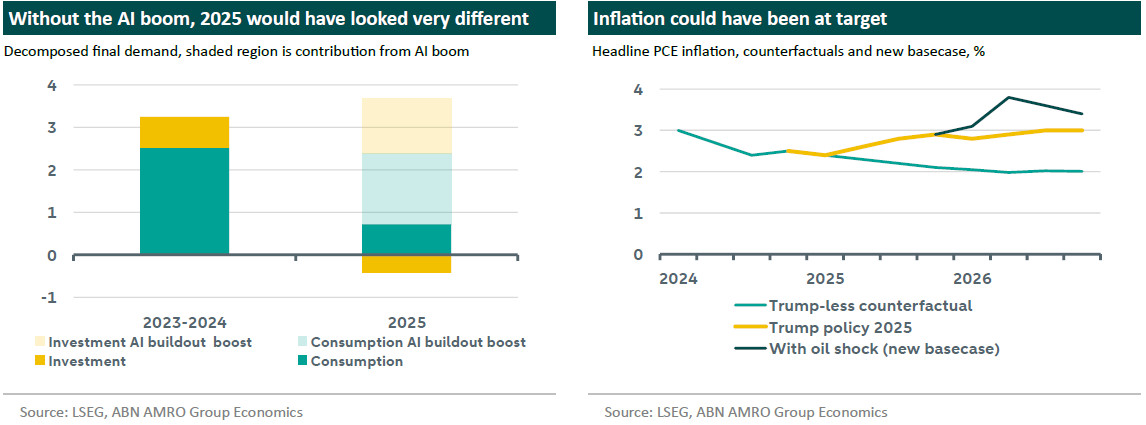
In the latest FOMC press conference, Chair Powell noted that the US economy created zero private-sector jobs in the last half year. Recent San Francisco Fed research finds a ‘one-for-one causal effect of unauthorized immigration worker flows on employment growth.’ While Stephen Miran touted record employment gains for native-born workers (based on a misinterpretation of the data), the reality is that job growth has stalled in its totality. GDP for Q4 was revised down to 0.7% from an initial estimate of 1.4%. Growth in private demand came in at 2.4% over the full year, compared to an average of 3.2% in the two years prior. We estimate that private demand would have grown by less than half a percent, had the AI investment boom not coincided with Trump entering office. Quarterly contractions would have been likely. Almost all of that deterioration is directly attributable to policy and policy uncertainty of the Trump administration.
Inflation was set on course to return to the 2% target, but tariffs led to a lack of disinflation. Inflation is now set to rise again due to rising oil prices. We’ve updated our base case to reflect these developments, as described in more detail in this month’s Global View. Based on our assumptions on oil price developments, we expect PCE inflation to rise to 3.6%, peaking in the second quarter of this year. We have limited concern about second order effects from the energy shock, given the K-shaped economy, and the abovementioned slowdown. Any second round effects will however be difficult to identify, given already re-accelerating inflation, with recent PPI readings showing significant price pressures throughout the economy. These are mostly supply-driven due to tariffs and labour shortages in select sectors, but there is a demand component attributable to the investment and consumption patterns associated with the AI build out.
We therefore expect a passive Fed, which does not fully ‘look-through’ the inflation, and refrains from the easing as it were poised to do before the conflict started. Chair Powell, in principle, has one meeting left in which he is unlikely to deviate from course, and his successor, Kevin Warsh, is likely to steer for consensus on not hiking. We now see the Fed on hold until December of this year, when the fog starts to clear and the FOMC has convinced itself of limited second order effects. We subsequently see further policy normalization with two quarterly 25 bps cuts in March and June 2027.
Will the US economy prove resilient? In our base case, the AI build-out continues to drive healthy headline figures for the US, at least in terms of growth. AI infrastructure is more dependent on electricity than on oil directly, and US electricity prices have seen little movement beyond the usual variability. The downgrade of our forecast for this first quarter is partly due to the oil shock, but predominantly on the back of incoming data. Headline inflation will rise substantially due to elevated oil prices, but we also slightly upgraded core inflation, which we expect to make little progress over the rest of the year. The labour market shows no sign of revival, and we expect a minor increase in the unemployment rate. Risks for core inflation are tilted to the upside, especially in the case of a prolonged Iran conflict, and potential fiscal stimulus before the mid-term elections. Risks to growth are tilted to the downside, and predominantly triggered in a scenario where the Fed would steeply tighten in response to de-anchoring inflation expectations.