China - A tale of resilience, Iran risks and chokepoints
Real GDP accelerated a bit in Q1, as expected, but risks from the Middle East still loom. March macro data already show some impact of the Iran conflict. Blockage of energy chokepoint Strait of Hormuz is a test for US-China relations.

Real GDP accelerates a bit in Q1, as expected, but risks from the Middle East still loom
In line with our and consensus expectations, China’s real GDP growth accelerated somewhat in Q1-2026, both in quarterly term (from 1.2% q/q in Q4-25 to 1.3% in Q1-26) and in annual terms (from 4.5% y/y to 5.0%). Our expectation for an acceleration was based on strong activity data for the first two months of the year, such as an export surge in February on the back of the global tech/AI cycle, solid industrial production, and with overall investment reported to grow again (see here). That said, domestic supply-demand imbalances remain, while downside risks have risen due to the ongoing Iran conflict. These higher risks include direct effects from higher energy prices and energy supply disruptions, and – perhaps even more important – effects from the conflict on global demand, as China’s imbalanced growth is still to a large extent externally-driven. We already lowered our 2026 growth forecast marginally last month (from 4.7% to 4.6%,), still within Beijing’s target zone of 4.5%-5.0%, and keep our growth forecasts unchanged for now.
March macro data already show some impact of the Iran conflict
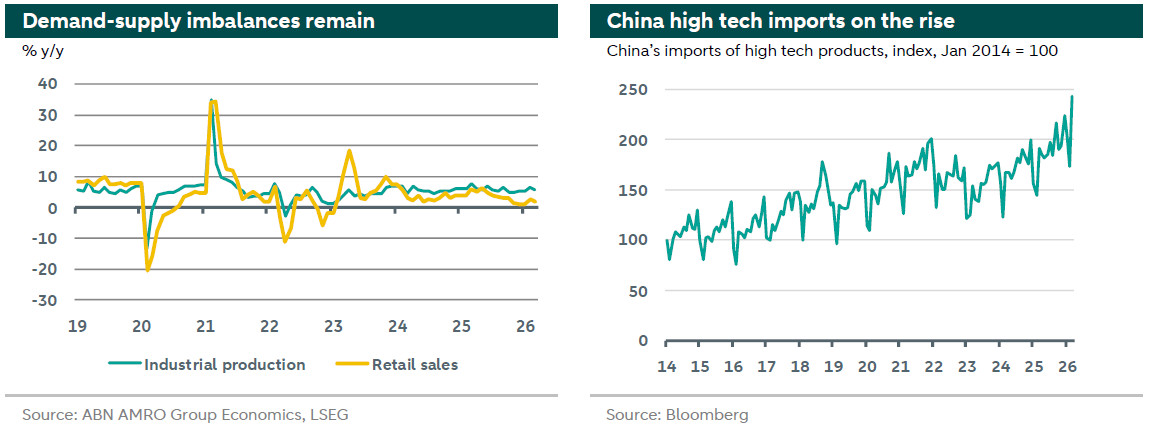
Earlier this month, the impact from the Iran conflict was already visible in the deterioration of the export-oriented PMIs from RatingDog, and in the sharp slowdown of annual export growth in March – although this slowdown was ‘overstated’ by base/seasonal effects. Meanwhile, imports rose sharply in March, with imports of high-tech products including semiconductors in particular surging, reducing the monthly trade surplus to a 13-month low. Despite this, other activity data for March point to ongoing supply-demand imbalances. Industrial production slowed (5.7% y/y, down from 6.3% in Jan/Feb), but continues to grow much faster than retail sales (1.7% y/y, down from 2.8% in Jan/Feb). Fixed asset investment stayed in positive growth territory (unlike 2025), but that is led by public investment, with private investment still declining. Annual growth of property investment and residential home sales remains deeply negative, although home sales picked up in March. The various weaknesses in the economy were also illustrated by a rise of the jobless rate, equaling a one-year high of 5.4% (February 5.3%). On the inflation side, the impact from the Middle East was mainly visible in producer price inflation, which turned positive again (0.5% y/y) for the first time since September 2022.
Blockage energy chokepoint Strait of Hormuz is a test for US-China relations
Although Beijing has been relatively quiet on the Middle East conflict so far, US actions versus China’s oil suppliers Iran - and earlier Venezuela - will not be welcomed. China is cushioned in terms of the energy crisis, but not immune (see here). Last year, Iran’s share in Chinese oil imports was around 10%, and a prolonged blockade would particularly hit its teapot refineries in Shandong Province. What is more, total oil imports from the Middle East were around 50% in 2025. The biggest risks still come from the hit to global demand, which will increase the longer the conflict takes to unwind. All of this impacts US-China relations, with a delayed Trump-Xi meeting still scheduled for May. China has the opportunity to retaliate, e.g. by tightening chokepoint restrictions (rare earths) again. We still think both countries have incentives to extend their trade/chokepoint truce in an ever more complex geopolitical landscape, but risks are rising.