Eurozone - Moderate contractions in GDP expected to continue

The eurozone has entered a recession, and we expect this to continue in the coming quarters.

GDP contracted moderately in 2022Q4 and 2023Q1; we expect comparable declines during the rest of the year
Core inflation fell in May and should gradually move lower during the rest of this year, also because wage growth looks to have levelled off
The ECB is ready to hike rates again in July and is keeping a hawkish stance
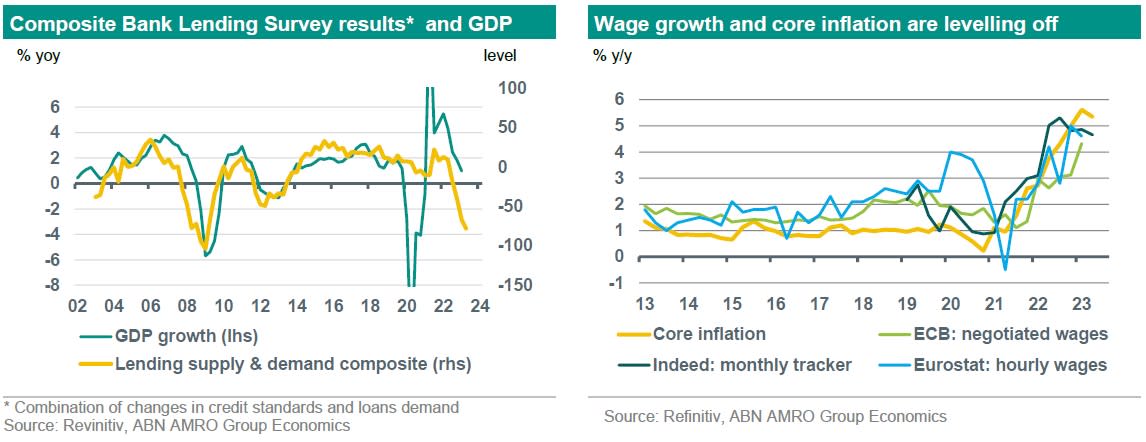
Eurozone Q1 GDP was revised lower to -0.1% qoq, down from the earlier estimate of +0.1%. Consequently, GDP has contracted for two consecutive quarters (22Q4 also recorded -0.1%), implying that the region has entered a recession. We think the weakness will persist for the rest of the year, and our base case foresees ongoing moderate contractions in GDP. This is due to a number of factors. To begin with, past interest rate hikes by the ECB have already resulted in banks tightening credit standards, and demand for loans is falling (see graph below-left). Actual loan growth has slowed and house prices are declining. Next, the post-pandemic rebound in services seems to have run its course (total services activity contracted by 0.6% qoq in Q1 after it grew by 0.6% in Q4), and goods consumption is edging lower, or stabilising at best. Also, construction contracted in March and April, after it had jumped higher in Q1 due to mild winter weather. Finally, industrial production and exports should remain weak as the global economy has lost momentum.
Inflation dropped from 7.0% in April to 6.1% in May. This drop was mainly due to lower food and energy inflation, but the core rate fell as well (from 5.6% to 5.3%), with the inflation rates of energy-intensive goods and services falling by 0.3pp each. Non-energy intensive goods inflation also declined (-0.2pp). Indeed, the only part of inflation that has not yet begun to decline is non-energy intensive services, which is largely driven by wage growth. That said, early evidence has suggested that wage growth has levelled off in the first months of this year (see graph below-right). We expect a further significant easing of wage growth to materialize in the second half of this year, as the expected economic weakness should hit labour demand and result in moderate rises in unemployment. Services inflation should therefore ultimately decline as well, though as argued in this month’s Global View, this hinges critically on the labour market softening. An early sign of a cooling of the labour market was the drop in the vacancy rate from 3.1% in 2022Q4 to 3.0% in 2023Q1. It peaked at 3.2% in 2022Q2 and has edged lower since then. The vacancy rate in industry and construction declined from a peak of 2.9% in 2022Q2 to 2.7% in 2023Q1, while that in services fell from 3.7% to 3.4%.
As expected, the ECB raised the deposit rate by 25bp in June. It also kept a hawkish policy stance and even appeared to open the door to rate hikes continuing past the summer. Nevertheless, we are sticking to our view that the ECB will hike only one time further in July, taking the deposit rate to 3.75%. This is because the ECB is likely to be surprised to the downside on both economic growth and inflation. As such, we think that by September, it will become clear to the Governing Council that it has done enough to fight inflation, and that it may even have overshot. A rate cut cycle is therefore still likely to begin in December and continue in 2024.
This article is part of the Global Monthly of 26 June 2023