Eurozone - Rising bond yields temper the ECB’s rate hike pace

September PMIs point to strong growth momentum, though this is unlikely to be sustained. Spain’s election impact limited in the near-term; tighter immigration could weigh in the medium term. Rising (French) bond yields are tempering the pace, but we still expect two more hikes from the ECB


Adrian Quinn
Economist Intern
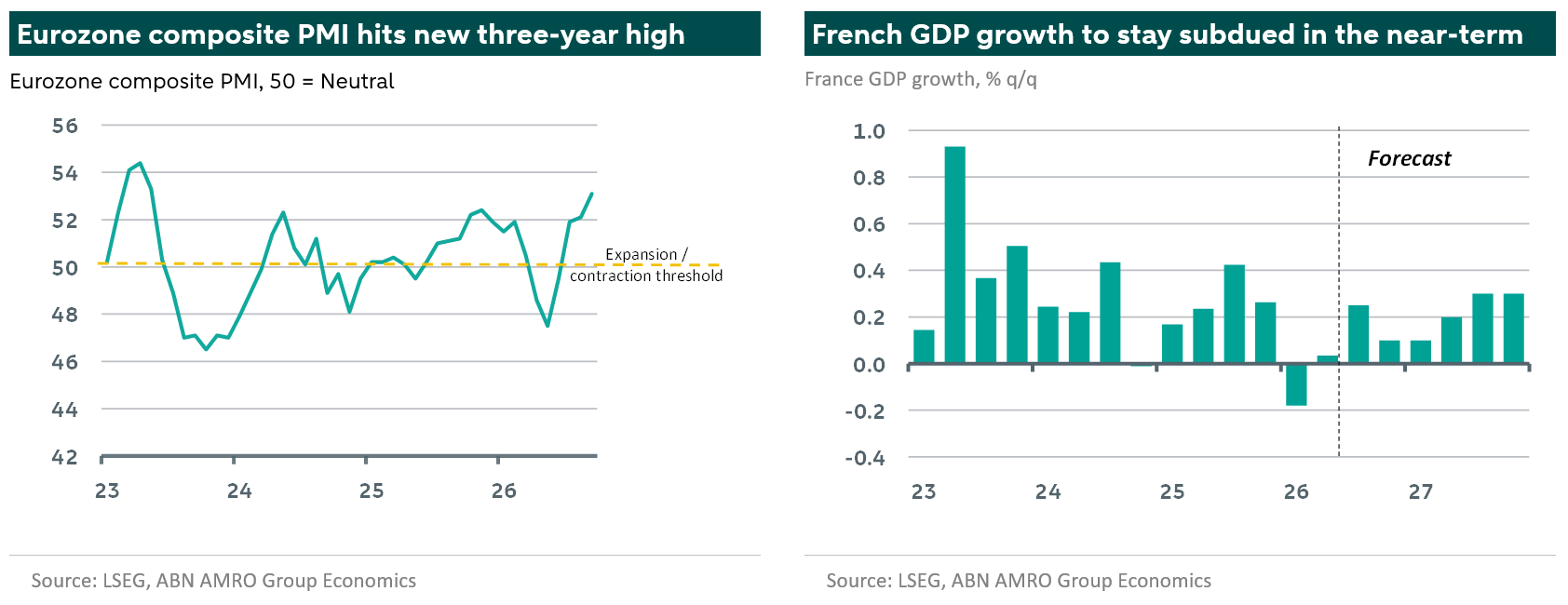
While we do not expect energy prices to normalise anytime soon, we do expect eurozone growth to remain resilient moving into Q4, with underlying (ex-Ireland) growth of around 0.2% q/q. We emphasise ‘underlying’ growth, because Ireland continues to significantly distort headline GDP; indeed, Q2 GDP was revised sharply higher, from 0.4% to 0.6% q/q, due entirely to Irish growth being revised to 10.2% from 3.9%. Flash September PMIs are also consistent with resilient growth. The composite PMI rose to 53.1 in September, up from 52.0 in August, and the strongest reading since April 2023. The improvement was broad-based, with both services and manufacturing gaining momentum. Services was particularly noteworthy, reaching a ten-month peak, driven by IT-related services likely linked to AI-related investment. While we doubt this momentum can be sustained, through the September reading alone is consistent with underlying quarterly GDP growth of around 0.4% for the eurozone – well above the 0.2% we expect for Q3 & Q4. So far, inflationary pressures and higher bond yields have had only a limited impact on eurozone business activity. With that said, we expect a combination of prolonged high energy prices and more ECB tightening to weigh on growth in 2027, and we have downgraded our quarterly growth forecast for the second half of 2027, to 0.3% q/q from 0.4% previously.
On a country-level basis, performance remains uneven. While most of the eurozone’s big hitters continue to show resilience, France continues to falter, skirting recession in the first half of 2026, and only a modest recovery expected in Q3/Q4. Growth in France is expected to remain well below trend, with political uncertainty, fiscal consolidation, and tighter financial conditions weighing on activity. Spain in contrast continues to boast some of the eurozone’s most impressive growth, with 2026 expected to come in at 2.7%. Snap elections are unlikely to dent this momentum, though the end of the EU’s Recovery & Resilience Fund (RRF) is expected to mean slower growth in 2027. On the elections, polling suggests a defeat for Sanchez in the election on 29 November, and an alliance between Spain’s centre and far-right. We expect the macro implications of the election to be limited, although a right-wing coalition government could well lead to an immigration crackdown, which could have some growth dampening effects in the medium term.
Rising yields and limited inflation spillover to mean more gradual ECB hikes
We recently changed our view for the ECB and added two extra rate hikes to our outlook. The hawkish forecasts at the September Governing Council meeting suggested the ECB would be minded to do back-to-back rate hikes in October and December. Since then, tighter financial conditions – particularly in France, but more generally via higher bond yields – alongside limited signs of second round effects in inflation suggest the ECB will stick to a quarterly rate hike pace. Indeed, market pricing for an October hike has been dialled back significantly, from 19bp immediately after the September GC meeting to just 3bp at the time of publishing. Given the lack of pushback from Governing Council members, with Philip Lane in recent remarks endorsing a ‘measured’ response to the inflation wave, we think the next hike is likely to come in December, with a final hike now expected in March.