FX Weekly - New macro view, new FX outlook

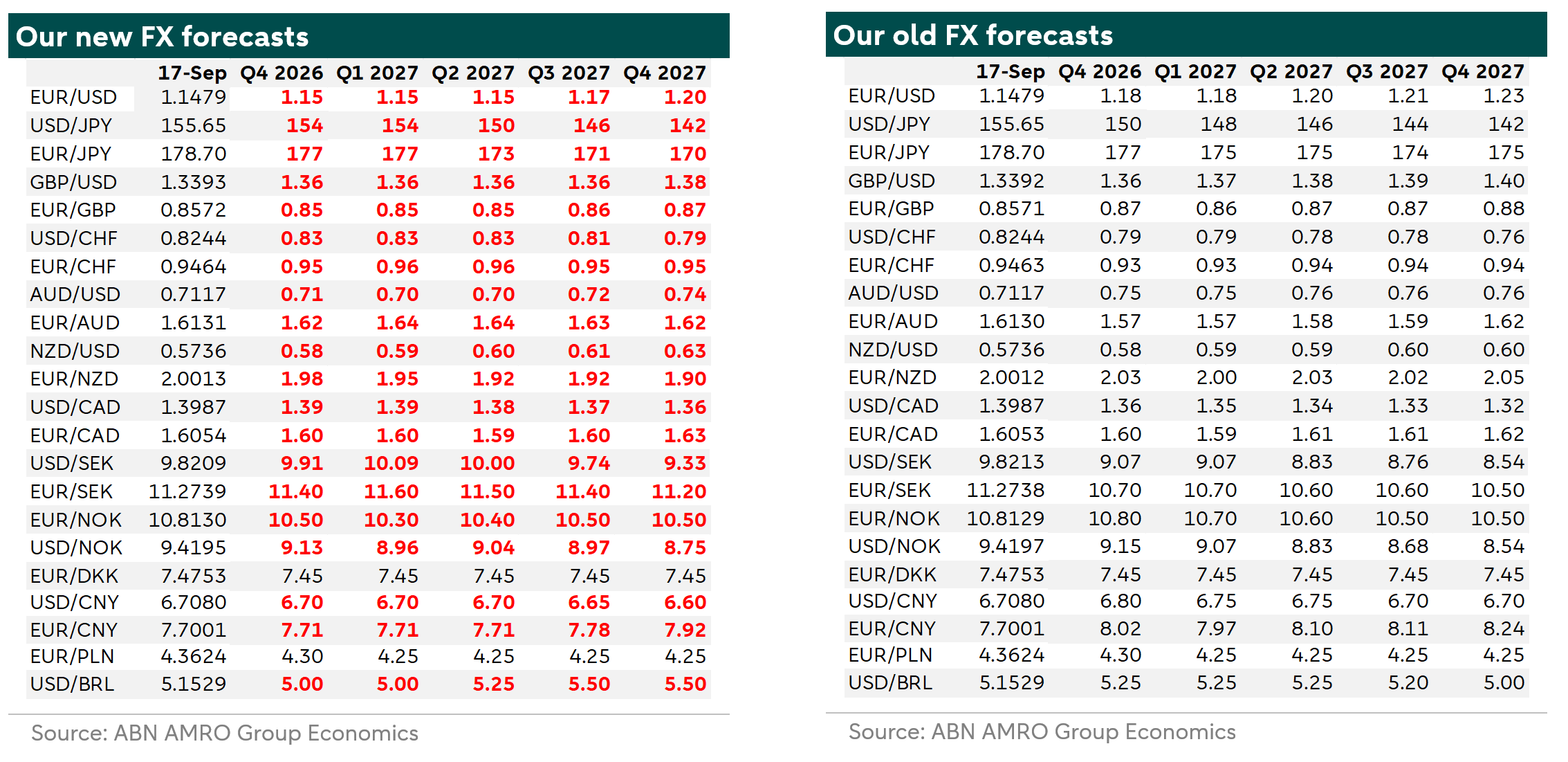
Following significant changes to our macro base case we have changed our currency forecasts, We expect the euro to be range-bound against the dollar over the next few months. Towards the end of 2027 we expect that USD will decline. Energy currencies NOK, CAD and BRL should remain supported, but trade tensions may limit Canadian dollar gains. Currencies with hawkish central banks (NOK, AUD, NZD) should do well. CHF and SEK may replace JPY in carry trades. Our next FX weekly will be published in the first week of October.

Fed
On Wednesday evening, the Fed decided to hike the policy rate by 25bp as widely expected. Warsh’s statements were more hawkish than anticipated, and the dots took a sharp hawkish turn (see more here), which supported the US dollar across the board. As a result EUR/USD dropped below 1.15, reversing part of the reaction to the disappointment of the previous Fed meeting.
Change in EUR/USD outlook
Earlier in the week we made some significant changes to our macro base case due to the resurgent energy shock (see here). As a result, we have downgraded our EUR/USD forecasts to 1.15 and now expect the currency pair to trade broadly sideways until Q2 2027. This does not imply an absence of volatility. Rather, it reflects the offsetting nature of several key drivers and the unusually high degree of uncertainty surrounding the outlook.
First, our views on the ECB and the Fed have changed. Previously, we anticipated no further Fed rate hikes and expected the ECB to leave rates unchanged after its September hike. We now expect both central banks to raise rates further. Financial markets are pricing in three additional rate hikes from both the Fed and the ECB. We forecast one further hike by the Fed and two by the ECB. If markets move towards our views, this would have a more negative effect on the dollar than on the euro.
Second, we now expect energy prices to remain higher for longer. Historically, elevated energy prices have tended to weigh more heavily on the euro and the yen than on the US dollar, limiting the upside potential for EUR/USD.
Third, political developments are likely to play a more prominent role. In the coming months, the US midterm elections could exert some downward pressure on the dollar. However, later in the year and beginning of next year, political uncertainty surrounding the French elections (April 2027) is likely to weigh on the euro as well.
Fourth, increased market scrutiny of fiscal dynamics is unlikely to be a challenge for the US alone. Concerns about fiscal sustainability may also affect the euro and sterling, reducing the relative impact on EUR/USD.
Looking further ahead, we expect currency markets to refocus on structural weaknesses in the US economy during the second half of 2027. This could lead to a higher risk premium on US assets and, combined with our expectation of lower energy prices by that stage, provide support for the euro against the US dollar.
BoE change in view
Alongside forecasting more ECB and Fed hikes, we have also changed our call for the BoE and now expect two rate hikes. While today still looks likely to be an on-hold decision, we now expect one rate hike in November, and another in February, to coincide with the BoE’s Monetary Policy Report and forecast updates. The BoE already has had rates in somewhat restrictive territory, so has had the luxury to be patient so far. But more persistent high energy inflation raises the risks of inflation expectations becoming de-anchored. Given the UK economy has also been faring better recently, the BoE now looks poised to respond alongside other major central banks. To reflect these changes in the Fed, ECB and Bank of England we made some changes in our sterling forecasts.
Our other currency forecasts
We have also revised our forecasts for other currencies. We expect the currencies of energy-exporting countries, including the Norwegian krone, Canadian dollar and the Brazilian real to remain well supported in the coming months. However, the Canadian dollar’s potential gains are likely to be limited by trade tensions with the US. We also expect currencies backed by more hawkish central banks than the Fed and ECB to perform relatively well. These include the Norwegian krone, New Zealand dollar and Australian dollar. The Japanese yen has become less attractive as a funding currency for carry trades, so investors have looked for alternatives and turned to the Swiss franc and Swedish krona. Inflation is below target in both Switzerland and Sweden, policy rates are low, and neither the Swiss National Bank nor the Riksbank appears likely to raise interest rates soon. All these dynamics are reflected in our currency forecasts below.