Germany - An important year for the country
The German economy grew by 0.2% q/q in Q4, landing the annual average for 2025 at 0.3%. We expect government spending alongside other factors to drive an increase in growth to 0.9% in 2026. Recent news on delays to government investment and tariffs introduce downside risks to the forecast.


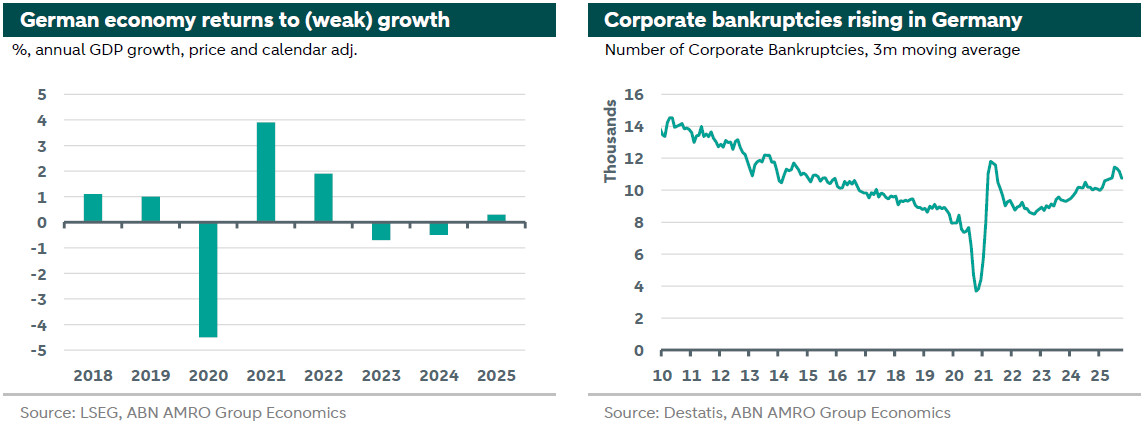
After two years of recession, the economy returned to growth in 2025, though the expansion was modest at just 0.3%. Destatis’ preliminary estimate for Q4 growth stood at 0.2% q/q, close to our forecast of 0.25%. This slight improvement in growth sets the stage for 2026, a year anticipated to see higher quarterly growth rates driven by increased government investment and defence spending, rising consumer real incomes, and past interest rate cuts supporting domestic demand. We forecast annual growth for 2026 to reach 0.9%. However, downside risks have risen, from delays in fiscal spending and renewed tariff threats (see here). Uncertainty around this keeps us from adjusting our forecast for now.
Business sentiment, despite the improvement since early 2025, has weakened recently. While overall GDP shows signs of recovery, business continues to face challenges. Indeed, over the course of 2025, key sectors still saw negative annual growth in value added: manufacturing (-1.3%), construction (-3.6%), and business services (-0.8%). Bankruptcies, which have steadily risen from the pandemic lows, are now at levels comparable to 2014, also contributing to higher unemployment. This trend is expected to persist in the short term before higher growth offers some relief. The weak macro situation, coupled with poor sentiment, has led to cautious responses from German leadership to Trump’s Greenland threats. Germany’s export model remains under pressure, with net exports continuing to be a drag in 2026. Though demand in export markets is expected to grow, German exporters are likely to see only limited benefits. Price competitiveness has declined in recent years, as reflected in a reduced global export market share. The stronger euro and the risk of new tariffs exacerbate the situation. Indeed, Germany already faces one of the highest effective US tariff rates within the eurozone. In summary, while GDP growth is projected to increase to 0.9% in 2026, up from 0.3% in 2025, downside risks to this forecast are mounting.
The German government is under increasing pressure from voters and business lobby groups. While the CDU/CSU and SPD swiftly formed a coalition agreement, many of its planned measures lack detail and require further refinement. Nearly a year into office, Chancellor Merz – despite prioritizing reforms during the campaign – has struggled to achieve meaningful progress. Plans have been introduced for tax reform, reducing bureaucratic barriers valued at EUR 16 billion (with IFO estimates suggesting the total could reach EUR 150 billion), along with reforms to social security and the pension system. However, these initiatives fall short of addressing key issues, such as pension costs, legal hurdles, or political resistance. Additionally, reports suggest that investment projects originally planned within the core budget have been reclassified into special investment funds to create fiscal space for social spending. If these reports are accurate, it would mean less investment in favour of current discretionary spending. As a result, the government’s objectives for strengthening defence and improving infrastructure will remain unfulfilled. Furthermore, without structural reforms, any growth stimulus will likely be temporary, and prospects for long-term economic improvement will remain elusive.