Global manufacturing shrugs off geopolitics

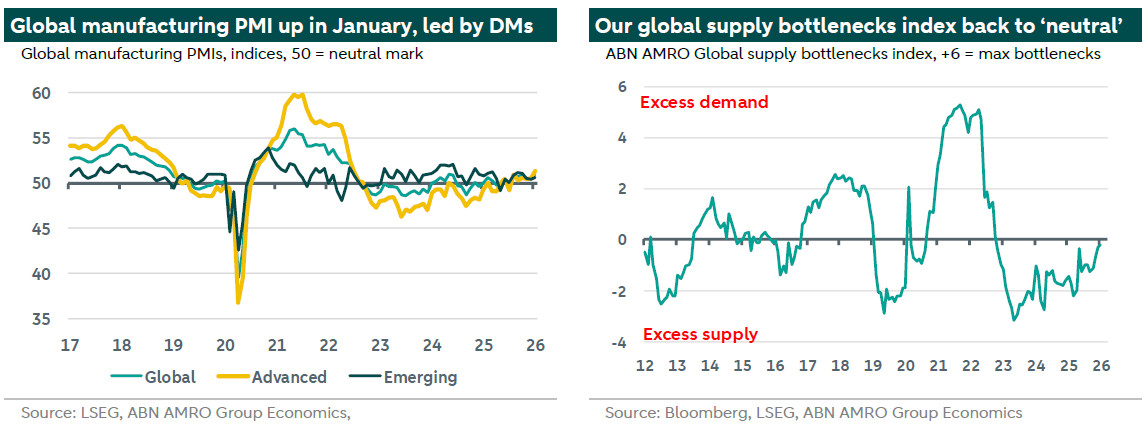
Global manufacturing PMI improved in January despite flaring-up of geopolitical tensions. After having coming down somewhat in the last few months of 2025, the global manufacturing PMI started 2026 on a bit stronger note, moving back up by 0.4 points to 50.9 in January. This implies that according to this survey, global manufacturing stayed in expansion mode for the sixth consecutive month, following some US tariff-related weakness in mid-2025. The improvement in January was clearly led by developed markets (DMs), for which the aggregate index rose by almost a full point to 51.4, the highest reading since June 2022. The aggregate for emerging markets (EMs) also improved, but only marginally, to a three-month high of 50.6.

The improvement in the global manufacturing PMI since the summer of 2025 is consistent with our view that downside risks to global growth have eased somewhat following the conclusion of more US trade deals, notwithstanding the recent flaring-up of geopolitical/geo-economic risks (around Venezuela, Greenland, Iran etcetera). This resilience is also illustrated for instance by relatively strong, and better than expected, Q4-25 GDP growth figures for the eurozone, including for Germany and the Netherlands (see here), and by the recent upgrade of our 2026 growth forecast for the US, although with a further discrepancy between strong headline growth and a weakening labour market (see here).
Broad-based improvement amongst developed markets
Within the DM category, the improvement was broad-based. The US manufacturing PMI from S&P Global rose back to a three-month high of 52.4, while the alternative ISM index jumped by almost five points to a 41-month high of 52.6. The UK and Japan also saw sharp improvements, with their respective indices well in expansion territory (at 51.8 and 51.5, respectively). The manufacturing PMI for the eurozone also improved, but at 49.5 remained in contraction territory and is still lagging the indices of other DMs. Withing the eurozone, there was a clear improvement for Germany (although at 49.1 remaining below the neutral 50 mark), and a further improvement for France – to a 3.5 year high of 51.2. Meanwhile for the Netherlands, the outperformance faded, with the index falling back to an 8-month low of 50.1, remaining just above the neutral mark ((see here). Within the EM-category, the modest improvement was in line with the uptick in RatingDog’s manufacturing PMI for China (to 50.3), although the ‘official’ index published by NBS dropped back to below the neutral mark (49.3) after a sudden improvement in December.
Both the supply and the demand side show improvements
According to the various subcomponents of the global manufacturing PMI, global supply conditions remain somewhat stronger than global demand conditions, but we also see clear improvements on the demand side. The global output subindex rose by a full point to a 19-month high of 51.8. This was mainly driven by DMs, with the DM output component jumping by 1.7 points to 52.8, the highest reading since April 2022. The global future output index rose to a 9-month high of 60.4. On the demand side, the global domestic orders component rose to an 11-month high of 51.1, also driven by DMs. The global export component rose by 0.8 point to a post ‘US Liberation Day’-high of 49.9 (with improvements for both DMs and EMs), although remaining just below the neutral 50 mark. This is still in contrast with the resilience of global trade volumes as reported by the CPB last year, which point to an increase of 4.4% y/y in January-November 2025. This is a reminder that the relation between ‘hard activity data’ and survey data like the PMIs seem to have become more complicated in a period of large trade policy uncertainty, given potential impact of shifts in sentiment and the prevalence of practices such as trade frontloading in the run-up to (expected) higher tariffs, and the unwinding thereof.
Our global supply bottlenecks indicator moves back to neutral
Meanwhile, our global supply bottlenecks index – an index capturing global supply-demand imbalances and supply bottlenecks at the global scale – has moved back to neutral. This is mainly driven by the gradual fading of global supply-demand imbalances. Our index includes the ratio between the global output component for EMs and the average of the global orders and export orders components for DMs, the typical end-users in global supply chains. This ratio has clearly fallen over the past half year and is almost back to ‘neutral’. As we reported in our global manufacturing update last month, the resurfacing of supply bottlenecks, witnessed by lengthening delivery times and rising container tariffs, had also contributed to our bottlenecks index normalising. Still, since last month we note that delivery times have shortened somewhat again, while container tariffs have come down somewhat. Note that the upward movement of our global supply bottlenecks index goes hand in hand with a rise in the global manufacturing PMI’s components for input and output prices in recent months, which signals potentially stronger global price pressures from industrial goods.