Global Monthly - It takes three to TACO
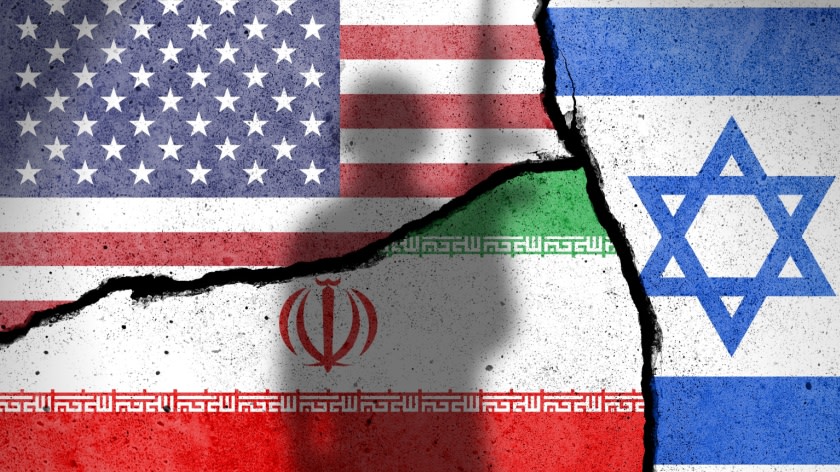
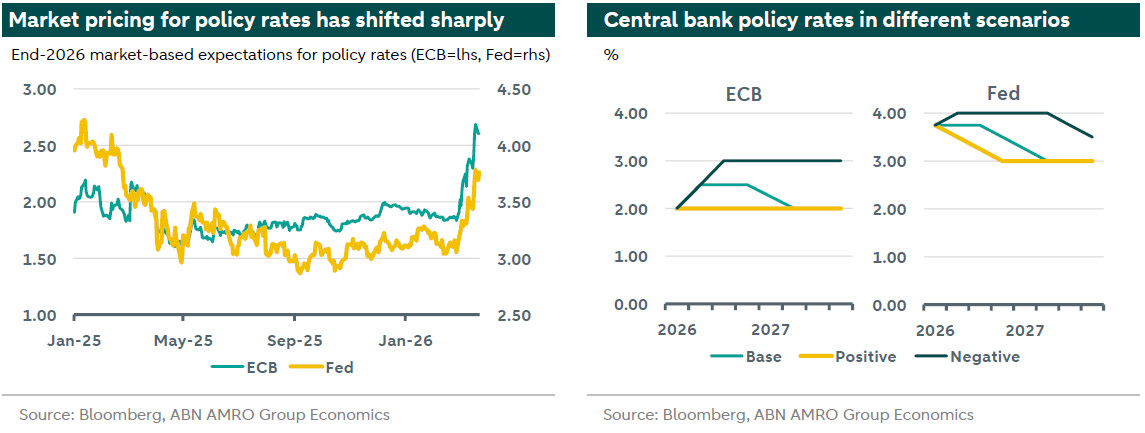
With the Iran conflict ongoing and the chance of a ceasefire uncertain, we update our base case for growth, inflation and interest rates. We assume severe energy disruptions last until the end of May, and this could happen even if the conflict ends relatively soon. The inflation impact of the energy shock continues to outweigh the growth hit, and central bank responses are therefore likely to tilt hawkish. We now expect the ECB to hike rates twice in Q2, and the Fed to delay cuts to Q4. Both central banks are expected to cut rates in 2027.


Global View: Updating our base case
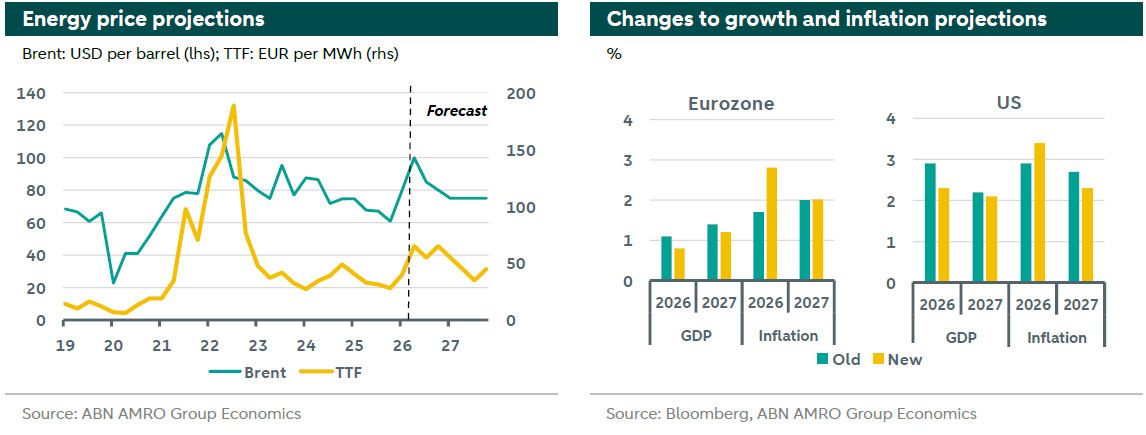
Following the outbreak of the Middle East conflict and resulting energy shock, we set out a number of scenarios (see here), while not changing our forecasts given the uncertainty. We are now changing our base case, albeit with a low conviction given the extraordinary uncertainty right now. Our new central scenario rests on two pillars. First, we do not take a view on the length of the conflict per se, but rather we assume that the period of severe energy supply disruptions will last for another two months, taking us well into the second quarter (further major damage to energy infrastructure is assumed to be limited). Second, the process of energy prices normalising is gradual and oil and gas prices will settle higher over our forecasting horizon than at the start of the conflict. This scenario implies that the energy price shock will have more limited effects on economic growth than inflation. Indeed, our base case is still for continued expansion, albeit at a slower rate and we do not see a very significant risk of recession. This is helped by the declining energy intensity of the economy as well as signs that positive economic momentum was building going into this crisis (see here). On the other hand, we have raised our inflation forecasts more significantly, especially for this year. Against this background, we think central banks will pay more attention to upside risks to inflation, and hence we should – and indeed are – seeing a hawkish pivot. We now see moderate tightening from the ECB in Q2, and a more extended pause to rate cuts from the Federal Reserve.
Might it take three to TACO this time?
Making assumptions about the length of the conflict and hence the duration and intensity of the energy shock is obviously challenging in this environment. Over the weekend, it looked like the chances of a very negative scenario were heightened as the US gave a 48 hour ultimatum and threatened hits on energy infrastructure. At the start of the week, President Trump backed down, saying that the threat was postponed for a five-day period because of ‘very good and productive conversations’ with Iran about ‘a complete and total resolution’ of hostilities. Iranian officials then denied that talks had even taken place, but softened the denial by saying that there are ‘attempts to reduce tensions’. This episode is certainly encouraging because it reduces the risk to further hits to energy infrastructure and it also suggests that the US administration is desperately looking for an off-ramp. Nevertheless, this situation is different from a classic TACO, in the sense that the President cannot just reach for an on-off button as in the case of tariffs. The Iranian regime sees this as an existential threat (it refers to the conflict as the ‘last war’) and has demanded an end to sanctions as well as security guarantees as part of any agreement. At the same time, Israel’s objectives do not seem to fully align with those of the US, and it continued heavy air strikes on Tehran after Trump’s reversal, while Israeli officials have briefed that the chances of a deal remain ‘very low’.
With all of this said, given the supposedly active negotiations at the time of publication, there remains a distinct possibility of a more positive scenario than that outlined below. At the same time, things could also still get a lot worse from here. Our publication of 11 March outlining more positive and negative scenarios therefore remains relevant.
Our new base case also allows for a range of outcomes
These include a messy end to the conflict, where the US might withdraw, leaving some form of lower level conflict between Iran and Israel continuing, and only a partial resumption of Hormuz energy flows. For instance, Iran at present is saying that it will allow vessels not aligned with the US to pass through. Even if the conflict entirely ends soon (within weeks, say), another way that disruptions could persist is that it is likely to take time to repair damaged infrastructure and to fully resume shipments. QatarEnergy, for instance, has said that 17% of its LNG capacity will take 3-5 years to fully repair. We are therefore far from convinced that the end of severe energy disruption is imminent. Even when supplies are fully restored, the need to replenish strategic and commercial stocks, alongside some residual risk premium, could keep prices high. On the other hand, we note that there are various offsets to the current disruptions, such as the east-west Yanbu pipeline transporting oil via the Red Sea, as well as demand destruction resulting from the conflict. We set out the full set of assumptions behind our energy price forecasts in more detail a separate note (see here).
Eurozone & ECB
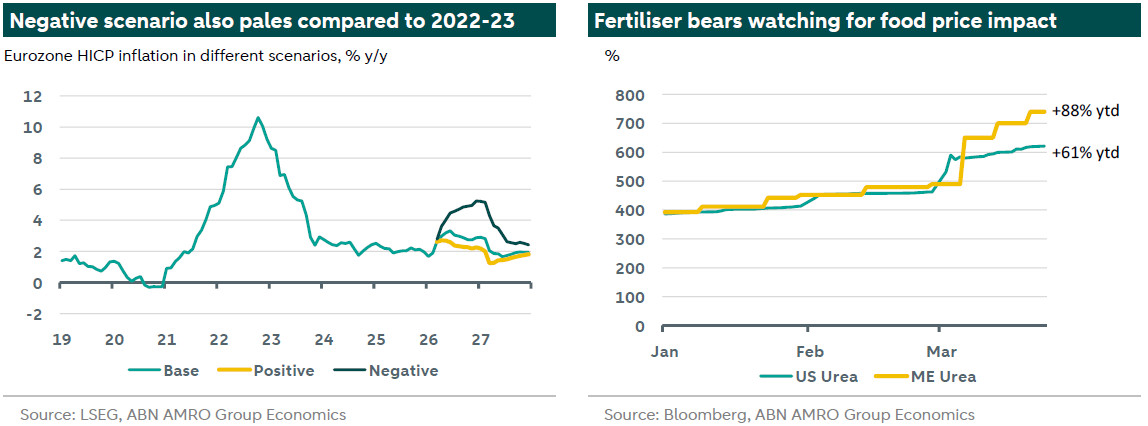
We have made significant downgrades to our growth forecasts due to the energy shock, reflecting the combination of weaker household and business confidence and higher near-term interest rates, but much more significant upgrades to our inflation outlook (see chart above for a summary of changes). Inflation is now expected shoot well above the ECB’s 2% target already from March, and to peak above 3% over the coming months as higher energy prices continue to pass through. An additional source of upward pressure is likely to come from higher food prices, driven by higher fertiliser prices[1], and higher energy-intensive goods prices.
In response to this, we expect the ECB to raise rates already at the April and June Governing Council meetings, taking the deposit rate to 2.50%, in order to pre-empt any de-anchoring of inflation expectations. We have more conviction in the April hike than the June hike, given the ongoing uncertainty of the conflict. It could well be the case that with the conflict ending and energy prices quickly normalising, the Governing Council gains enough visibility on the inflation outlook that it holds off from hiking in June. Policy tightening would be aimed at preventing second round effects from the energy shock spilling over to the labour market specifically – something we saw in the aftermath of the 2022 energy shock, which coincided with a relatively tight labour market and therefore encouraged workers to demand pay rises to compensate for the real income shock. This ultimately fed back into services inflation, setting off a short-lived wage-price spiral. The combination of a smaller initial inflation shock, pre-emptive ECB tightening and a higher starting point for interest rates, as well as a looser labour market, should prevent such a dynamic from taking hold this time around. With that said, we do expect some limited second round effects that will offset some of the drag from falling energy prices that we expect in 2027. This will keep inflation from moving significantly below the ECB’s target. Still, by early 2027 we expect the ECB to be confident enough in the inflation outlook to gradually bring rates back to its estimate of a neutral policy setting. We expect one rate cut each in Q1 and Q2 2027, bringing the deposit rate back to 2%.
Why is the growth impact so much smaller than the 2022-23 energy crisis?
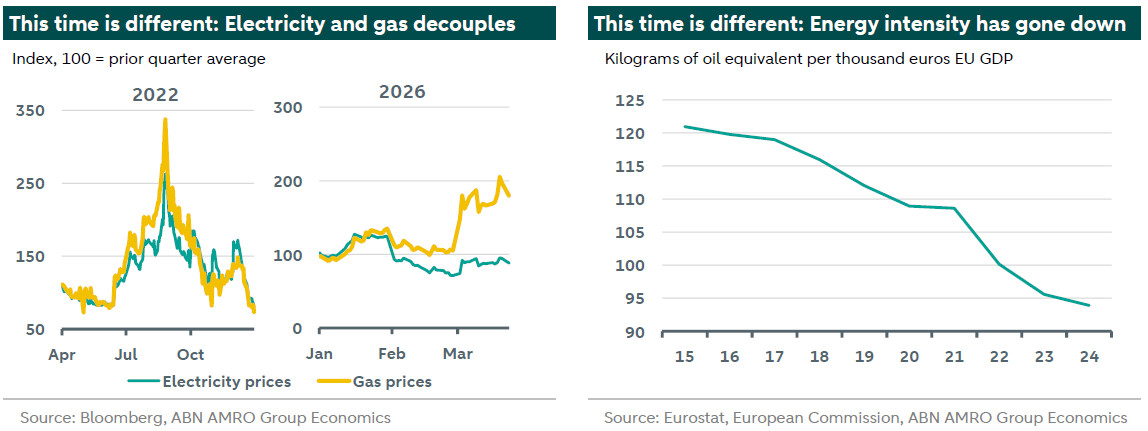
While growth is weaker than in our prior base case, we note that the shock is much smaller than the 2022-23 energy crisis, when the economy stagnated for five quarters. There are three reasons for this. First, the sheer magnitude of the price shock (even in a negative scenario, see chart above) is much smaller and less broad-based [Jv5] [BD6] than in the previous crisis, with inflation set to peak at around 3.5% compared with the double digits we saw in 2022. Part of the reason for this is that the gas price shock is having a much smaller impact on electricity prices this time around, thanks largely to Europe’s renewables buildout – although the extent of the gas price decoupling varies considerably per country (see this month’s Eurozone). This means the real income shock and the knock-on hit to consumption is also much lower. The second reason the growth hit is likely much lower is that there is less scope for pain in energy-intensive industry than in 2022-23. Back then, there was a significant adjustment following the energy crisis, with much of it either closing/relocating or adapting to become more energy efficient. This led to a sharp decline in the energy intensity of GDP in the years following the crisis (see chart below). Third, the extent of the monetary policy response is also much lower. Then, the ECB raised rates by 450bp in a little over a year, the ECB’s steepest policy tightening on record. Now, the ECB is expected to raise rates by only 50bp, and even in a negative inflation scenario, by just 100bp.
US & Fed
On the US side, we predominantly see an inflation impact. Changes to our growth forecasts are concentrated in the first quarter, and are largely based on incoming data, rather than the energy shock. The new inflation impulse adds to still elevated inflation which we expected to persist throughout the year. At the same time, if one worries about second round effects, it is relatively benign excess inflation in the sense that it is mostly supply driven; mechanical through tariffs and more fundamentally because of tightness in certain labour markets due to immigration policy. There is a demand-driven component, but it is quite narrow and mostly associated with the AI buildout. Upper income households, supported by wealth effects, also provide some demand pressure. The current constellation therefore presents a completely different background from the set of circumstances that allowed for the post-pandemic inflation wave, and we have limited concern about inflation escalating out of control. We believe the Fed will settle on a similar conclusion, meaning that we do not think the Fed will raise rates in response, but rather responds passively by holding the current, marginally restrictive, policy rate for longer. There are two wildcards. The first is the change of the guard at the Fed, and the second is the potential for broad fiscal support in anticipation of the midterms. We think incoming Fed Chair Warsh will not drastically alter the FOMC’s charted course, which will not see any room for easing in the near term. At the same time, the Fed will also likely refrain from hiking, because of a limited need, and a fear that a severe tightening of financial conditions could trigger a sharp downturn in activity. Wider fiscal support has the potential to create the demand that might accelerate inflation beyond our base case, and could be a catalyst for inflation expectations de-anchoring. In such a scenario, the risk to both inflation and policy rates is tilted to the upside. (Nick Kounis, Bill Diviney, Rogier Quaedvlieg)
[1] We note however that fertiliser is but one of many inputs into food production costs, making up 5-15% of the final retail price. Moreover, a big reason for the food inflation surge of 2022-23 was a shortage of agri food commodities such as sunflower oil and wheat out of Ukraine. We do not face such shortages this time around.