NGEU - related growth at risk of undershooting

The EU remains the single largest issuer in the euro SSA market, having placed more than EUR 160bn in bonds in 2025 and expected to raise another EUR 90bn in the first half of 2026 alone. The core of this issuance has been under the NextGeneration EU (NGEU) programme, with its main instrument being the Recovery and Resilience Facility (RRF). The NGEU was launched in 2021 to provide support following the Covid-19 pandemic, and is now approaching its final year. In fact, all disbursements under the RRF must occur before the year-end, with payment requests by Member States having to be submitted before 31st of August 2026. On the back of this, this note examines RRF fund spending patterns and its effect on GDP by addressing five main questions: 1. How do RRF disbursements stack up against total envelopes? 2. Are Member States expected to receive the remaining funds before the 2026 deadline? 3. Are Member States on track for spending the already received RRF funds? 4. How have EU Member States spent the RRF funds? 5. What will be the impact on growth if EU countries do not fulfil all of their investment plans?


Giovanni Gentile
Fixed Income Strategist
Disbursements under the Recovery and Resilience Facility (RRF) are lagging, even as the total envelope size has significantly decreased since last year
RRF disbursements are conditional: Member States can access RRF funds only after meeting pre-defined milestones and targets…
…But some countries are lagging on their progress towards achieving these milestones and targets
In fact, for some countries, the disbursement rate of funds exceed the share of milestone/targets achieved
Despite the question on whether all RRF funds will be disbursed before the deadline, the bigger bottleneck remains on spending
Across the EU, only about 46% of received funds have been spent on average; with several large beneficiaries (notably Spain, Portugal, Belgium, Italy) lagging behind
Most spending has taken place in the form of capital transfers, which have a lower GDP multiplier
Furthermore, most countries directed investments towards building renovations and railway construction, implying a smaller impact on growth
The GDP growth impact of the RRF funds is highly conditional on disbursement and spending composition
Hence, low disbursement rates, delayed spending and the composition of expenditures raise the risk that the boost on GDP growth attributed to the RRF might, in fact, be somewhat overstated
1. How do RRF disbursements stack up against total envelopes?
As highlighted in our 2026 SSA outlook (see ), disbursements under the Recovery and Resilience Facility (RRF) have continued to lag expectations. The RRF envelope originally stood at EUR 651bn, composed of EUR 360bn in grants and EUR 291bn in loans. By the end of January this year, the total RRF purse had been reduced to EUR 577bn: the grant component was kept flat at EUR 360bn, while the loan envelope decreased by over 25% to EUR 217bn after eight Member States de‑committed around EUR 74bn. These Member States include the likes of Belgium, Spain, Portugal.
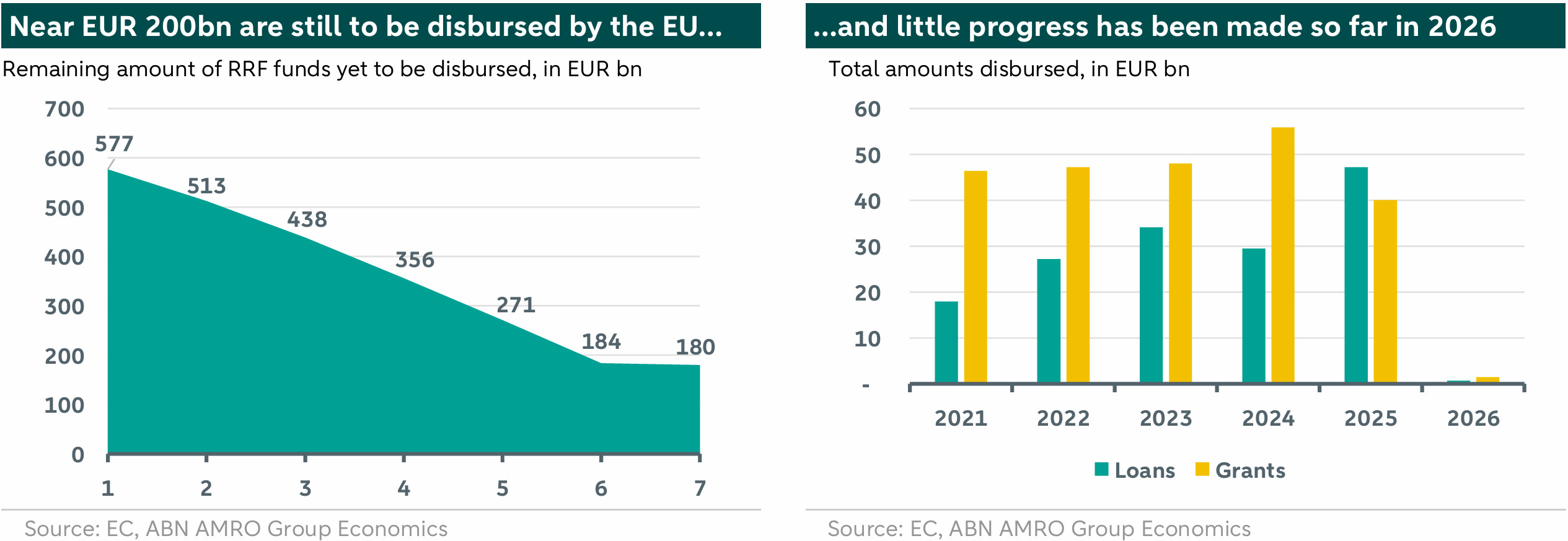
So far, EUR 240bn in grants has been requested and disbursed since the inception of the programme, roughly 67% of the total grant envelope. The picture for loans is similar: EUR 157bn have been paid out to date (~72% of total new loan envelope of EUR 217bn). This leaves altogether EUR 180bn in loans and grants that still need to be disbursed before the end of this year: EUR 120bn in grants and EUR 60bn in loans. Disbursements typically take place later in the year, which helps explain why they have been so low so far in 2026, as the top right chart suggests.
All in all, momentum is not encouraging. Loan disbursements did accelerate in 2025, EUR 47bn versus EUR 29bn in 2024, but grants moved in the opposite direction. Only EUR 40bn in grants were released last year, down from EUR 56bn in 2024.
2. Are Member States expected to receive the remaining funds before the deadline?
The RRF was designed as a fundamentally performance‑based instrument. Hence, Member States must demonstrate tangible progress by achieving pre‑defined milestones and targets before grants and loans can be disbursed. Access to funding is therefore conditional, and financial support is directly linked to the implementation of reforms and investments outlined by each country.
Against this backdrop, in order to assess whether Member States will be able to request all available funds under the envelope before the August 2026 deadline, it is noteworthy to look at how advanced Member States are in achieving such pre-defined milestones and targets. As of the end of January 2026, more than half of all milestones and targets have already been assessed as fulfilled on average across all seventeen countries. France stands out as the most efficient implementer, with close to 83% of its milestones and targets completed. Among the largest beneficiaries of the Facility, Italy has made the most progress, with 64% completed (see left chart below). These figures point to a broadly positive implementation dynamic across the Union, particularly among countries with sizable allocations.
While there has been progress, it is not yet near the 100% required to be achieved by August 2026 so that all RRF envelopes can be fully disbursed. This raises the question of whether Member States will be able to achieve those milestones and targets in time to receive all funds. However, while all targets and milestones need to be met before August 2026, the EC emphasizes progress rather than final outcomes. More specifically, the commission defines milestones and targets as “measures of progress towards the achievement of a reform or an investment”. In this sense, milestones and targets capture steps in a reform or investment process, rather than the achievement of results. This distinction implies that formal compliance with milestones does not necessarily equate to completed reforms or fully operational investments.
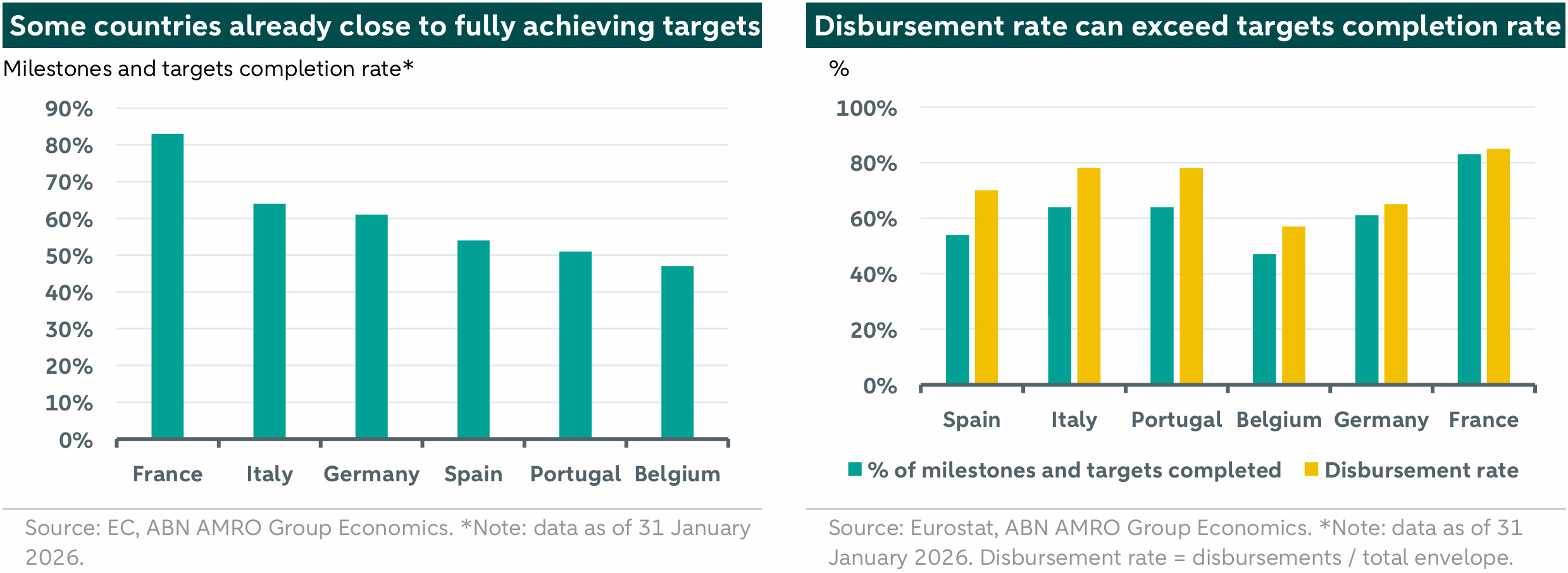
This conceptual gap becomes particularly relevant when looking at the relation between disbursements and implementation. In practice, some Member States have received more funds than what their completed milestones and targets would strictly imply. This is notably the case for Italy, Spain, and Portugal (see right chart above). Italy provides the most striking example: its final payment request depends on the completion of a number of milestones and targets that is almost three times higher than the average number attached to each payment request in its plan. This front‑loading of disbursements, combined with a heavier concentration of milestones toward later stages, raises execution risks and increases the importance of timely delivery in the final phase of the programme.
Additional to that, while the achievement of milestones and targets is a pre-requisite for both grants and loans, there is a prioritization of grants over loans as the RRF nears its completion.
This means that Member States would prefer to exhaust the grant envelope before moving on to loans. Indeed, in an update published last June, the EC itself encouraged Member States to ramp up grants request and prioritise them over loans. This explains why the disbursement of grants has been quicker than that of loans. Going forward, we expect that all grants will be disbursed, including those to the Netherlands and Hungary, which have seen recent political change which will most likely enable reforms and the subsequent disbursement of funds.
As for loans, there are additional reasons for why requests have lagged behind compared to grants. First, cost of funding is a key element. Countries such as Germany, Netherlands and Austria, can borrow more cheaply by issuing government bonds rather than requesting loans from the EU. This is also true for countries such as Spain, which has seen its curve tighten to that of the EU and where yields in the long end are lower compared to that of the EU, weakening the demand for loans (indeed, loan amounts allocated to Spain have been de-committed recently, as mentioned above). However, the disbursement of loans has been slow even for countries such as France and Belgium, where bond yields trade above the EU curve. This could be due to the administrative costs and strict conditionality of the loan. In theory, these countries could receive cheaper funding, but at stricter conditionality, which make the premium they would pay funding themselves relatively cheaper than the administrative costs. Moreover, the loans disbursed by the EU are to stay on the balance sheet of the Member States, meaning it would add up to the member state’s sovereign debt, the same as if they would borrow themselves.
As such, while we remain optimistic on grant disbursement, we do not expect the entire loan envelope to be disbursed before the August 2026 deadline. The EC itself has urged Member States to prioritize grants over loans given the “limited capacity to complete all projects and reforms before the August 2026 deadline” (see ). Hence, we expect that only around EUR 10bn of loans will be disbursed this year, leaving EUR 50bn on the table compared to the total loan envelope. Hence, the total of disbursements in 2026 will be around EUR 110bn, meaning that a combined EUR 70bn (EUR 20bn in grants and EUR 50bn in loans) will fail to be disbursed.
3. Are Member States on track for spending the already received RRF funds?
Beyond questions of formal compliance with milestones and targets, another key issue emerging from the implementation of RRF is the growing gap between funds transferred by the EC and actual spending on the ground. While disbursements have progressed at a relatively rapid pace, the spending and execution of these resources by Member States has been markedly slower, highlighting capacity constraints and implementation bottlenecks at the national level.
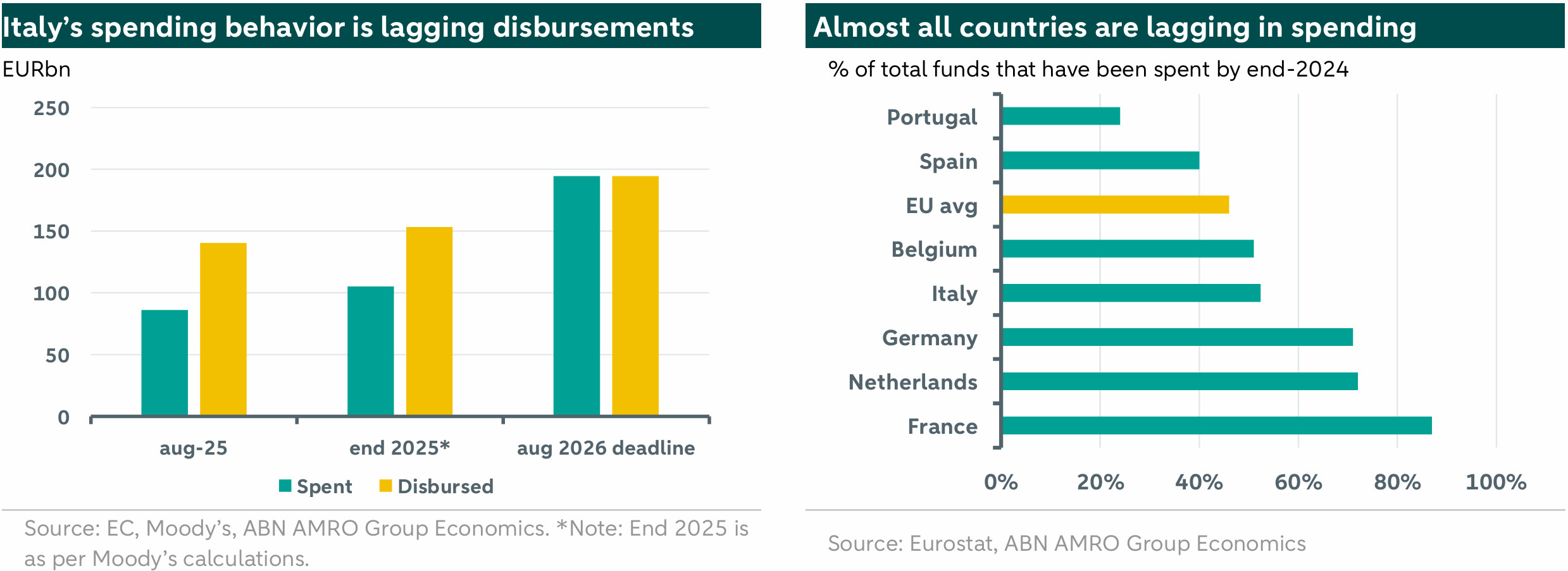
On average, cumulative expenditure across the EU amounts to only around 46% of total funds received (see right chart below). Several large beneficiaries stand out as clear laggards in terms of spending, most notably Spain, Portugal, Belgium, and Italy. These countries have spent significantly less than half of the resources already transferred to them, despite having secured substantial pre‑financing and interim payments. In contrast, France emerges as a clear outlier: by the end of 2024, it had already spent around 83% of all RRF funds received, suggesting a markedly stronger execution capacity and a more effective translation of EU inflows into actual investment and reform spending.
Italy’s case is particularly illustrative of the broader mismatch between transfers and expenditure. By August 2025, Italy had spent approximately EUR 86bn out of the EUR 140bn received, corresponding to a spending rate of about 61%. While this already placed Italy above the EU average, it still implied that a sizable share of funds remained idle. According to Moody’s estimates, spending picked up somewhat toward the end of 2025, rising to around EUR 105bn against total receipts of EUR 153.2bn. This represents a moderate improvement in the spending rate to roughly 69%, but still leaves a significant gap between disbursements and effective use of resources. Still, there is a EUR 89bn gap between what was calculated to has been spent by end of 2024 and how much needs to be spent to fully use all funds under the envelope. This implies that the pace of expenditure will need to pick up during 2026 to make full use of the RRF resources and maximise the economic growth impact. We think inflationary pressures and unstable market conditions are perhaps likely reasons for why spending has lagged. These factors create bottlenecks in sectors such as construction, to which a large part of the loans are directed to, meaning the economic feasibility of these projects might be declining. With also less projects in the pipeline, there is also a lower need for loans, linking back to our previous section on why RRF loan disbursements have lagged across the EU.
Taken together, these figures show that the main challenge for the RRF now is not only the approval and disbursement of funds, but also spending them quickly and efficiently. As payment deadlines approach, countries with large unspent balances—especially those that received funds early—must speed up execution. Delays could hurt the programme’s economic impact and force investment into a shorter period, reducing efficiency and long-term results.
4. How have EU Member States spent the RRF funds?
An important dimension of the economic impact of the RRF is not just how much funding has been deployed, but how it has been used. We start first by looking at the tool used for the investments deployed using RRF funds, before moving into examining the type of projects financed.
On the former, we make the distinction between mainly four type of investments. These are: gross fixed capital formation, capital transfers, current expenditure, and the category “others”, which refers to any investment that does not fit into the first three categories. Investments deployed in the form of gross fixed capital formation refers to direct investment activity undertaken by general government itself, whereas capital transfers mainly consist of investment grants paid to entities outside government—such as firms or households—to finance their own investment projects. Current expenditures, on the other hand, refer mainly to ongoing, day-to-day government costs that are not in the form of capital investments.
These differences matter for growth outcomes. Fixed capital formation tends to generate an immediate demand impulse, particularly in construction and capital goods sectors. As a result, the GDP multiplier for public investment is generally higher, typically estimated in the range of 1 to 2.5x, depending on the cyclical position of the economy and country‑specific conditions. Capital transfers, by contrast, are associated with lower and more uncertain multipliers. Their macroeconomic impact ultimately depends on how private recipients deploy the funds, whether the investment is genuinely additional, and how quickly it materialises. For example, when a company receives support to invest in renewable energy, the growth effect hinges on whether the project would have gone ahead anyway and on the speed with which spending feeds through to activity.
The weakest economic impulse typically comes from current expenditure, which under the RRF largely includes training programmes, subsidies, and operational spending. These items tend to have multipliers below one, reflecting their more limited capacity to generate sustained increases in productive capacity or private‑sector spillovers. As a result, the overall growth impact of RRF funds depends crucially on the balance between these different spending channels.
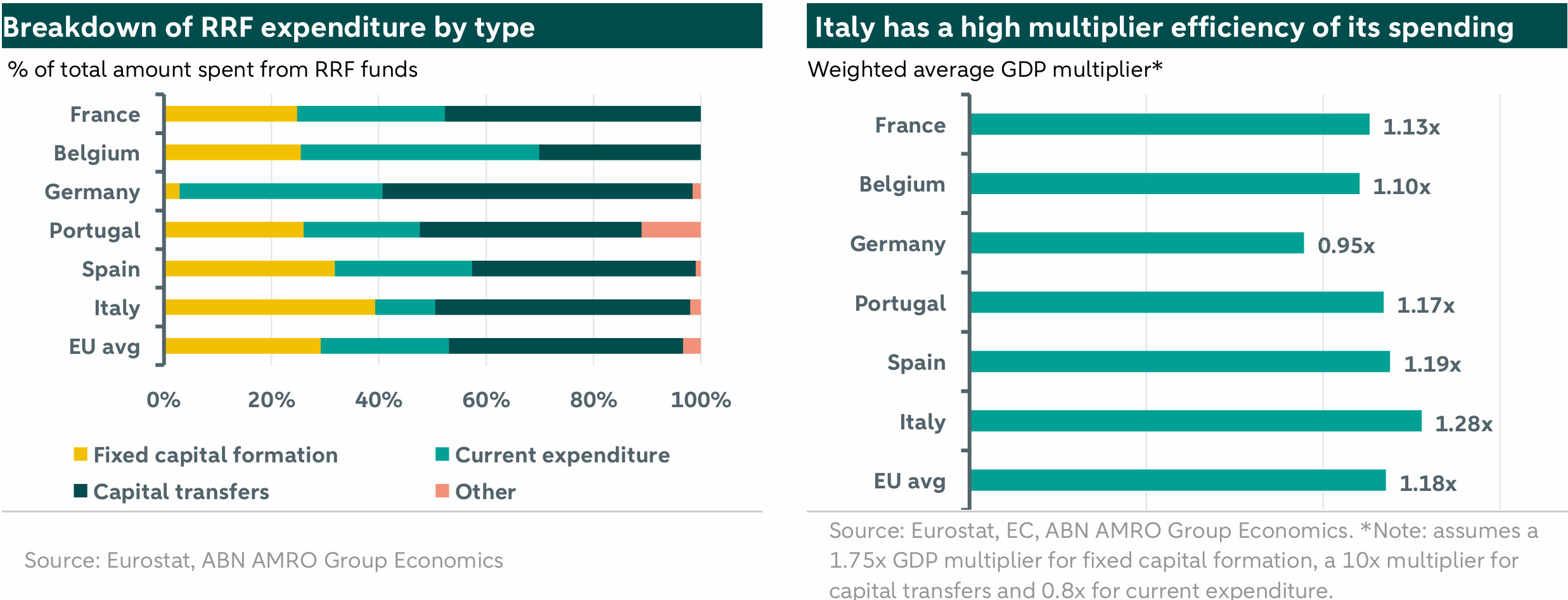
Across the EU, the majority of the funds received under the RRF have been channelled through capital‑related spending. On average, around 40% of the funds have taken the form of capital transfers, while roughly 30% have been spent as gross fixed capital formation. Only 24% has been allocated to current expenditure, the investment with the lowest GDP multiplier. However, there are significant cross‑country differences. For example, Germany stands out with an exceptionally low share of RRF resources allocated to gross fixed capital formation—only around 3% (see left chart below). Belgium and France also devote a relatively modest share to this category, at roughly 25% each. However, Belgium has a significant share (44%) in the form of current expenditures, significantly above the EU’s average. Both Italy and Spain stand out as countries with the largest share of RRF funds deployed in the form of fixed capital formation and capital transfer. That also implies that, for these two countries, the spending amount adjusted for the GDP multiplier is significantly higher than for other countries (see right chart below).
Looking beyond spending by form of investment, we move now to analyse the nature of the projects themselves. Unfortunately, there is no data available regarding the actual expenditures by project. The available information covers only the projects proposed by Member States in their national plans. As such, the sum of all these proposed investments equal the allocation of the total RRF envelope, rather than the realised or disbursed spending.
Spain’s RRF programme is characterised by a highly diversified sectoral allocation, with funds spread relatively evenly across different areas. Italy’s approach is more concentrated, with a strong emphasis on building renovation—expected to account for around 24% of total RRF envelope—followed by railway construction, which represents roughly 12% (see left chart below). This composition implies differing timelines and transmission mechanisms. For example, the OECD estimates that in the short-term, infrastructure investments have a slightly higher GDP multiplier than investments in low-carbon technology, such as renewable energy and energy efficient solutions (see ). These difference however tends to increase over the years, reaching 1.7x for infrastructure over 20 years compared to 1x for low-carbon technologies.
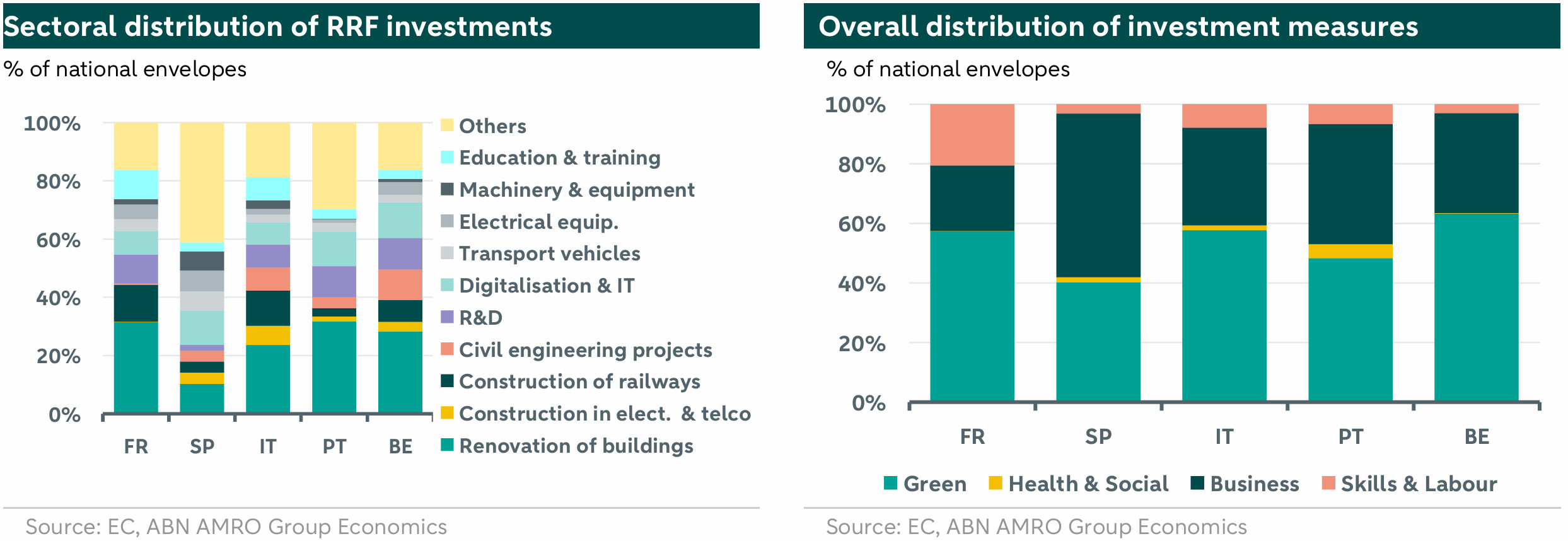
For illustrative purposes, we regrouped these projects into four broad objectives: green, business, health and social, and skills and labour. Measured along these lines, most countries in the sample focus predominantly on green‑related investments. Spain again stands as an exception, allocating the majority of its planned investments—around 55%—to business‑related projects (see right chart above).
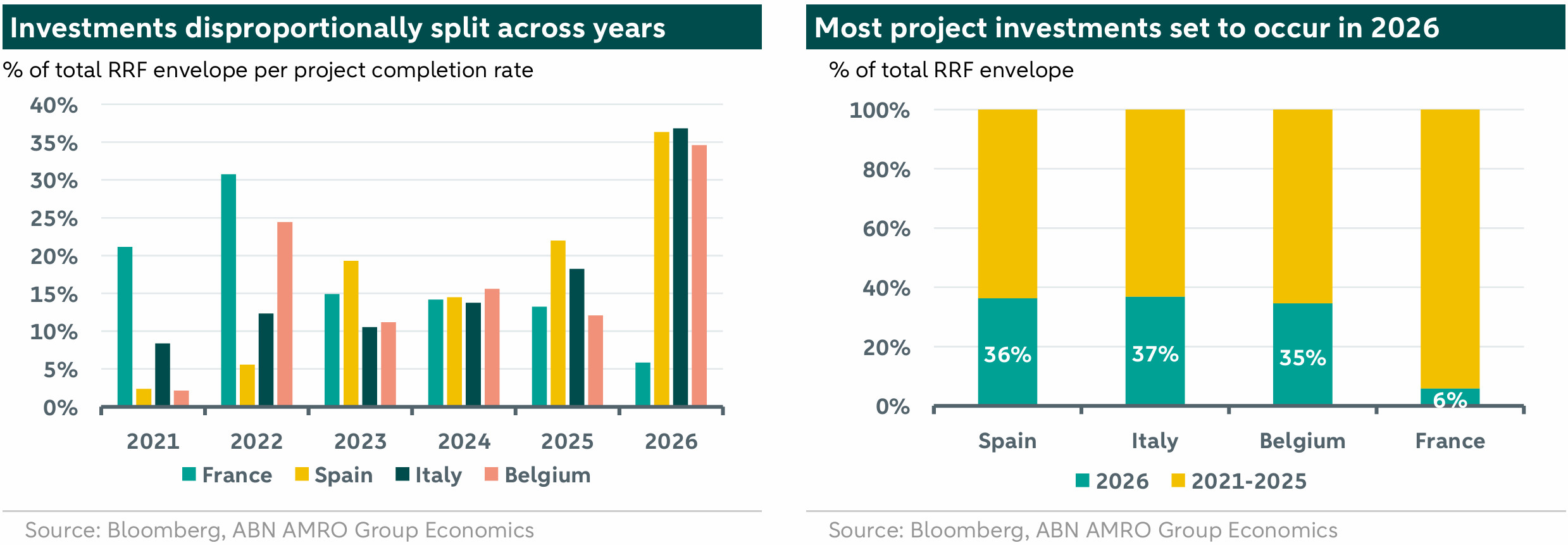
The same database also provides insights related to each proposed project’s completion. Interestingly, Spain, Belgium and Italy are expected to deploy most of their investments in 2026 (see left charts). On average, around one third of the investments would need to take place in 2026. That could help explain why there is so far a lag between funds received and funds spent. Nevertheless, should disbursements not pick-up in the coming months, this also brings into question the ability of these countries to deliver on these projects that are so relevant to boost GDP growth.
Taken together, these patterns help explain why the short‑term growth impact of the RRF has varied across countries and may remain uneven going forward. The balance between direct public investment, transfers to private actors, and current spending—as well as the sectoral focus of projects—plays a decisive role in shaping both the size and the timing of the economic benefits from the programme.
5. What will be the impact on growth if EU countries do not fulfill all of their investment plans?
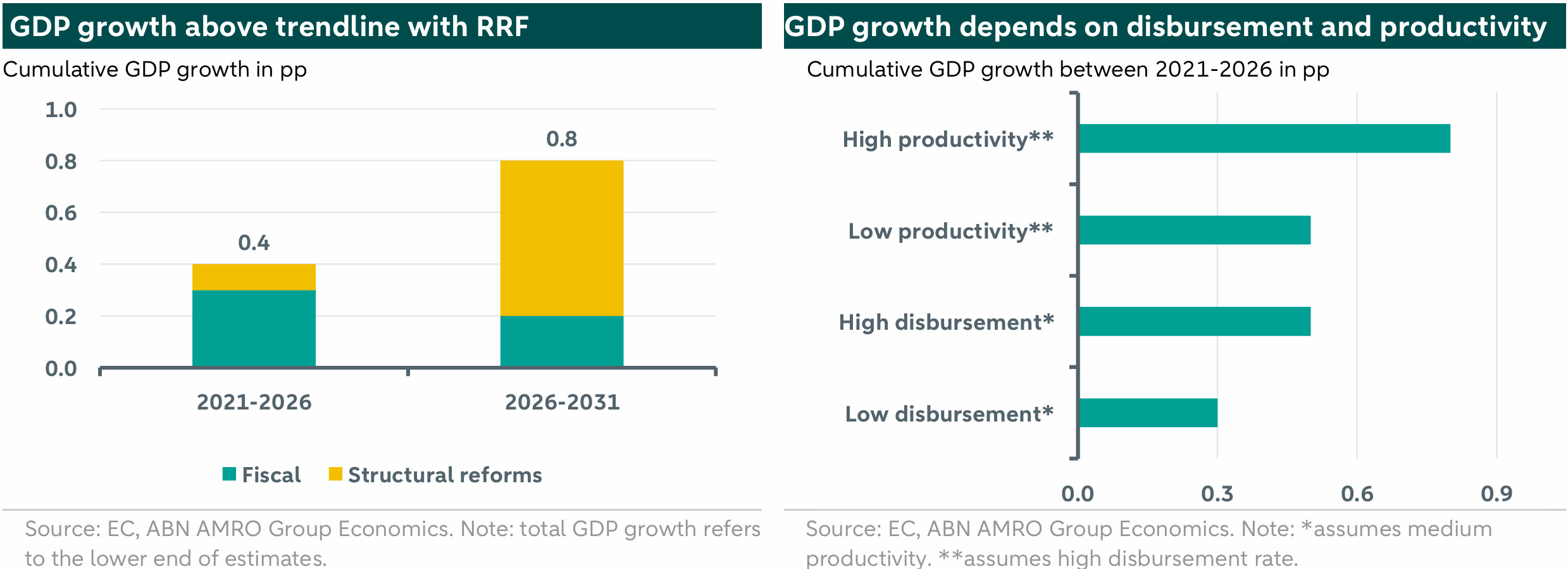
It is hard to separate how much of the GDP growth across EU Member States between 2020-2025 came from the funds deployed by the RFF. The EC estimates that the impact of the programme on the level of GDP could range between 0.4% and 0.9% above the non-programme baseline by 2026, with gains increasing to 0.8-1.2% up to 2031 (see ). More specifically, up to 2026, most of the GDP growth comes from fiscal measures (ca. 75% of all GDP growth), while the growth will be mostly driven by structural reforms between 2026 and 2031 (see left chart below). Effects are particularly pronounced in the main beneficiary countries, including Italy and Spain, where gains are two to three times higher than for the euro area average. Furthermore, the impact on GDP growth varies according to productivity levels and fund disbursement rates (that is, disbursements relative to total envelope). For example, a scenario with low disbursement rates of RRF funds would drive cumulative EU GDP growth between 2021-2026 of only 0.3% compared to 0.5% in a high disbursement rate scenario. Likewise, higher productivity could increase GDP growth by 0.3pp.
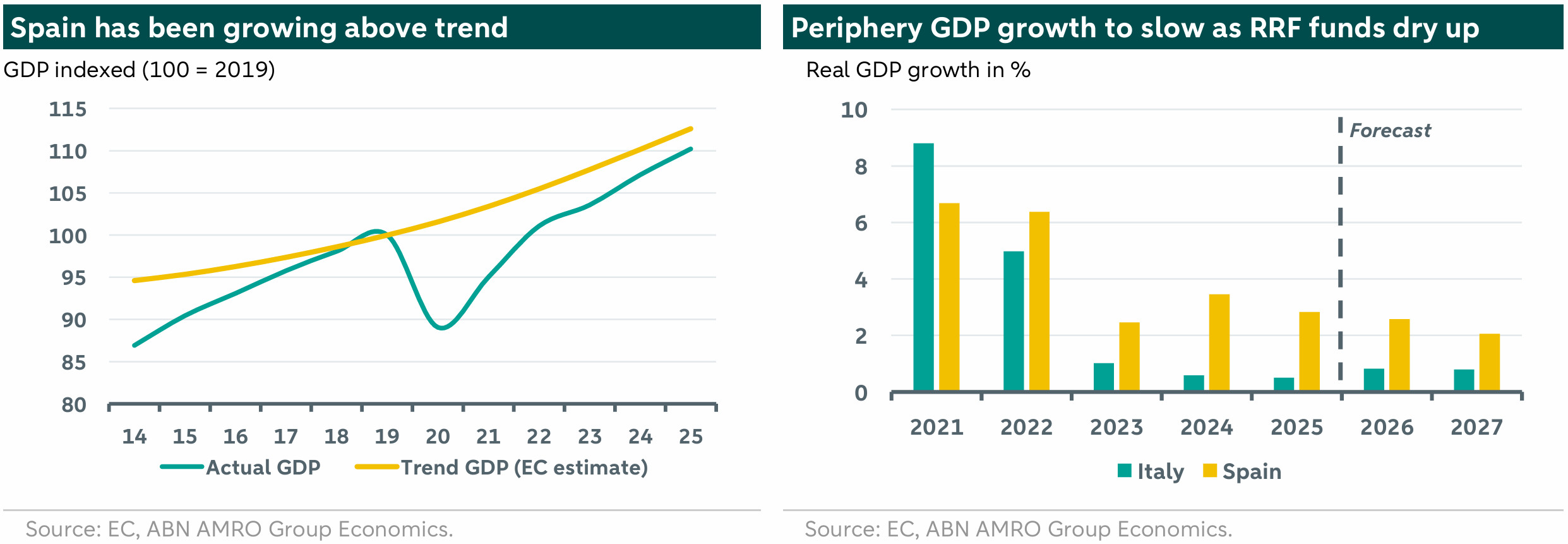
Indeed, periphery countries, as main beneficiaries of the RRF funds, have continued to outperform the core. That is particularly the case for Spain, which continues to grow at a well above trend pace. The EC estimates that 1.4pp of the cumulative GDP growth between 2021-2026 for Spain was driven by the continued RRF disbursements (see ). That would imply that, on average, Spain’s annual economic growth would have been 0.2pp lower without the tailwinds provided by the RRF. This seems small considering the average ~3.8% annual GDP growth between 2021-2026, though note this average is boosted by the exceptionally strong post-pandemic recovery period (see chart below). With that said, underlying growth of southern European countries (i.e. despite the boost provided by the RRF funds) has also been strong as these countries have been better positioned to benefit from the sectors seeing the strongest growth in the last few years, namely tourism, and services more broadly.
Looking ahead, our economists expect growth in the periphery to slow as RRF spending dries up, and this explains the growth dip that we expect in 2027 (see right chart below). Our base case already assumes that not all remaining funds are disbursed, but there is naturally uncertainty for the periods in Q3-Q4 26 when the RRF is projected to end. There is also the possibility that remaining funds that have not been disbursed under the RRF are repurposed for other means, which is something we flagged in our eurozone outlook. This could take the form of defence investments, or the energy transition in light of the global energy shock. Indeed, on the back of the recently announced AccelerateEU strategy aimed at implementing measures to reduce EU’s dependency on fossil fuels, EU leaders are discussing the possibility of repurposing available RRF funds towards energy security measures (see and ). This could theoretically extend the growth support of the RRF beyond the current projected end in the second half of 2026.
Conclusion
Overall, the RRF has had a meaningful macroeconomic impact across many Member States, with effects particularly pronounced in Italy and Spain. However, the extent of economic growth provided by the RRF depends not only amounts disbursed, but also on how quickly they are spent, in what form they are deployed, and the type of investment made. To date, both Italy and Spain have lagged on spending: Italy is expected to have spent only 69% of the funds received by the RRF at end of 2025. Most project investments are planned for 2026, but continued slow rates of fund distribution and spending may result in many projects lacking sufficient funding, which could hinder growth. With rising interest rates, a weak economic expansion might worsen debt and fiscal issues, further impacting sovereign bond spreads.
At the EU level, issuance is set to remain elevated. The EUR 90bn Ukraine loan, alongside defence-related initiatives such as SAFE, will continue to support high issuance volumes in capital markets. This comes at a time when refinancing needs are also rising, with 2026 marking the first year of substantial redemptions, at around EUR 40bn.
We will publish separate notes examining in more detail the end of the NGEU and its implications for country spreads, as well as the outlook for EU funding needs and EU bond spreads.