Rates Strategist - France: More than fundamentals priced-in

Current OAT-Bund spreads imply investors are pricing more than just a severe deterioration in France's fiscal outlook, as evidenced by the sharp rise in the OAT-CDS basis. We create a measure for the portion of OAT-Bund spreads that cannot be explained by (1) common euro-area factors, (2) broader rates volatility and (3) sovereign credit risk, including fiscal sustainability concerns. We show that this unexplained spread component has increased sharply and remained elevated since the June 2024 political shock, marking a persistent shift in France’s spread regime rather than a short-lived market dislocation. Absent a credible catalyst, OAT-Bund spreads are likely to remain in the 130-150bp range, while partial progress to reduce political uncertainty could bring them towards 120-130bp and a return to the post-June 2024 regime consistent with spreads around 105-115bp.


Alejandro Leiva
Rates Strategist Intern
Introduction
French government bond spreads have risen to record highs, raising questions about what markets are pricing and how much further the move could go. In this note, we examine the forces behind the widening in OAT–Bund spreads and the conditions that could shape their next move.
What is priced in by markets?
A useful starting point is to compare current market pricing with France's underlying fiscal outlook. Academic research has shown that, all else equal, elections in highly indebted countries tend to push spreads up by around 25bps on average (see ). Correcting for this uncertainty premium, we can back calculate the debt/GDP and interest/GDP ratios currently implied by OAT-Bund spreads. As shown in the charts below, markets seem to be implying a debt and interest ratio levels of around 140% and 3.7%, respectively - a level much higher than forecasted by the EC (see ). Credit ratings are also closely linked to governments' interest burden, and an interest expenditure ratio of 3.7% would historically be consistent with a sovereign rating in the A-/BBB+ range, several notches below France's current ratings. We note that the implied ratios should be interpreted as the levels markets may ultimately expect rather than a figure for 2027 specifically. However, given the fact that debt ratios are generally expected to evolve only gradually thereafter, EC’s 2027 debt ratio provide a reasonable proxy for fiscal dynamics that are ultimately reflected on bond spreads.
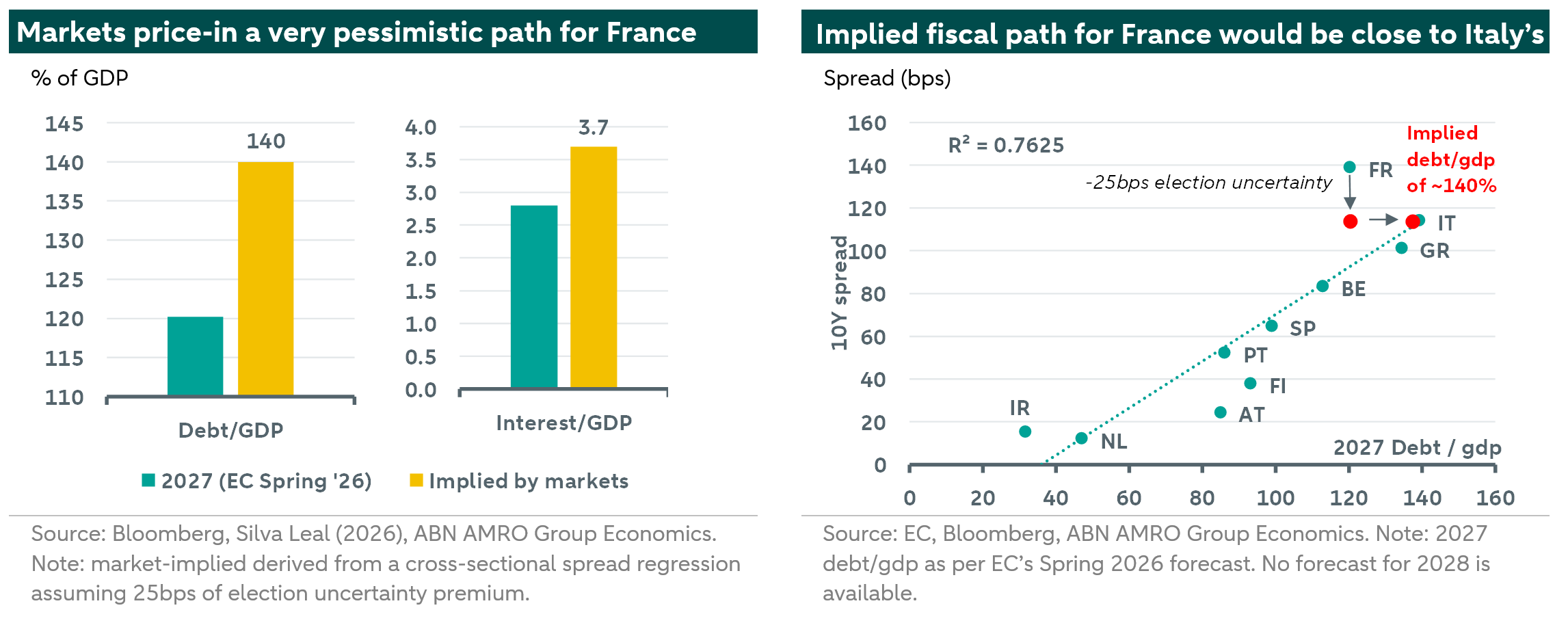
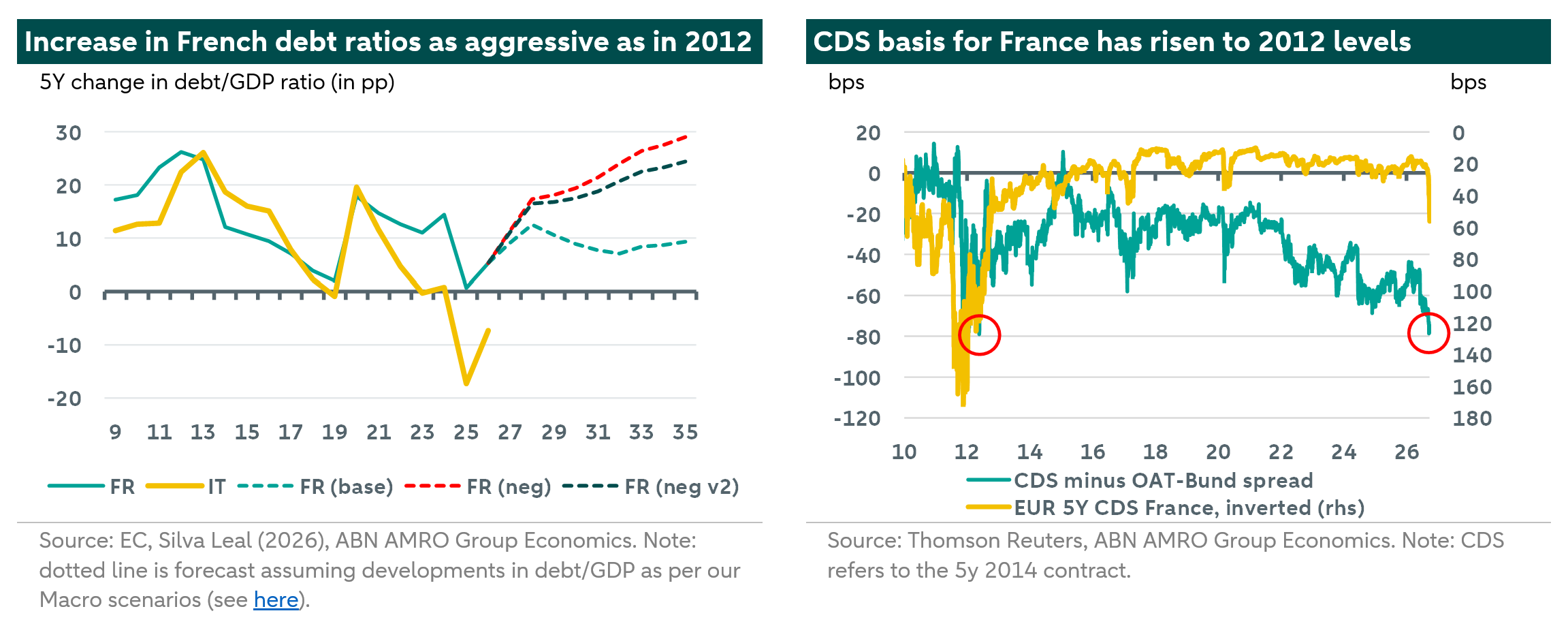
If French debt were to reach these levels, the deterioration in public finances would be comparable to that experienced by Italy during the sovereign debt crisis (see left chart below). In other words, current spreads appear to price a very severe fiscal scenario. Our economists believe that debt and interest burdens of this magnitude would only materialise under a significant downside scenario, and not before 2032, partly owing to France's relatively long average debt maturity (read our macro analysis on France here). Taken at face value, therefore, markets appear to be assigning a meaningful probability to a substantial deterioration in France's fiscal outlook.
However, this conclusion depends critically on the assumption that the uncertainty premium is limited to around 25bp. If investors are demanding a significantly larger premium for political and fiscal uncertainty, the implied deterioration in France's fiscal fundamentals becomes considerably less severe.
Less severe French fiscal deterioration visible in CDS markets
To assess whether markets are genuinely pricing a sharp deterioration in France's fiscal fundamentals, it is useful to compare developments in bond markets with those in sovereign CDS markets. Sovereign CDS spreads are widely viewed as a market-based measure of sovereign credit risk and are generally more directly linked to investors' assessment of fiscal sustainability and default risk than government bond spreads (see for example ). That is because bonds also capture a broader risk set of risk premia and market factors that are not captured by CDS markets, such as term premia, supply dynamics, investors preference towards durations and safe-asset demand, and so on.
Importantly, French euro 5Y CDS spreads have increased since 2024, indicating that investors are indeed pricing a deterioration in France's fiscal fundamentals (see right chart above). However, the magnitude of the move in CDS markets has been considerably smaller than in cash bond markets. This divergence is captured by the CDS-OAT spread basis, which has risen to levels last seen during the euro-area crisis. The fact that OAT-Bund spreads have widened much more sharply than CDS spreads suggests that while investors are pricing weaker fiscal fundamentals, they are also demanding an additional premium to hold French government bonds that cannot be fully explained by sovereign credit risk alone. Fiscal and political uncertainty and concerns about future bond supply are likely important drivers. This raises the possibility that current OAT-Bund spreads are pricing not only a deterioration in fundamentals, but also a sizeable component that is not present in the CDS market, such as political risk.
France’s unexplained spread component marks a regime shift
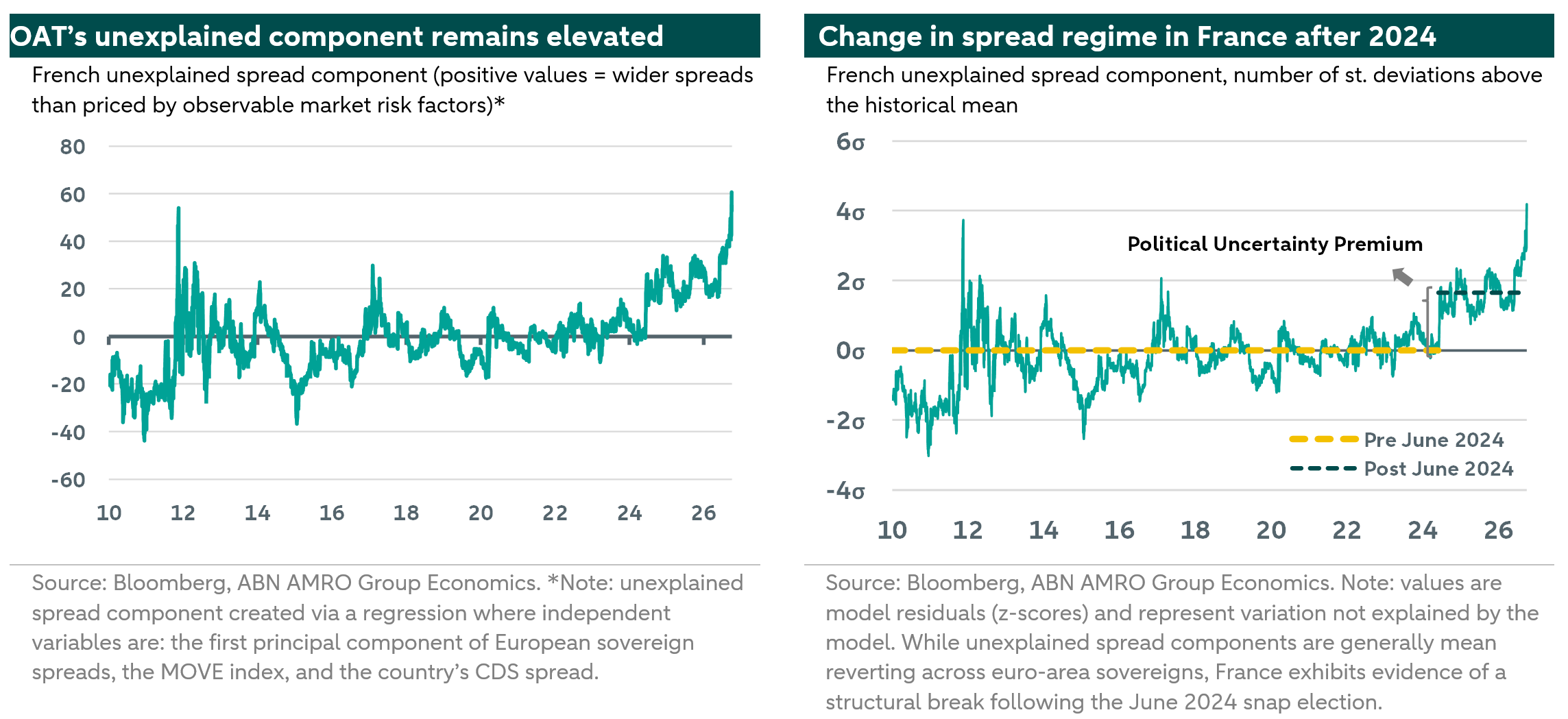
We therefore construct a measure to capture the portion of OAT-Bund spread widening that cannot be explained by (1) common euro-area factors, (2) broader rates volatility, as proxied by the MOVE Index, and (3) sovereign credit risk, as reflected in French CDS spreads. We refer to this residual as the "unexplained spread component". By construction, it captures the part of OAT-Bund spreads that is not explained by common sovereign factors, rates volatility or sovereign credit risk. It may reflect a range of influences, including political uncertainty, fiscal risks not yet fully priced through sovereign CDS markets, concerns about future bond issuance, investor positioning and liquidity conditions, among other factors. Positive values indicate that OAT-Bund spreads are trading wider than implied by these drivers, while negative values indicate the opposite.
As shown in the charts below, the unexplained spread component has risen sharply since 2024 and remains at historically elevated levels. More importantly, its persistence marks a clear break from previous episodes. Prior to the June 2024 political shock, deviations from fair value typically mean reverted relatively quickly. Since then, however, the unexplained spread component has shifted into a persistently higher regime, averaging around 1.5-2 standard deviations above its historical norm, equivalent to around 25bps. This magnitude is consistent with our previous assumption for an election uncertainty premium, as we discuss in page 1 (see also ). However, the unexplained spread component has recently widened significantly further beyond that point and now reaches around 4 standard deviations above its historical norm (or ~60bps). This suggests that investors are demanding compensation well in excess of that implied by observable market and credit fundamentals, as well as by the election-related uncertainty premia typically identified in the academic literature.
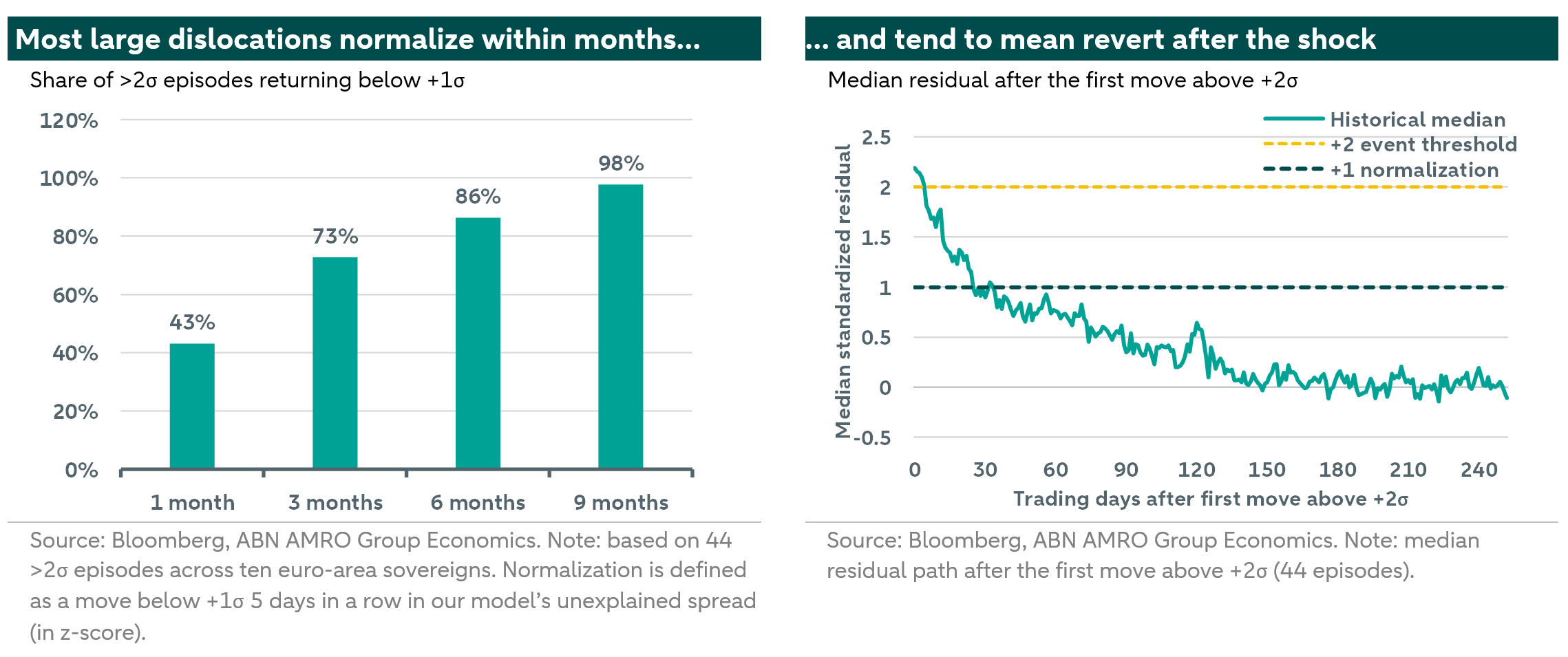
This naturally raises two questions: how long can this unexplained spread component remain so elevated, and could it rise even further? Historically, during episodes when the unexplained spread component of large euro-area sovereigns moved significantly higher, such dislocations tended to normalize quickly. Nearly half normalized within one month and almost all within nine months (see left chart below). Similarly, the right chart shows that following a move of more than 2 standard deviations, the median unexplained component typically falls back below 1 standard deviation within a matter of weeks and eventually converges towards zero.
France stands out as a clear exception. While elevated unexplained spread components across euro-area sovereigns have historically normalized relatively quickly, France's has remained elevated for almost 500 trading days, or nearly two years. This persistence is highly unusual by historical standards and suggests that the post-June 2024 regime shift remains firmly in place.
Putting a range around uncertainty, how high can spreads go?
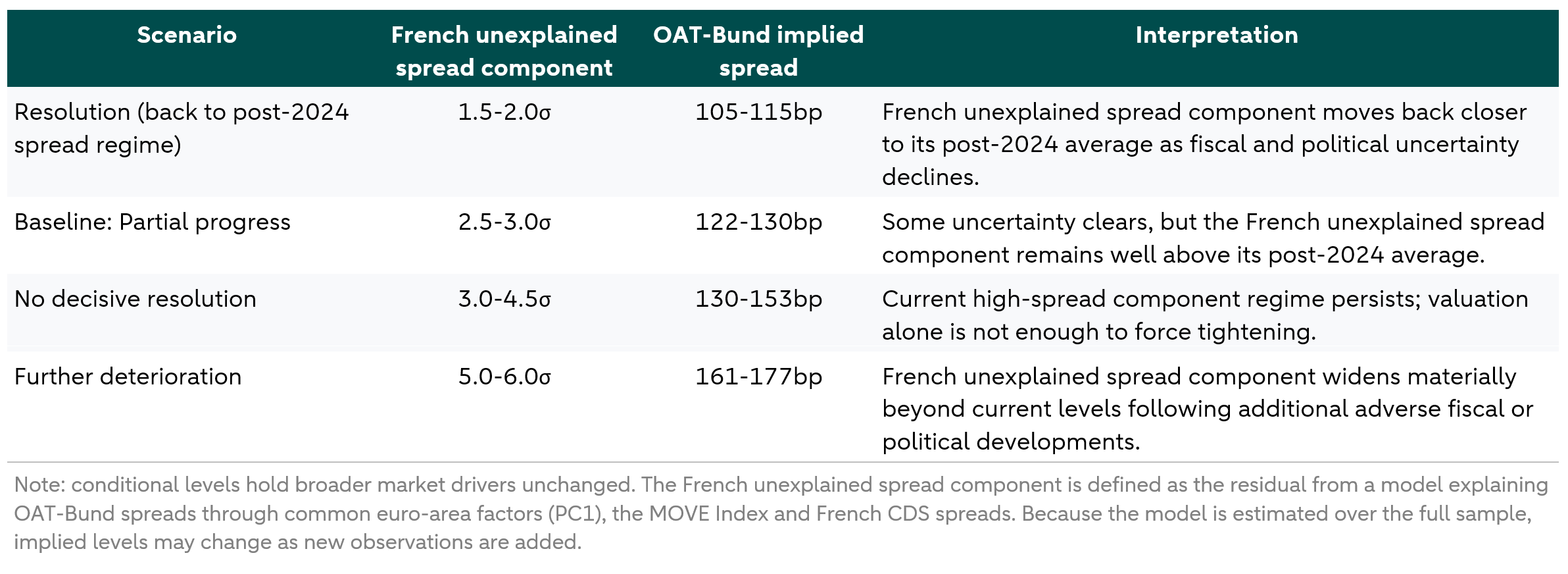
While it is difficult to predict when the unexplained component for French spreads might begin to compress, it is possible to quantify how OAT-Bund spreads could evolve under different scenarios for further widening or normalization of this component.
To illustrate the sensitivity of spreads to changes in the unexplained spread component, we hold all other drivers unchanged, including common euro-area factors, market volatility and CDS-implied sovereign credit risk, and vary only the France-specific unexplained spread component. Our baseline assumes that OAT-Bund spreads will at least continue to trade in the higher post-June 2024 regime until political uncertainty is fully resolved (this could extend beyond the 2027 Presidential elections, given the parliamentary fragmentation). Under this scenario, OAT-Bund spreads should remain anchored in a 105-115bp range. Without any further improvement in fiscal visibility and broader risk sentiment in France, OAT-Bund spreads could remain in a relatively elevated 130-150bp range. However, some progress that partially reduces uncertainty without fully resolving it could compress the unexplained spread component and bring spreads towards 120-130bp.
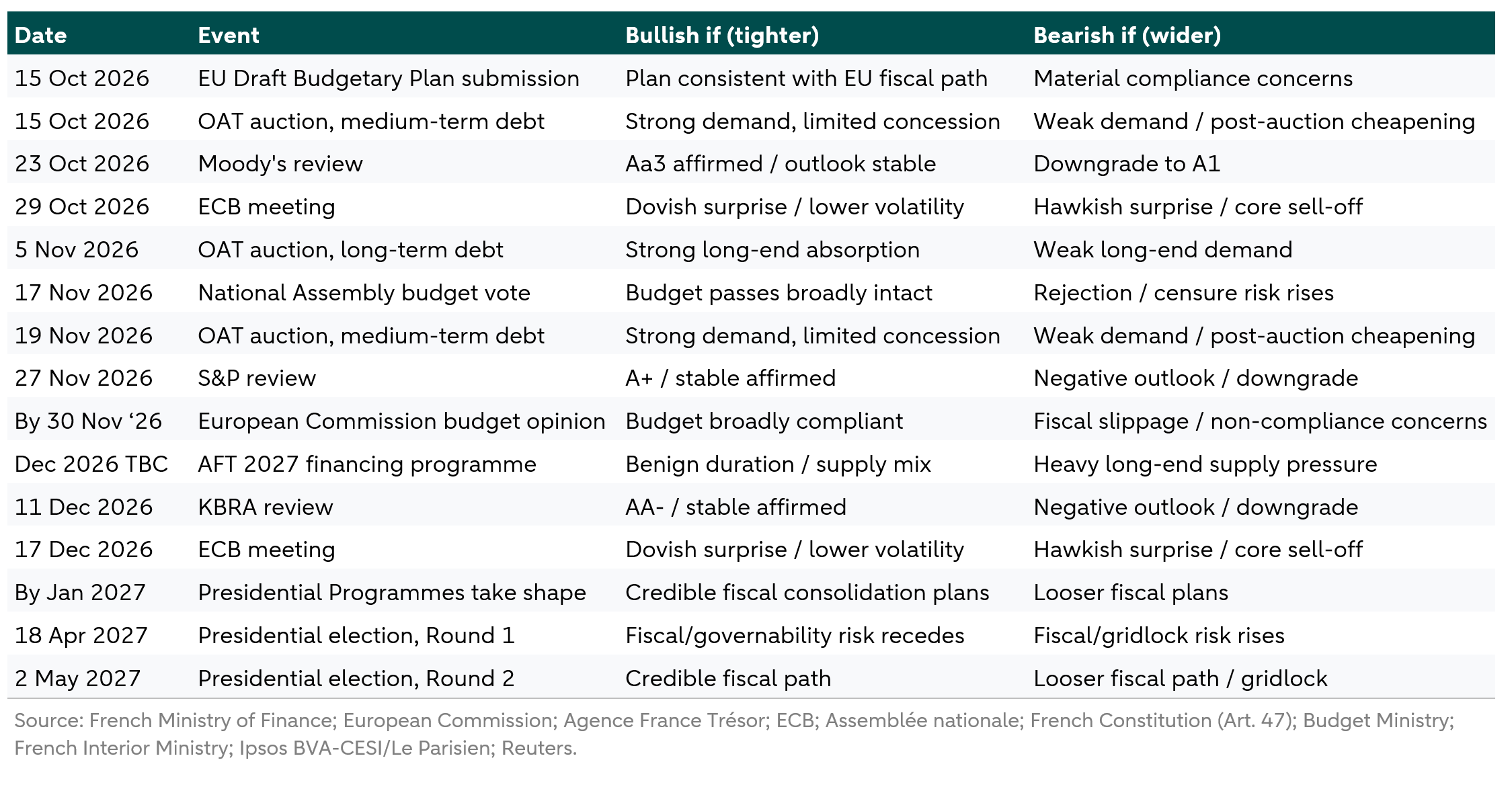
Historical evidence suggests that once the elevated unexplained spread component begin to unwind, the adjustment can be relatively swift. While we continue to expect eventual mean reversion, a sustained decline in the unexplained component will likely require a clear catalyst that reduces fiscal and political uncertainty. Until then, this component could remain elevated or widen further. The October-November budget and rating cycle represents the first meaningful test, and the appendix outlines the key upcoming events that investors should monitor and their potential implications for OAT-Bund spreads.
Importantly, these scenarios isolate the effect of changes in the unexplained spread component. An improvement in France's fiscal trajectory would likely also compress CDS spreads, generating additional tightening beyond the ranges shown above. Conversely, we do not expect OAT-Bund spreads to reach the 200bp+ levels seen during past Italian stress episodes, which were driven by euro-area tail risks that are largely absent today. As we will explore in an upcoming piece, those episodes were associated with a sharp increase in euro-area tail risks, including fragmentation and redenomination concerns, which are largely absent today.
Conclusion
Current OAT-Bund spreads already imply a substantial deterioration in France's fiscal outlook. However, sovereign CDS spreads, which are more closely linked to fiscal fundamentals and credit risk, have increased by significantly less than cash bond spreads. This divergence suggests that current OAT-Bund spread levels are pricing more than just weaker fundamentals.
The spread component not explained by common euro-area factors, rates volatility and French credit risk indicates that negative sentiment around France remained unusually elevated since the June 2024 political shock, indicating that investors continue to demand compensation for uncertainty surrounding the country’s fiscal trajectory, political outlook and future policy direction. Usually, this unexplained spread component normally mean reverts within months rather than years. Yet the French experience since 2024 shows that valuation alone is not enough to trigger such a reversal. In our view, a durable tightening in spreads will require visible progress in reducing fiscal and political uncertainty. Until then, spreads are likely to remain elevated, with further widening possible if uncertainty intensifies.
Appendix: Catalysts to watch in France in the coming months