Spotlight - A perfect storm for food inflation?

Food inflation remained contained in recent quarters, but leading indicators suggest upward pressures are building and we expect food inflation to start rising again towards the end of 2026 and into 2027. Heat and drought records were once again broken across the EU and the US, which is expected to put upward pressure on European food price. The impact of El Niño is likely to be more mixed. Our base case sees food price rises adding 0.5pp to eurozone HICP inflation at its peak by Q3 2027.


Food inflation has remained contained in recent quarters. This favourable picture is unlikely to persist, however. Leading indicators suggest that upward pressures are building, and we expect food inflation to start rising again towards the end of 2026 and into 2027. The increase is likely driven by higher agricultural commodity prices, (expected) weather-related disruptions, and renewed energy-related pressures. At the same time, several factors dampen the impact on food inflation. Global inventories remain ample, many firms are protected by existing energy contracts, and retailers appear reluctant to fully pass higher costs on to consumers.
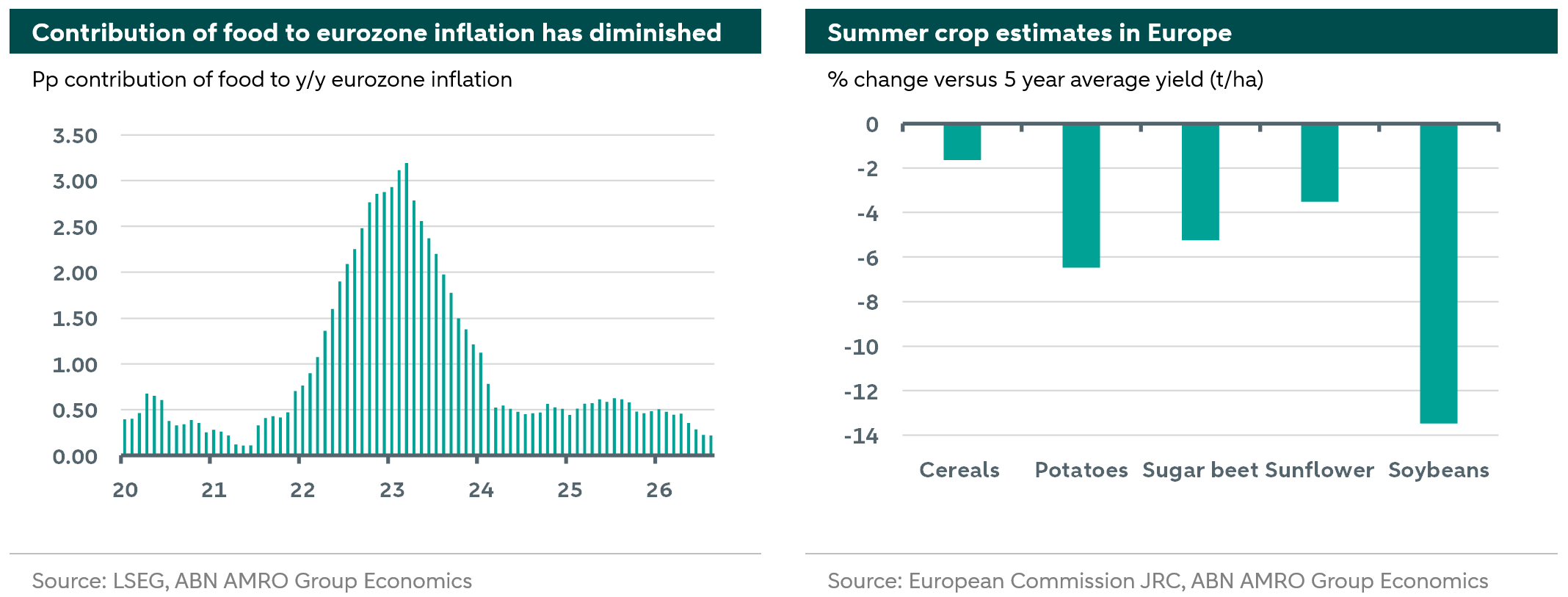
Food prices are driven by a broad range of factors. Agricultural commodities account for roughly 40% of food production costs for the EU, while the remaining 60% consists of factors such as labour, energy, transport and packaging [1]. Pressures have been building on both sides.
Weather-related developments can be an important driver of agricultural commodity prices. To begin with, this summer, heat and drought records were once again broken across the EU and the US, which is expected to put upward pressure on European food prices (see our earlier research notes on this here and here). The EU’s August crop forecasts (see ) show that yield expectations for summer crops have been sharply reduced, falling on average around 7% below the five-year average, although the impact varies considerably across crops. Next, forecasts suggest that a very strong El Niño event will develop in 2026-27, potentially reaching unprecedented intensity (see ). Such an event could affect the supply of a wide range of globally traded agricultural commodities, including coffee, sugar, rice, cocoa, soybeans, vegetable oils, maize, and wheat, some of which are imported into the EU in significant quantities.
When assessing the potential impact of weather-related changes in the supply of agricultural commodities on food prices in Europe and the Netherlands, it is important to consider available inventories of these commodities, as well as the ability to offset supply shortfalls through substitution with alternative products or increased imports. Another factor to take into account is that El Niño does not affect all agricultural commodities in the same way. While prices of some commodities, such as soybeans, tend to decline during El Niño episodes, prices of others, including coffee and cocoa, tend to increase. As a result, the overall impact on European food prices is likely to be heterogeneous and subject to considerable uncertainty (see, for example, the European Commission’s Joint Research Centre report ). Consequently, any estimates should be treated with caution. Nevertheless, as a rule of thumb, a decline in European summer crops comparable to that discussed above, could increase overall food prices in the EU by around 1-3%. The impact of El Niño is likely to be more mixed, but most studies suggest a net upward effect on food prices that could persist for an extended period [2] (for instance see a report by the ECB about this topic ). Indeed, El Niño could drive food price increases above the range mentioned above, while an exceptionally strong El Niño event could potentially double the estimated impact of the heat and drought in Europe. All told, our base case sees food price rises adding 0.5pp to eurozone HICP inflation at its peak by Q3 2027, offsetting the likely drag from energy prices at that point.
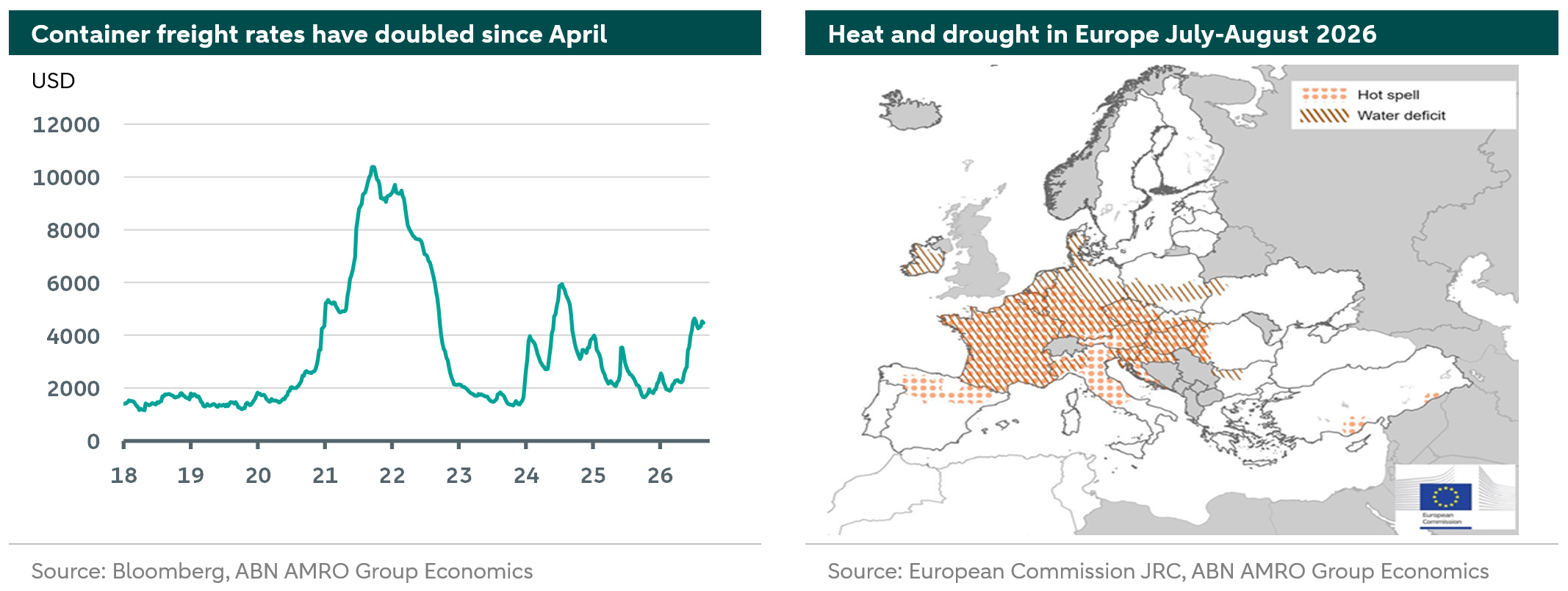
Another factor affecting agricultural markets is the rise in specific fertilizer prices following the conflict in Iran. While the impact is substantially less pronounced than during the fertilizer shock following Russia’s invasion of Ukraine, prolonged shortages, mainly in developing countries, could put additional pressure on future harvests. In Europe the effect is mainly limited to an price shock for farmers rather than an availability issues.
At the same time, agricultural markets are entering this period from a relatively strong position. Global inventory levels for example grains, wheat and rice are historically high, helping to cushion the impact of adverse weather conditions on prices. Also, a large share of agricultural commodities is contracted in advance rather than purchased on spot markets. As a result, increases in commodity prices usually pass through to food inflation gradually and partially.
While developments in agricultural commodities tend to attract most attention, the majority of food production costs originate elsewhere. The renewed increase in energy prices following the Iran conflict is putting pressure on food production both directly through energy costs and indirectly through transportation, packaging, another inputs. Although companies remain relatively protected through existing energy contracts, cost pressures will rise when these contracts expire. Labour costs are another source of pressure. In the Netherlands, the collective agreement wages in the food sector increased by 4% year-on-year in the second quarter of 2026, illustrating that wage pressures remain elevated. Given that labour accounts for roughly 15% of total production costs, wage developments are also relevant for food inflation. Besides the impact on agricultural commodity prices, the summer heat and drought in Europe also had a more indirect on food prices, via higher transportations costs due to exceptionally low water levels in main rivers such as the Rhine and Danube. This is also visible in recent PMIs, which point to rising transportation costs and supply-chain pressures. Finally, governmental policies can affect food inflation, such as the planned minor indexation of alcohol excise duties in the Netherlands from 1 January 2027 onwards.
An important difference with earlier inflation waves is that pricing power is expected to be weaker. Following several years of sharp price increases, negotiations between supermarkets and suppliers have become challenging. Retailers appear more reluctant to pass higher costs directly to consumers, increasing the likelihood that part of the shock is absorbed in producer margins. This points to a smaller pass-through of cost increases than during previous periods.
Food inflation is particularly relevant as it plays a large role in the formation of household inflation expectations. Consumers tend to attach disproportionate weight to them when assessing inflation developments. It could therefore also influence wage demands, and thereby increase the risk of second-round effects. As the food price jump is hitting at a time where circumstances for general inflation are unfavourable, the ECB is also paying close attention to food inflation, as signalled in the recent Governing Council meeting (read ).