Transaction Trends: Keeping a finger on the pulse of higher energy prices
Are Dutch households already feeling the impact of higher energy prices? In this publication, we use anonymised and aggregated transaction data from more than a million households to track how higher energy prices are affecting household finances. Interestingly, despite five months of elevated energy market prices, the median household energy payment has barely increased. This is because many existing contracts are still in effect and new electricity tariffs are not significantly higher. Although higher oil prices are quickly passed on at the pump, the increase in household fuel spending has so far remained limited as motorists adjust their behaviour.


War in Iran and uncertainty surrounding the Strait of Hormuz persist
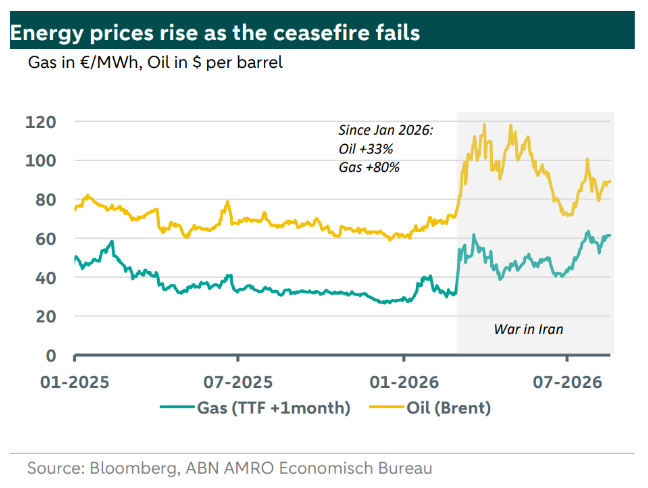
During the brief period in which the ceasefire between Iran and the United States was in effect, shipping traffic through the Strait of Hormuz gradually resumed and oil and gas prices declined. Since late June, however, uncertainty surrounding the course of the conflict has resurfaced, reversing the positive developments seen in the preceding weeks. The number of tanker transits through the Strait of Hormuz has virtually come to a standstill, and prices in both gas and oil markets have risen again. At the time of writing, Brent crude oil prices are hovering around USD 90 per barrel, while TTF one-month gas prices are above EUR 60 per megawatt-hour, approaching the peak levels recorded in April and May shortly after the outbreak of the conflict. Energy prices have therefore remained elevated for several months compared with levels prior to the outbreak of the war. In this publication, we examine how these developments are affecting Dutch household finances. Specifically, we focus on trends in household energy bills and fuel expenditures.
Gas and electricity prices for new contracts below their spring peak
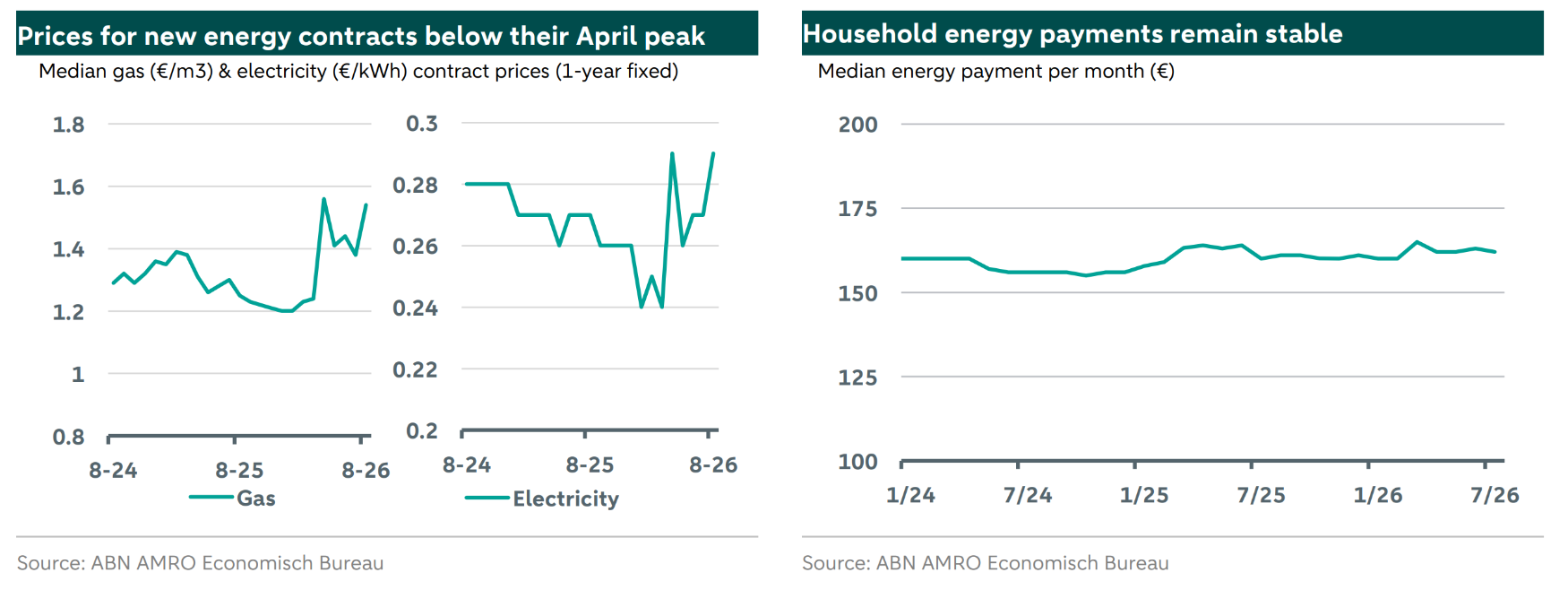
Rising energy market prices are feeding through into higher rates for new energy contracts (see the chart on the right below). According to data from the Netherlands Authority for Consumers and Markets (ACM), which publishes median rates for newly signed one-year energy contracts, prices have declined from the peak reached in April and May shortly after the outbreak of the war. Nevertheless, they remain significantly higher than their pre-war levels. The recent increase in wholesale market prices is expected to exert further upward pressure on rates for new contracts in the coming weeks. Given recent market developments, this effect is likely to be more pronounced for gas prices than for electricity prices.
If we put things into perspective, however, a more nuanced picture emerges of current price developments. Electricity prices have increased recently but compared with August 2025 and August 2024 they are only moderately higher, by around 7% and 4%, respectively. The picture is different for gas. In August, the price of a new gas contract is approximately 23% higher than in August 2025 and around 19% higher than in August 2024.
Impact on household energy bills remains limited
Using anonymised and aggregated transaction data, we track the actual energy payments of approximately one million Dutch households (see the methodology section for more details). Our data does not provide a complete picture of households' energy consumption or the type of energy contract they have. However, it does show the monthly amounts that households pay, allowing us to observe when higher energy prices begin to affect household finances. In the first half of 2026, the median Dutch household spent approximately EUR 160 per month on energy. This means that half of the households in our sample paid less than this amount, while the other half paid more. The advantage of tracking the median energy payment across a large group of households is that it captures the broader trend, making developments for the typical household clearly visible.
The chart on the right above shows the median monthly energy payment over time. Notably, despite higher wholesale and contract prices, the typical household energy bill has so far increased only marginally. One would expect that as more fixed-rate energy contracts expire, a growing number of households would be exposed to higher prices, pulling up the median payment over time. During the 2022 energy crisis, this effect was clearly visible in the transaction data after a few months. In that respect, the current dynamics differ markedly from those observed during the 2022 energy crisis. As discussed above, contract prices are higher now than they were before the conflict in Iran. However, electricity contract prices are not substantially higher than they were one or two years ago. Gas prices have risen more significantly, but households generally consume more electricity than gas. As a result, many households that are currently renewing their energy contracts are doing so at rates that are broadly comparable to those of their expiring contracts. For this group, energy prices therefore change little, meaning that the median energy payment remains relatively stable, provided energy consumption remains unchanged. This contrasts with the situation during the 2022 energy crisis, when tariffs for new energy contracts rose much more sharply. Households renewing their contracts at that time invariably faced substantially higher energy costs, pushing up the median energy bill considerably.
Expenditure at the pump remains muted
Fuel prices respond quickly to changes in wholesale market prices. Since the beginning of July, petrol and diesel prices at the pump have risen again as a result of higher market prices. By mid-July, for example, the price of a litre of petrol had reached EUR 2.23, around 4% higher than a month earlier. To measure the impact of higher fuel prices on Dutch households, we examine the median monthly fuel expenditures of approximately 700,000 households that actively use a car. This development is shown in the chart at the bottom right. Because months contain different numbers of days, monthly expenditures have been normalised to 30-day months to ensure comparability.
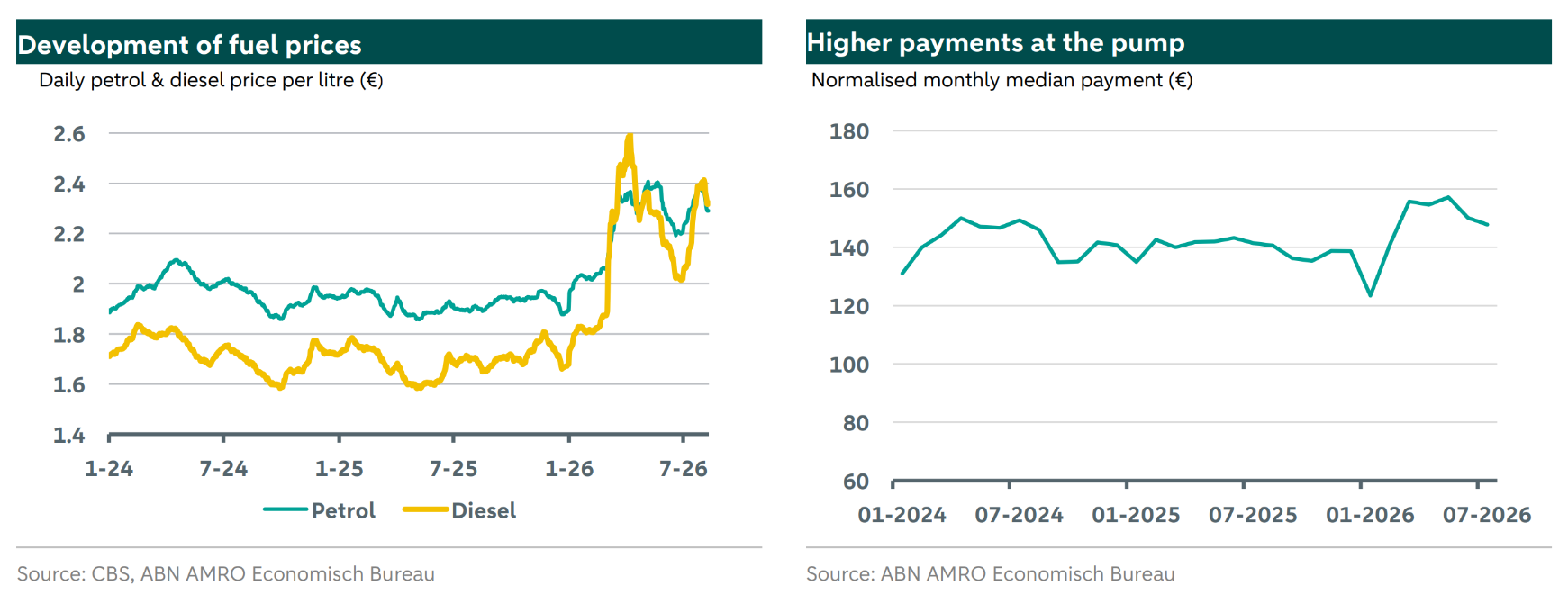
The chart shows that households have been spending more on fuel since the outbreak of the war than they did beforehand. Unlike energy bills, this price shock is reflected in median fuel expenditures almost immediately. Between March and July, median fuel expenditures amounted to approximately EUR 765, compared with EUR 708 during the same period a year earlier. This represents an increase of around 8% year-on-year.
However, the increase in fuel spending has been more limited than the rise in fuel prices. While petrol prices have been more than 21% higher and diesel prices around 37% higher since the outbreak of the war than during the same period a year earlier, median fuel expenditure over that period was only around 8% higher. This suggests that households are reducing their fuel consumption or, for example, refuelling more frequently at lower-cost petrol stations in order to offset part of the increase in prices. This behavioural response is consistent with findings from other .
Given the persistence of uncertainty in the Middle East and continued tightness in oil markets through the end of the year, higher prices at the pump are likely to remain in place for some time. In a forthcoming publication, we will examine in greater detail how households respond to higher fuel prices. In doing so, we will look both at the impact on fuel consumption and at whether higher spending at the pump comes at the expense of other forms of consumer spending.