Rates Outlook 2027: Steeper roads ahead

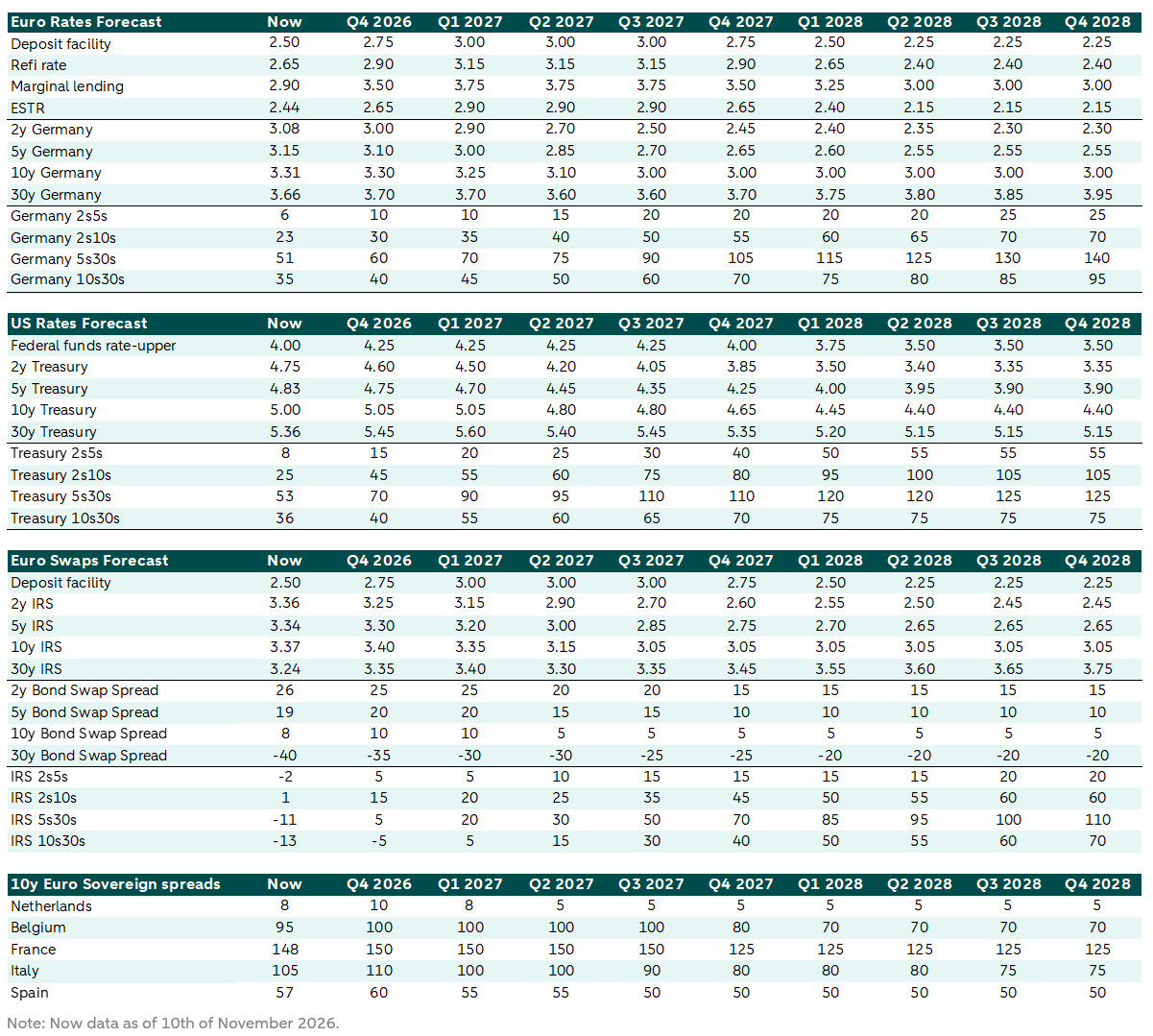
We expect a steeper Bund curve in 2027, with lower front-end yields as ECB easing is repriced, while higher supply and term premium pressures keep ultra-long yields elevated. Spain and the Netherlands have a more supportive outlook than France, Italy and Belgium, reflecting stronger fundamentals and/or more favourable supply dynamics. We expect US curve steepening, primarily in 2s10s, as eventual Fed easing supports the front end while fiscal concerns, large refinancing needs and a elevated term premium limit longer-end yields declines. The Dutch pension transition should reinforce 10s30s steepening and 30Y swap-spread widening, as hedging demand shifts away from the ultra-long end. Overall, we expect yield declines to be concentrated at the front-end, alongside curve steepening in UST 2s10s, Bund 2s10s/10s30s and EUR IRS 10s30s.


Jaap Teerhuis
Senior Fixed Income Strategist
Bunds: from policy expectations to term premium
The short-end of the German Bund curve has this year moved almost exclusively around changes in expectations for monetary policy. As we previously explained (see ), the 2Y Schatz is closely linked to the average level of 3m Euribor futures over the coming two years and tends to historically only significantly deviate from it if (1) risk sentiment has deteriorated significantly, whereby a flight-to-quality move pushes 2Y yields below what is implied by the path for expected monetary policy (read more ); and (2) the ECB is conducting some form of QE.
As we have argued in our Global Monthly outlook (see ), we expect the ECB to deliver two additional hikes, in December this year and March next year, after which it will remain on hold before initiating an easing cycle starting in Q4 2027, bringing policy rates back to 2.25% by Q2 2028. Currently, markets are pricing in two ECB rate hikes over the next six months, in line with our view, but continue to diverge from our expectations on rate cuts in late 2027 and beyond. As such, we think it is mostly policy rates expectations beyond 2027 that put upward pressure on 2Y Schatz yields, leaving scope for yields to decline once those expectations adjust.
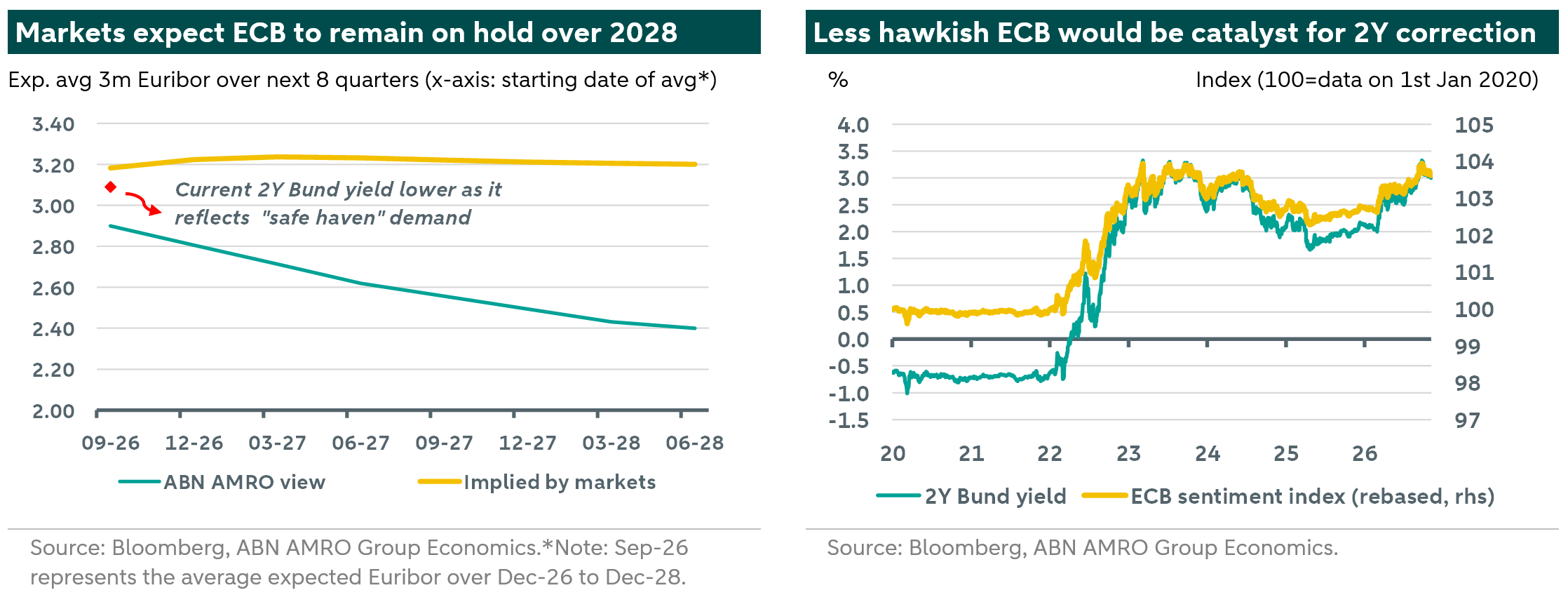
Until markets converge towards our ECB view, we do not expect significant declines in 2Y Schatz yields. The key question is therefore when convergence is likely to occur. Historically, a key catalyst for lower rates has been a shift towards less hawkish ECB communication. We do not expect such shift until the hiking cycle is complete at the 18th of March meeting, with the subsequent change in communication and market repricing likely to unfold in early Q2. Less hawkish ECB communication could then provide a catalyst for lower 2Y Schatz yields, even before actual rate cuts begin.
Looking forward, our view for the front-end part of the Bund curve is therefore underpinned by the following two elements: (1) markets will continue to price in a “higher for longer” environment through Q1 2027, after which we expect a gradual but sharper move lower in 2Y yields following a shift in ECB communication; and (2) cautious risk sentiment in 1H 2027, as exemplified by our elevated BTP-Bund spread forecast, will continue to push 2Y Schatz yields slightly below what is implied by the expected monetary policy. We therefore expect the 2Y Schatz yield to drop ~60bps from current levels to ~2.4% by end of 2027.
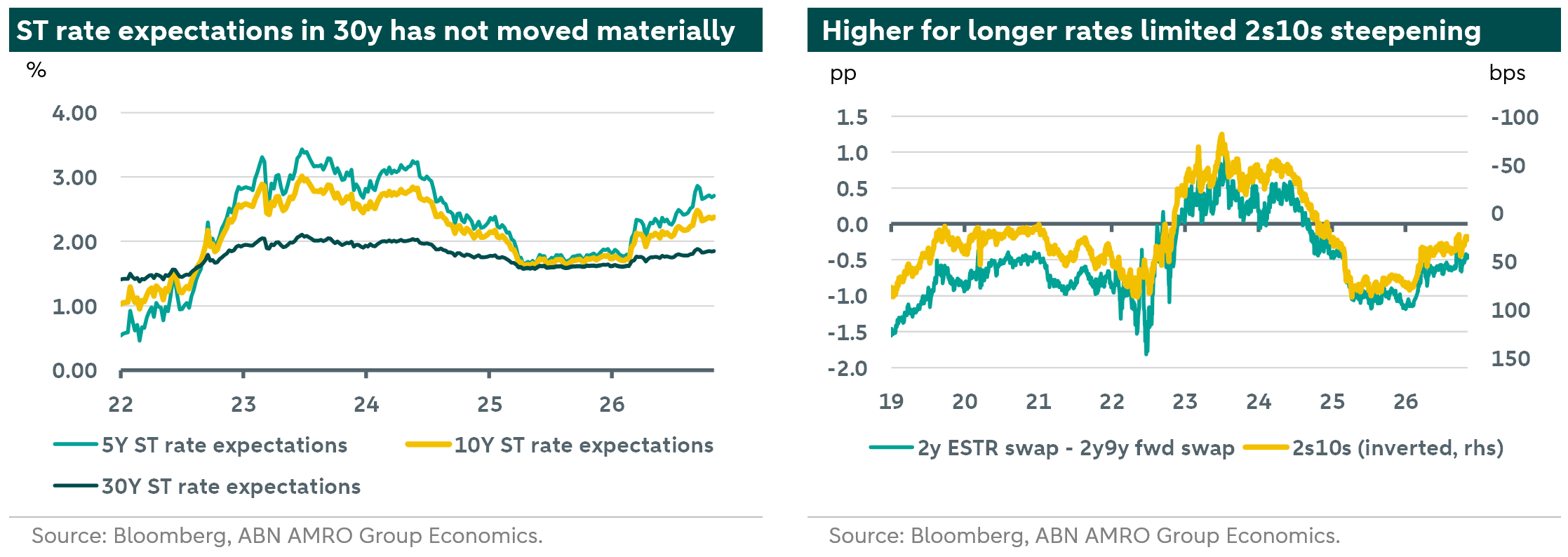
At the longer end of the curve, yields reflect both expected future short rates and term premia. So far this year, higher short-rate expectations have been the main driver of the rise in 10Y and 30Y Bund yields, while term premia have remained subdued, with a modest increase at 30Y. Resilient economic growth and continued investment demand associated with AI, energy and defence may be leading markets to remove insurance cuts, resulting in a higher expected rate path across medium- to long-term horizons, although repricing diminishes further out in the curve (see left chart on the next page). The elevated 2y9y forward swap, which we use as a proxy for the longer-run policy rate, reinforces this higher-for-longer pricing idea, and helps explain why curves have remained relatively steep this year, in contrast with previous hiking cycles, when expectations of subsequent easing contributed to a pronounced flattening and, in some cases, inversion of the curve (see right chart).
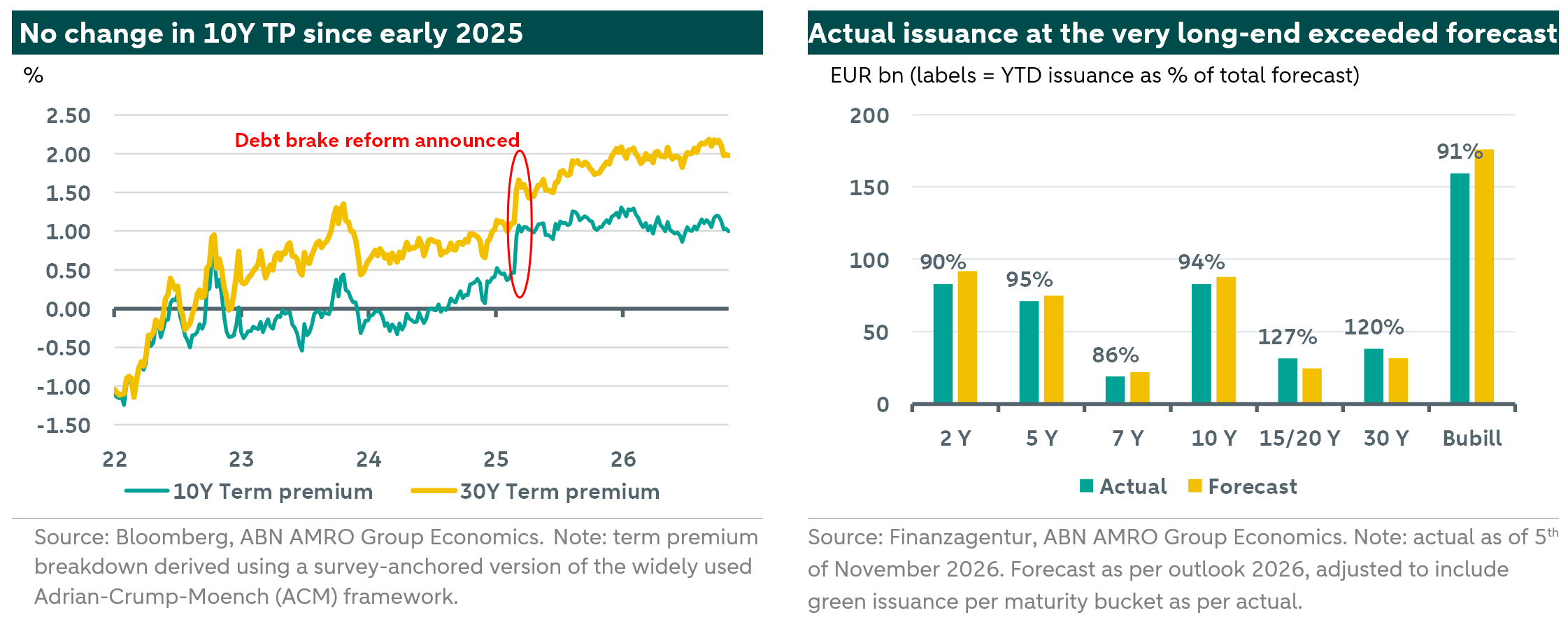
While short-rate expectations have risen in 2026 across the curve, term premia have remained subdued. One potential explanation is that much of the fiscal and supply repricing had already occurred following the 2025 debt-brake reform (see left chart below). Since then, 10Y term premium has remained broadly stable, while 30Y has edged higher, likely reflecting greater supply at the ultra-long end. Indeed, German issuance in the 15/20Y and 30Y part of the curve has exceeded initial plans by as much as 25% so far this year (see right chart below).
Looking ahead, supply pressures are set to intensify in 2027. We expect net supply of German government bonds to increase by around 25% year-on-year, compared with around 16% between 2025 and 2026. This reflects a further widening in the fiscal deficit, from 4.1% of GDP in 2026 to 4.3% in 2027, slightly above consensus at 4.2%. We expect the weighted average maturity of issuance to remain broadly stable at around ~9.5y, but ultra-long issuance could remain somewhat elevated as the Finanzagentur seeks to build and deepen benchmark lines across the 15Y, 20Y and 30Y maturity buckets, implying continued meaningful duration supply.
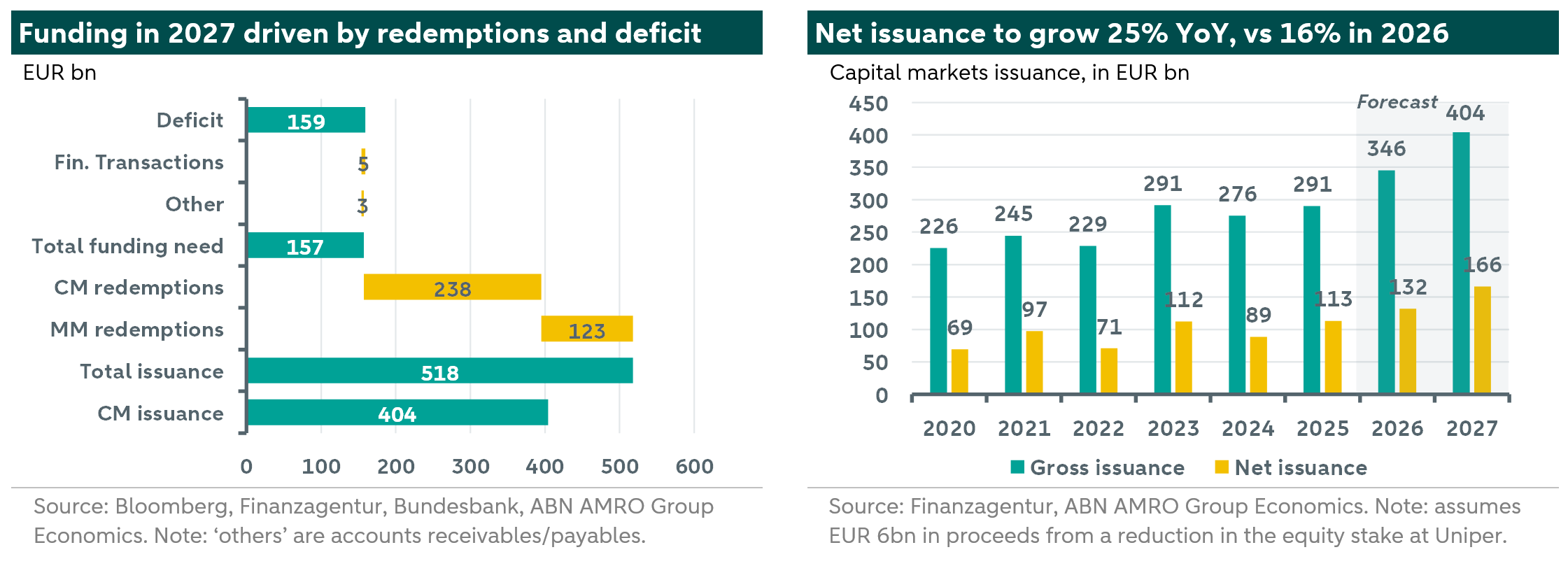
These supply pressures are compounded by continued Eurosystem balance-sheet runoff, which increases the amount of duration that needs to be absorbed by private investors. We estimate around a quarter of the EUR 355bn combined APP and PEPP redemptions in 2027 are likely German government bonds, adding to the increase in net issuance and further raising private-sector absorption needs.
Specifically, higher issuance and the Eurosystem runoff are known to markets, and our forecast does not assume that investors have overlooked them. Instead, we judge that current term premia do not fully compensate for the additional duration private investors will need to absorb in 2027. The expected increase in net supply and potentially elevated ultra-long issuance underpin this judgement, with the strongest upward adjustment at 30Y and a more modest normalisation at 10Y. The broadly unchanged 10Y term premium since early 2025 is also consistent with our view that there remains scope for further normalisation.
Overall, we expect a steeper Bund curve in 2027. At the front end, 2Y yields should decline as markets increasingly price our expected ECB easing cycle. At 10Y, lower short-rate expectations should outweigh a more modest normalisation in term premium, allowing yields to decline, but less than at 2Y. At 30Y, stronger term-premium pressure should outweigh the decline in yields across the curve, pushing yields higher. These different net effects underpin steepening in both 2s10s and 10s30s, with the move more pronounced in 10s30s. We expect 10s30s to reach around 70bp by end-2027, from around 35bp currently.
Country spreads: mind the French gap
We expect EGB markets to remain characterised by elevated sovereign differentiation in 2027, with France the main source of political and spread volatility. Durable OAT tightening requires credible fiscal and political progress which we do not expect in the next few months, but at the same time our base case excludes a systemic euro-area fragmentation episode. Spillovers should remain selective: Belgium is particularly exposed to French shocks, while Italy and Spain remain more driven by domestic fundamentals and broader market factors. On the other hand, lower beta EGBs such as the Netherlands should benefit from the cautious risk sentiment. With fragmentation contained, direct ECB intervention remains unlikely, leaving markets to continue to impose fiscal discipline.
France/OATs
France enters 2027 with a sizeable risk premium already embedded in OATs. While the fiscal outlook has deteriorated, current OAT-Bund spreads appear to price considerably more than weaker fundamentals alone. Our framework, which controls for common euro-area factors, rates volatility and sovereign credit risk, shows that a large France-specific component emerged after the June 2024 political shock and has remained unusually persistent (read here). That is, the market is demanding additional compensation for political uncertainty and concerns over the future policy direction.
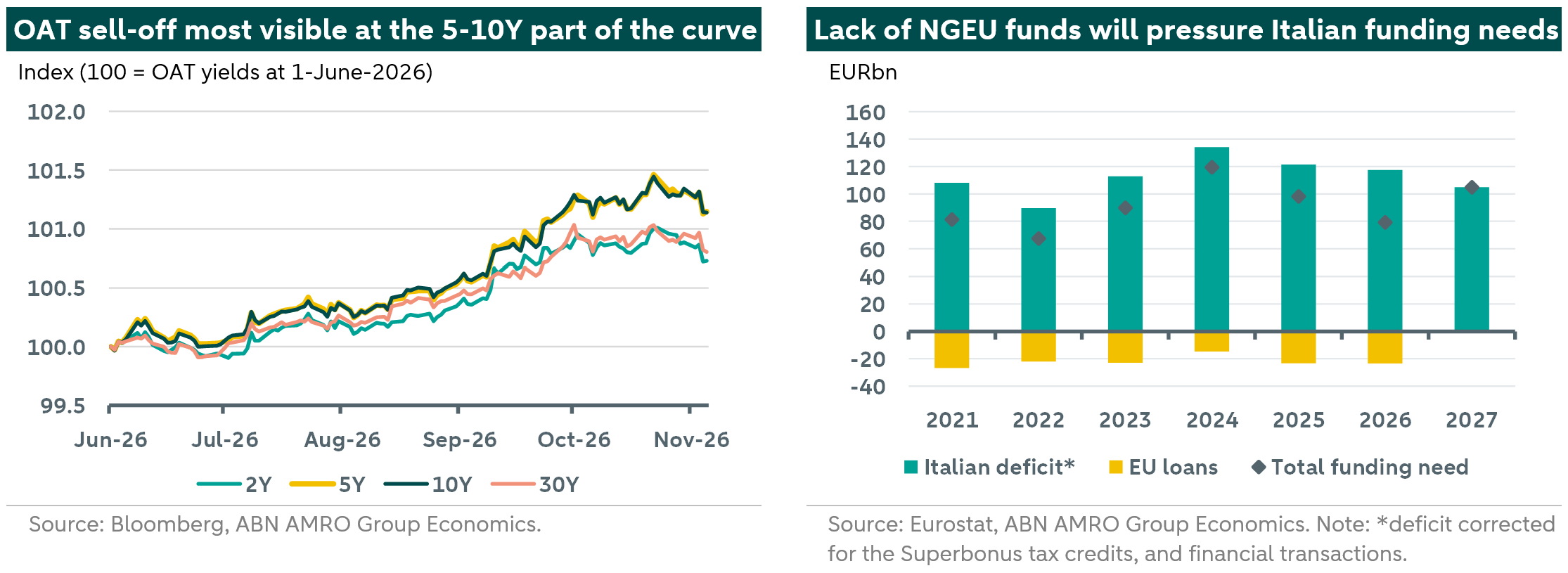
So far, the sell-off has been concentrated in the belly of the curve (5y and 10y), with less spread widening at the 2y and 30y (see left chart below). This suggests concerns over fiscal consolidation, policy credibility and political stability, rather than immediate debt servicing / default risks, extreme long-run debt-sustainability or broader euro-area tail event.
Against this backdrop, we see little scope for a meaningful reduction in uncertainty during at least the first nine months of 2027, keeping 10Y OAT-Bund spreads at around 150bp, accompanied by elevated volatility as markets continuously reassess the political and fiscal outlook ahead of the elections. Greater clarity on fiscal policy after the presidential election and any subsequent parliamentary election, should allow spreads to tighten towards 125bp by year-end. Conversely, a looser fiscal policy or prolonged political gridlock could push spreads wider, but levels above 200bp would likely require a broader challenge to euro-area cohesion, rather than simply a further deterioration in France’s fiscal outlook (read ).
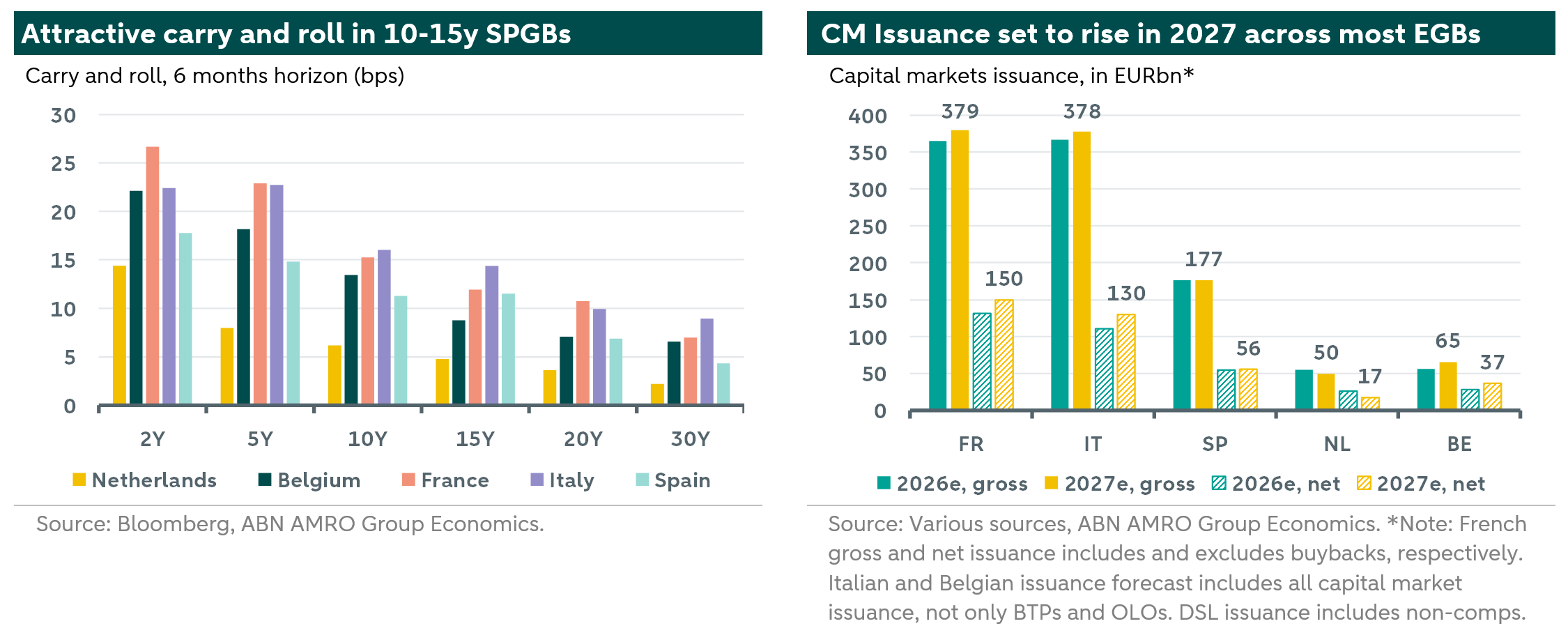
Supply adds another headwind. We estimate gross capital markets issuance, including buybacks, to increase to EUR from EUR 365bn to 380bn next year. Net issuance (adjusted for redemptions and buybacks) increases 14% to EUR 150bn. With sizeable French funding needs and the ECB continuing to reduce its sovereign bond holdings, private investors will have to absorb a significant amount of French duration.
We see limited scope for sustained OAT spread tightening, including at the short-end, broadly through 1H27, until there is greater political and fiscal clarity.
Italy/BTPs
Italian BTP-Bund spreads widening since late September largely reflect an increase in the country’s fiscal risk, rather than pure French contagion (read ). Italy has confirmed at the end of September that it would not be able to exit the EU’s Excessive Deficit Procedure (EDP) as its 2025 deficit remained above the 3% threshold. Since then, the government has approved a sizeable EUR 28bn spending package on energy and defence, which it expects will be excluded from the EDP calculation. Still, EU approval remains uncertain (read ), leaving a risk that Italy remains under the EDP for longer and delaying the prospect of meaningful fiscal consolidation.
Political uncertainty could add to these fiscal risks. Snap elections as early as April next year remain possible, with polls suggesting that the current FdI-Lega-Forza Italia coalition bloc could need support from the more Eurosceptic and fiscally expansionary Futuro Nazionale to secure parliamentary majority. For bondholders, the key risk is that such an outcome could weaken fiscal consolidation and increase the likelihood of renewed tensions with the EU, keeping the sovereign risk premium elevated.
Supply also becomes a larger headwind in 2027. NGEU funds historically reduced Italian funding needs by around 20%, but with NGEU coming to an end, Italy will need to finance a greater share of its still-elevated deficit directly through the bond market. We therefore expect net BTP supply to rise next year, increasing the amount of Italian duration that private investors need to absorb.
Overall, the combination of limited fiscal consolidation, political uncertainty and rising bond supply leaves little room for a sustained tightening in BTP-Bund spreads. We therefore expect spreads to remain around current relatively wide levels, with greater fiscal and political clarity needed to support a more durable tightening.
Spain/BONOs
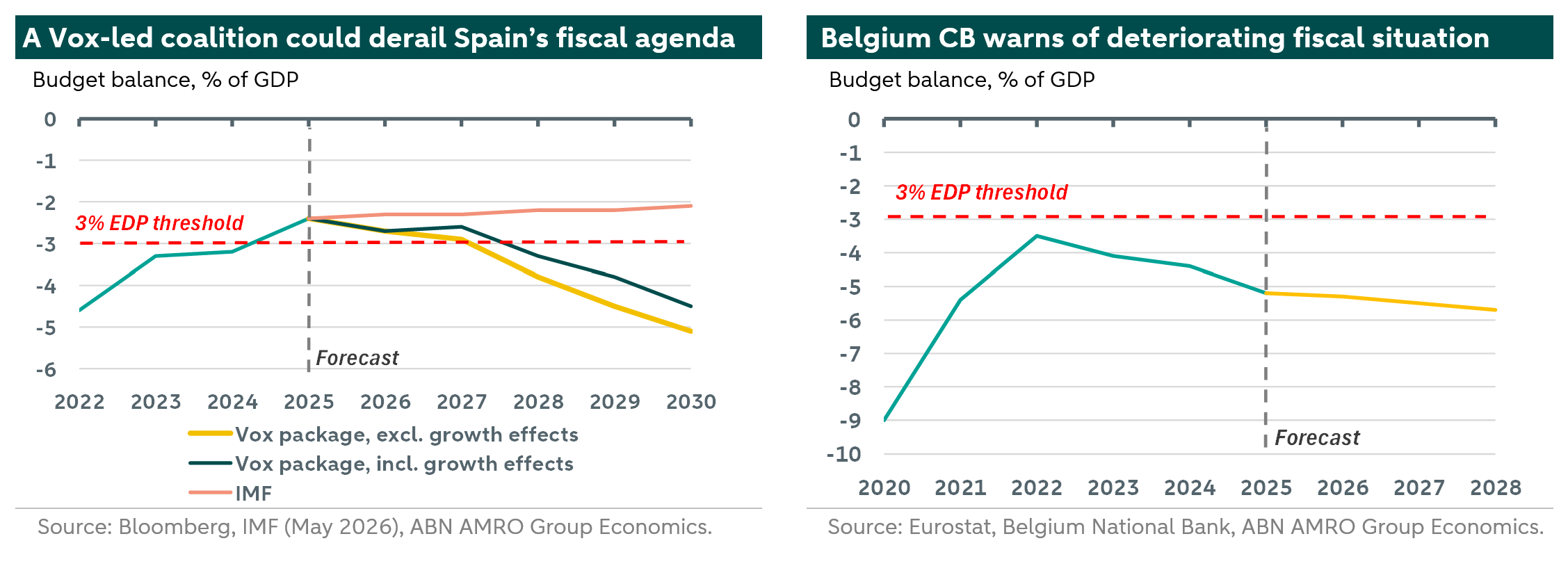
Spain’s snap election on 29 November is likely to result in a shift to the right, with a PP-Vox coalition currently the most plausible outcome. The key uncertainty for bondholders is how much influence Vox would have in a PP-led coalition. While PP has broadly a pro-growth, lower-tax agenda, but a government dependent on Vox could combine tax cuts with also higher spending commitments. Specifically, if all of Vox’s bold tax and spending pledges are implemented, the deficit could rise towards 5% of GDP by 2030.
Still, Spain enters this political transition from a relatively favourable starting point, having reduced its budget deficit from 4.6% in 2022 to 2.4% in 2025. The main risk for bondholders is therefore not an immediate fiscal crisis, but rather a potential reversal of the country’s recent consolidation trend. Our base case is that investors should expect some fiscal slippage following the election, but not a severe deterioration in the near term. More pronounced deterioration would become a medium-term risk if Vox secures substantial influence over the coalition's fiscal programme and a large share of its tax cuts and spending commitments is implemented.
Supply should also remain relatively supportive. Despite the end of NGEU funding, we expect Spanish sovereign issuance to remain broadly stable in 2027, contrasting with the stronger increase in supply expected elsewhere in Europe. This should limit supply-driven widening pressure on Spanish spreads.
Belgium/OLOs
In Belgium, the government has so far failed to reach a budget agreement for 2027, highlighting the difficulty of delivering fiscal consolidation from an already challenging starting point: the country has one of the highest budget deficits in the euro area, at around 5.2% of GDP in 2025, and the National Bank of Belgium projects it to widen to around 5.7% by 2028 (). Hence, it looks unlikely that Belgium will be able to exit the EDP by 2029.
While the government has avoided a collapse for now, it remains very fragile and politically fragmented, being formed by a five-party coalition with substantial differences among its constituents parties. Although Belgium has a long history of political deadlock, the current impasse is particularly relevant given the weakness of the fiscal outlook. A government collapse could lead to lengthy coalition negotiations or early elections, and either outcome could delay fiscal adjustment further and keep Belgium’s fiscal risk premium elevated.
On top of the fragile fiscal situation, bond supply is also expected to rise next year. OLOs also remain particularly exposed to developments in France given their historically high correlation with OAT bonds. As we discussed in our recent piece (see ), Belgium has also experienced the clearest contagion from the recent French sell-off.
Given the challenging fiscal outlook, political uncertainty, high bond supply and our expectation that OAT-Bund spreads will remain elevated and volatile, we see limited scope for sustained OLO-Bund spread tightening and expect spreads to remain around 100bp through at least 1H27.
Netherlands/DSLs
We expect DSL–Bund spreads to remain tight in 2027, with scope for further tightening, particularly at longer maturities. The main support comes from diverging supply dynamics: German issuance is expected to rise, including at the ultra-long end, while we do not expect the DSTA to materially increase long-dated issuance. We expect Dutch issuance policy to remain broadly unchanged, with the minimum average maturity of total outstanding debt, including money market instruments, remaining at 7.5 years. The reported average maturity of 8.7 years at the end of October provides room to maintain this approach without a substantial increase in long-dated supply.
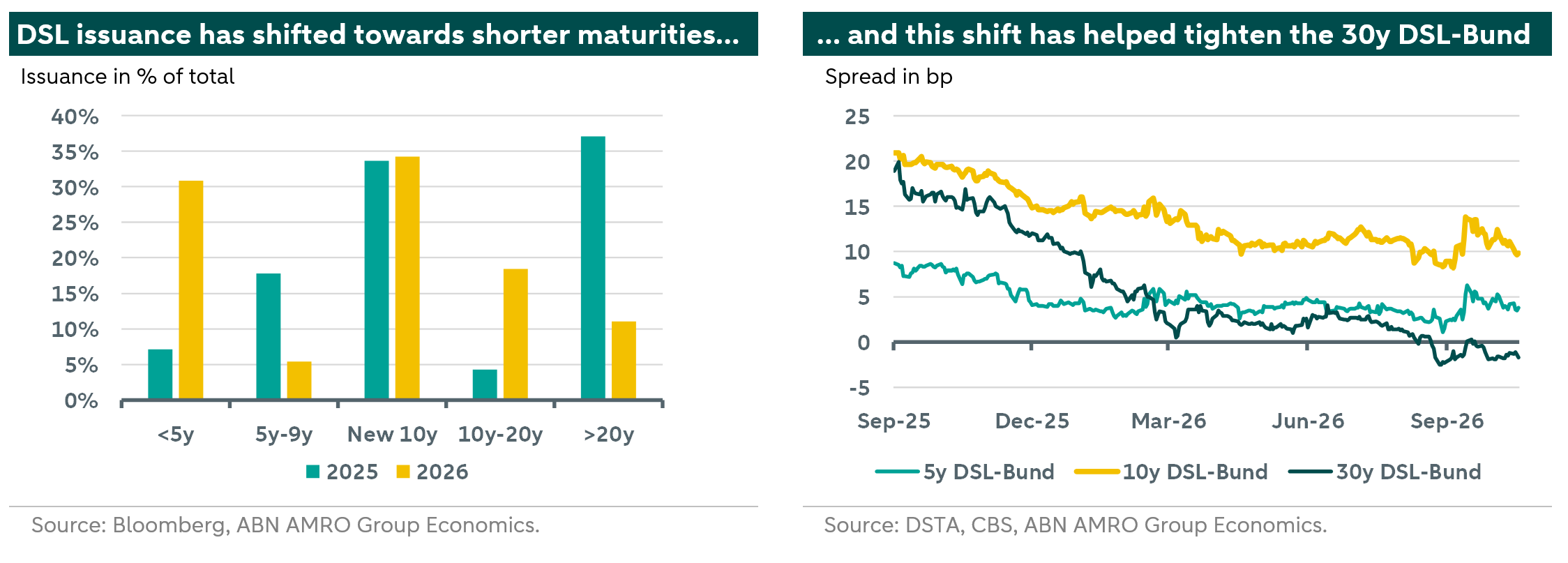
Recent performance illustrates the importance of these relative supply dynamics. DSLs have outperformed Bunds across the curve since the summer of 2025, most prominently at longer maturities. The DSL 2056, issued in September 2025 at 20.5bp over its reference Bund, the DBR 2056, now trades at almost −2bp. Issuance of DSLs with maturities exceeding 20 years has been considerably lower in 2026 than in 2025, whereas long-dated Bund issuance has increased (see left chart below). The anticipated shift in Dutch pension funds’ allocations from European government bonds towards equities, which contributed to earlier spread widening, has also yet to materialise in their reported asset allocations.
The pension transition nevertheless remains an important consideration for 2027. As discussed in the swaps section, we expect the next transition wave to have a greater market impact as hedging shifts away from the 30-year point towards shorter maturities and fewer offsetting market positions remain. That expectation concerns interest rate hedging flows and does not, by itself, imply an equivalent reduction in cash-bond holdings. For DSLs, the key question is whether the anticipated shift in asset allocations begins to translate into lower demand for long-dated government bonds. This remains a risk to the supportive relative supply outlook.
The long end offers greater tightening potential from Dutch–German supply divergence, although 30-year DSL yields are already below Bunds. At shorter maturities, Bund liquidity and market depth limit the scope for negative DSL–Bund spreads. However, 2-year DSLs are characterised by subdued spread volatility and around 15bp of carry and roll. Severe flight-to-quality episodes remain a risk to Dutch spreads.
Conclusion: curve and overall supply outlook
For 2027, Spain and the Netherlands have a more supportive outlook than Italy, France and Belgium. Spain's 10–15Y sector offers attractive carry and roll, further supported by favourable fiscal starting point and a benign supply outlook, with net issuance expected to rise by only around 2% in 2027. Dutch 2Y bonds offer around 15bp of carry and roll alongside relatively subdued spread volatility. Higher German supply relative to Dutch funding needs should also support DSLBund tightening at the ultra-long, subject to pension-related cash-bond demand and severe risk-off risks. Italian bonds offer sizeable carry and roll, at around 15bp in 10Y and 22bp in 5Y, but we do not judge this to be sufficient compensation given the recently high spread volatility. Fiscal risks, weaker risk appetite and renewed French stress leave BTP spreads vulnerable, while the expiry of NGEU funding contributes to an expected 18% increase in net issuance. We therefore see limited scope for BTP spread tightening for now, particularly at longer maturities, although the 5Y carry cushion provides some offset to spread risks. We also expect French and Belgian spreads to remain under pressure over the next six months: persistent political and fiscal uncertainty in both countries, Belgian exposure to French spillovers and net issuance increases of around 14% and 30%, respectively, contrast with the more supportive Spanish and Dutch outlook.
US Treasuries: a fragile market
Our central view for 2027 is a steeper US Treasury curve, primarily in 2s10s. Markets pricing less Fed tightening and more subsequent easing than currently expected should pull down 2Y yields more than longer-dated yields, where fiscal and refinancing risks keep term premia elevated. Debt-ceiling uncertainty and frequent refinancing can interrupt this downward adjustment through episodic bill-market stress, but do not necessarily overturn the broader policy-driven decline in 2Y yields.
Similarly to Bunds, the 2Y part of the US Treasury (UST) curve remains closely linked to expectations for the Fed policy path. As we elaborated in the Global Monthly, we expect one additional hike by the Fed in December, followed by a hold through the first three quarters of 2027. By late 2027, however, we expect the Fed to be sufficiently convinced that the energy shock has not passed through materially to wages and inflation expectations, and that price pressures stemming from IT goods remain sufficiently narrow not to warrant maintaining a restrictive stance across the broader economy. As such, we expect an easing cycle to begin in Q4 2027, bringing the upper bound of the Fed funds target range back to 3.5% by Q2 2028.
Since this week, markets have turned significantly more hawkish, now pricing almost three additional Fed hikes over the next nine months, compared with just one hike in December in our forecast. Further out, markets now price roughly a 50% chance of a rate cut by mid-2028, but we expect an aggressive 75bps rate cut cycle starting in Q4 2027 (see left chart below). The key divergence, and what is keeping 2Y UST yields elevated, is therefore both the extent of near-term tightening and the timing and magnitude of the subsequent easing cycle.
That being said, until markets converge towards our Fed view, we do not expect a significant decline in 2Y UST yields. We expect this repricing to begin towards the end of Q1 or start of Q2 2027, when Fed communication is likely to become less hawkish as the end of the tightening cycle becomes increasingly established. At that point, greater emphasis from Fed officials on contained second-round effects from the energy shock, anchored inflation expectations and the relatively narrow nature of IT goods price pressures could then provide a clear catalyst for lower 2Y UST yields, even before the Fed delivers any actual rate cuts.
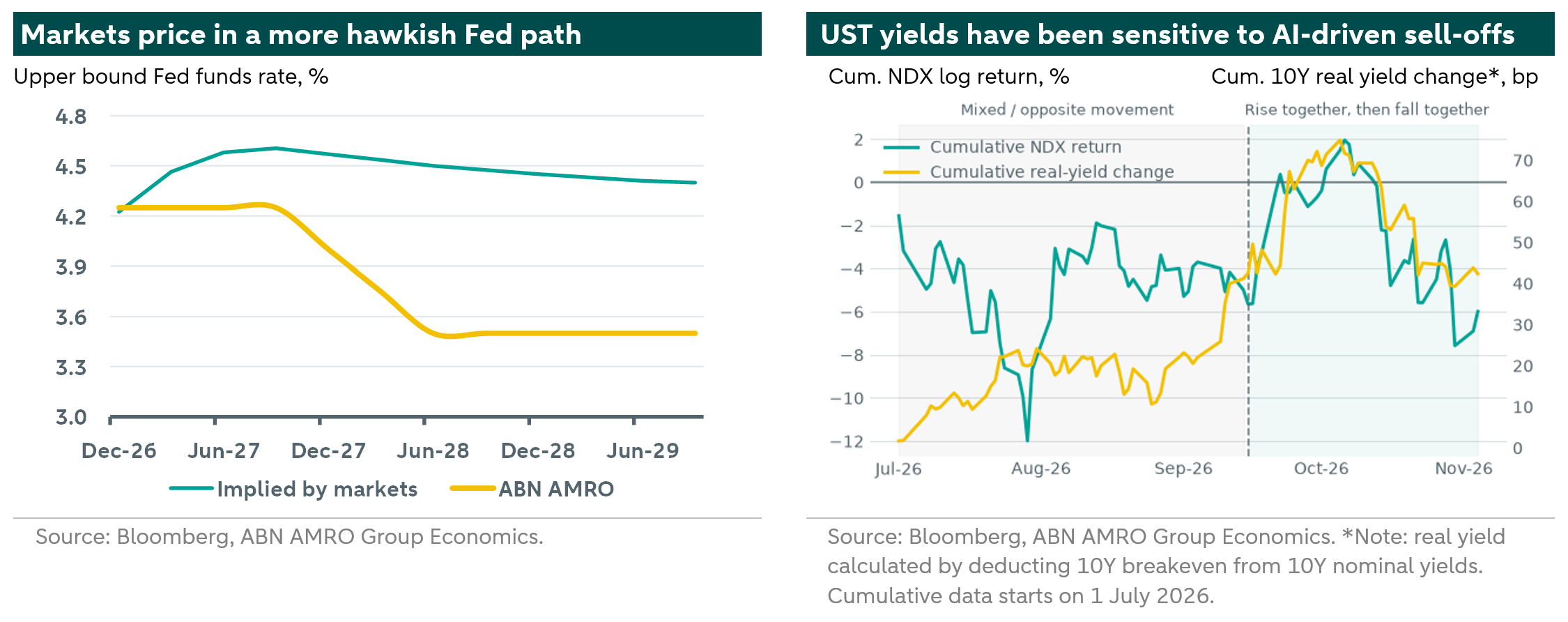
Additionally, recently, AI-related equity corrections have also pushed UST yields down, reflecting a combination of safe-haven demand and some repricing of the growth and Fed outlook. Indeed, as we elaborated in a recent piece (), AI-capex related news moved 2Y and 10Y UST yields by around 2.5bps and 1.3bps, respectively, and a 1% decline in the Nasdaq has been associated with a 2-2.5bps decline in yield across the curve.
Looking ahead, an AI investment bust is not our base case and slower AI capex growth should not translate into a materially weaker growth outlook for the US (read here). As a result, AI-related risk-off episodes can generate temporary UST rallies, but absent a genuine AI investment bust, we do not expect this dynamic to drive a sustained decline in yields. Instead, we expect the long-end of the UST curve to be increasingly influenced by Treasury supply and fiscal concerns, while the short-end should remain primarily anchored by expectations for the Fed policy path.
On the fiscal situation, important to note that the results of the recent US mid-terms moderate, but do not remove, fiscal risks in the US for 2027. As we elaborated in our Global Monthly (here), Democrats won both chambers but lack the two-thirds majority in each needed to override a presidential veto, making legislative gridlock the likely outcome. This limits the scope for additional fiscal expansion, potentially easing fiscal and supply-related premia at the long-end of the curve (particularly the very long-end). However, preventing further expansion is not the same as delivering fiscal consolidation. Borrowing needs and debt-servicing pressures remain high, while government funding and debt-ceiling negotiations remain potential flashpoints. The implication is therefore two-sided: some relief for long-end yields from a more constrained fiscal agenda, but continued exposure to fiscal sustainability concerns and episodic bill-market stress.
Indeed, the fiscal deficit is expected to remain elevated in FY2027, with primary dealers projecting a modest increase from around USD 2.1tn in FY2026 to USD 2.2tn. Despite this, privately held net marketable Treasury borrowing is expected to remain broadly stable at around USD 2.0–2.1tn in 2027 (see ), as part of the higher deficit can be financed through the Treasury’s cash balance and non-marketable debt.
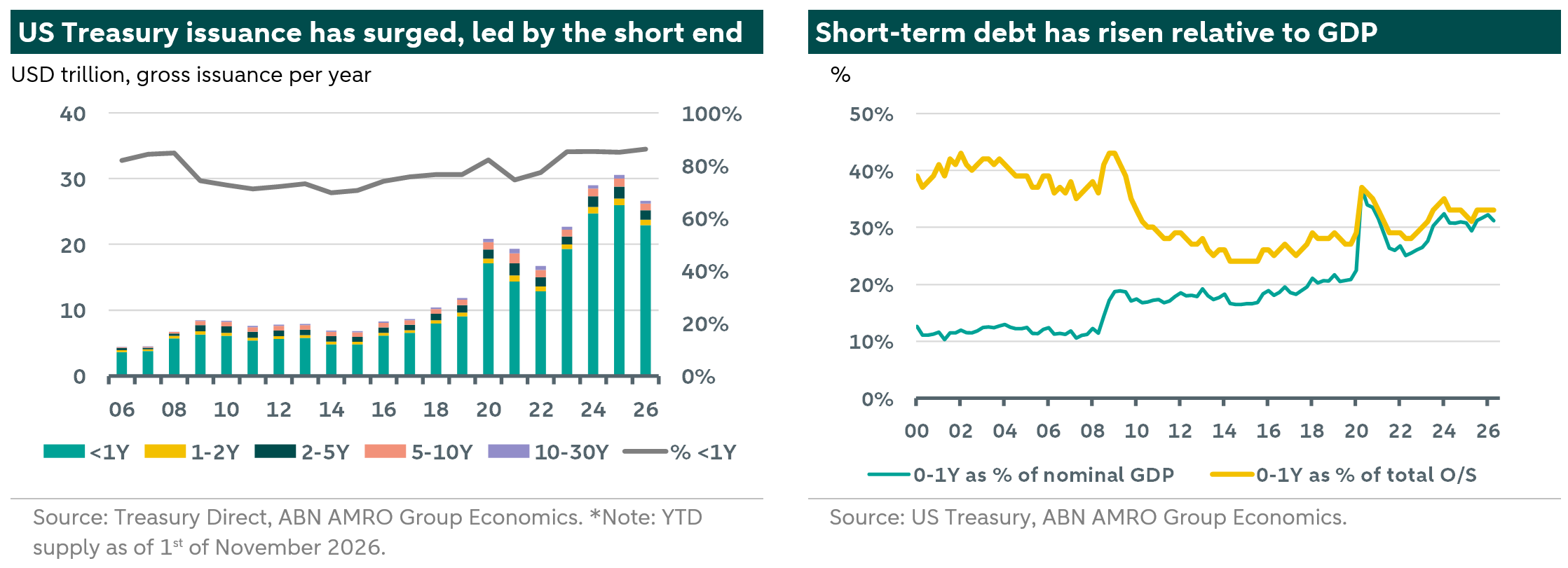
With net borrowing expected to remain broadly stable, the key concern is not necessarily a further increase in supply, but rather the refinancing exposure created by the large stock of short-term debt. Gross issuance of short-term US Treasuries has risen sharply in recent years. However, this largely reflects an increase in overall issuance, rather than a shift towards shorter maturities: short-term securities continue to account for around 85% of annual issuance (see left chart below). The more important change is relative to the size of the economy: debt requiring refinancing within one year now stands at around 30% of GDP, well above levels 15–20 years ago. As such, stable net borrowing does not remove the need to refinance a large volume of maturing debt.
With Treasury borrowing expected to remain broadly stable next year, while nominal GDP growth slows (read here), the refinancing burden relative to the economy could deteriorate, depending on the how the maturity profile of issuance evolves. A further shift towards short- and intermediate-term issuance, with smaller auctions at the long-end, would increase this exposure. Crucially, this would affect long-term yields through two opposing channels. Smaller long-end auctions would reduce the long-term supply that private investors must absorb, easing direct supply pressures. But greater refinancing exposure and the associated increase in fiscal uncertainty could raise the term premium, offsetting some of this relief. Reduced long-end issuance provides therefore near-term relief to longer-dated Treasuries, but the structural drivers behind a higher term premium remain firmly in place.
We also expect debt ceiling concerns to re-emerge as a key source of US Treasury market volatility in 2027. Specifically, the Bipartisan Policy Center estimates that the US will most likely reach the debt limit once again sometime between late winter and mid-summer 2027 (see ). The most direct yield pressure would be on bills maturing around the period of greatest uncertainty as the X-date approaches, rather than necessarily on the 2Y part as a whole, although some spillovers are possible. The historically high volume of debt requiring frequent refinancing, potentially increased by a further shift towards shorter maturities, could amplify volatility in short-term funding markets. In our base case, however, these are episodic pressures alongside, rather than a reversal of, the policy-driven decline in 2Y yields.
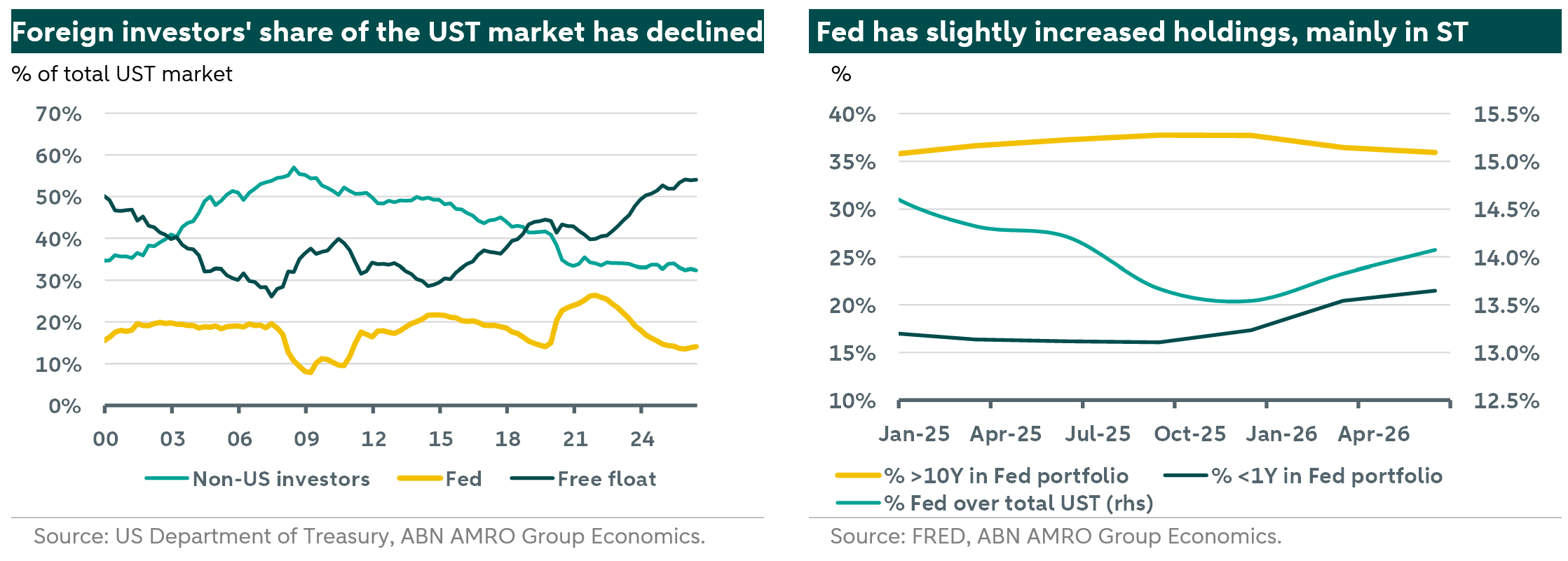
Overall, supply concerns would be less problematic if demand for Treasuries would still be concentrated among long-term, buy-and-hold investors willing to absorb rising supply. But that is no longer the case as one of the more important changes in recent years is that the market has become less dependent on official or foreign buyers and more reliant on domestic investors (read here).
Domestically, the Fed is also still an important holder of US Treasuries, holding around of 14% of the US Treasury market, up from the 25-year low of ~13% reached in December 2025. Since end of last year, the Fed has also been modestly expanding the size of its balance sheet, mainly through purchases of Bills. Specifically, the share of very short-term securities (<1Y) in the Fed’s portfolio has increased by 5pp to 23% since December, while the share of longer-dated securities (>10Y) decreased by around 2pp (see right chart on the next page). Still, despite this declining share, the Fed’s holding of long-dated USTs increased in absolute terms on the back of the expanded balance sheet.
Still, a Fed task force is currently assessing the possibility of reducing the central bank’s balance sheet. Recently, Fed Chair Kevin Warsh indicated that the task force’s recommendations will likely be presented to the FOMC early in Q1 2027. There is therefore a significant possibility that the Treasury market will no longer benefit from the same degree of support from the Fed.
The potential impact on the Treasury curve would depend on how Fed support is withdrawn. A simple end to the Fed’s current purchases, which have been this year concentrated in bills, would primarily remove demand from the short-end of the curve and could therefore put upward pressure on short-term Treasury yields. But a change in the composition of the Fed’s portfolio could have a different impact. One approach being considered is a reduction in the average maturity of its holdings, involving a shift towards a more market-neutral portfolio, or a “Reverse Operation Twist.” Such a shift would reduce the Fed’s relative demand for longer-dated Treasuries and would therefore be more likely to put upward pressure on long-end yields, potentially steepening the curve.
Taken together, for 2027 we expect lower 2Y yields and a steeper Treasury curve, with more pronounced steepening in 2s10s than in 10s30s. The decline in 2Y yields should be driven by markets increasingly pricing Fed easing from late Q1 or early Q2, although debt-ceiling uncertainty, high refinancing needs and any withdrawal of Fed bill purchases could generate temporary short-end pressure. At the long end, still-large financing needs, a more price-sensitive investor base and potentially reduced Fed support should keep the term premium elevated, limiting the scope for a sustained rally. Periods of relief are nevertheless possible, particularly if political gridlock constrains further fiscal expansion, AI-related risk-off moves boost safe-haven demand, or Treasury shifts issuance towards shorter maturities. However, these would provide only temporary relief without addressing the underlying fiscal and refinancing vulnerabilities. Overall, we expect the steepening to be primarily front-end driven, as lower policy-rate expectations pull down short-term yields more strongly, while elevated term premia provide greater resistance to lower yields further out the curve.
Euro swaps: set for 10s30s steepening and long-end spread widening
The euro swap market has largely tracked EGB rates and curves, while spreads have swung sharply. Bund scarcity from low issuance and ECB purchases pushed the 10-year spread to 100bp in 2022. Rising net issuance following QT in 2023 and Germany’s relaxation of the debt brake to stimulate the economy then drove it to around −15bp in early 2025. Since then, it has been relatively stable, initially around zero and subsequently around 5bp this year. In late September, political and fiscal tensions in France triggered a flight to quality, pushing the spread above 10bp. At the time of writing, it has fallen back below that level.
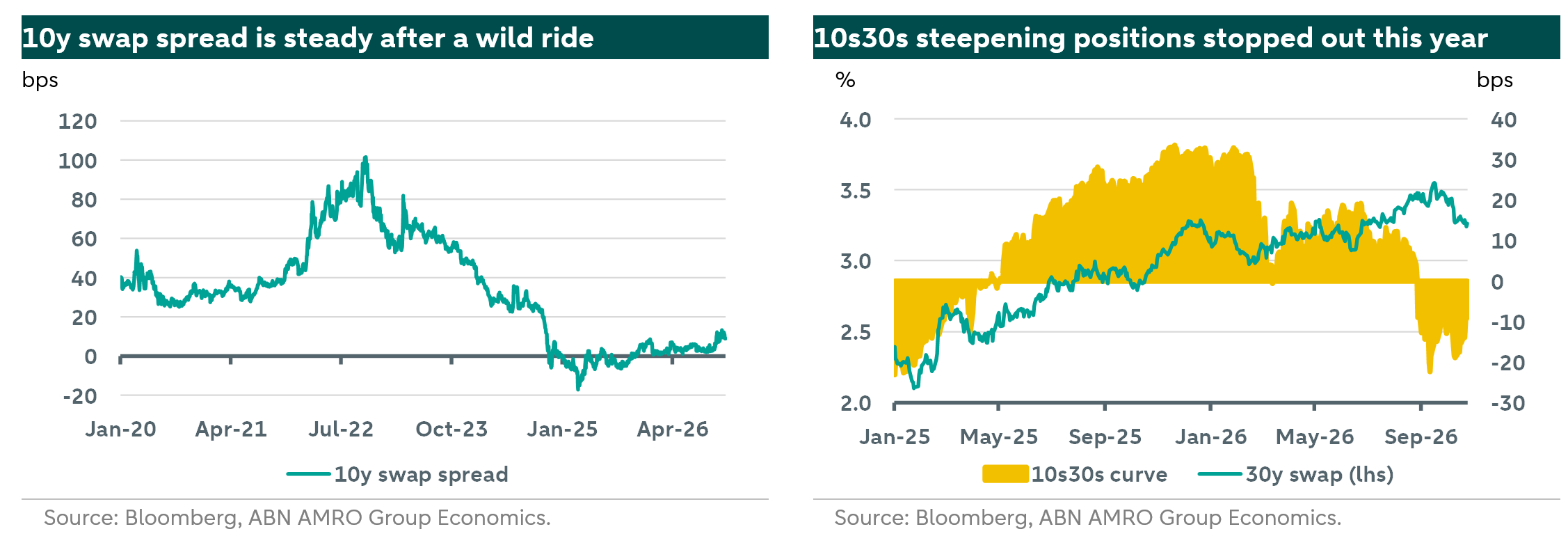
We expect the 10-year swap spread to trade around 10bp in the first half of 2027, before narrowing to 5bp from Q3 onwards, rather than turning negative again. Higher Bund issuance and continued ECB QT have already reduced Bund scarcity and contributed to a tightening in swap spreads. While we expect some further normalisation in Bund term premia in 2027, at the 10-year point we think this adjustment will be relatively modest, with the more pronounced repricing concentrated at the ultra-long end. As a result, we see limited scope for Bund-specific term-premium pressures to drive a renewed and sustained cheapening of 10-year Bunds versus swaps. Moreover, as the recent French flight to quality demonstrated, Bunds retain their safe-haven status. This should support demand for Bunds, particularly early next year while France’s outlook remains uncertain ahead of the presidential election and possible subsequent parliamentary elections. As a result, we expect 10-year swap spreads to trade slightly above our year-end estimate of 5bp during the first months of 2027.
Another key development for the swap market is the Dutch pension sector’s transition from a defined benefit to a defined contribution framework. The transition is well under way: around a third of the sector, measured by assets under management, has already moved to the new framework, with the next wave of pension funds due to follow on 1 January. This will bring significant changes to investment practices and associated interest rate hedging strategies (see also for our latest pension fund note). Our analysis suggests that the introduction of a life-cycle investment approach, under which participants’ asset allocations and interest rate hedges are determined by age, will shift hedging from the 30-year point towards shorter maturities, centred around the 10-year point on the curve. The overall volume of interest rate hedging required will also decline, primarily because the new framework requires fewer reserves.
This shift in hedging will put steepening pressure on the swap curve, including the 10s30s segment. However, macroeconomic developments and monetary policy expectations have a much greater influence on curve dynamics. Last year, unchanged policy rates anchored the short end, while higher term premia lifted long-end rates, steepening 10s30s swaps and other developed-market curves.
Against this backdrop, the market impact of the pension transition at the beginning of this year was limited for two reasons. First, pension funds have up to a year after their transition date to rebalance their positions towards their target allocations. Larger funds, in particular, took several months to do so. Second, many investors held offsetting positions at the start of the year, helping to absorb paying flows at the long end of the curve.
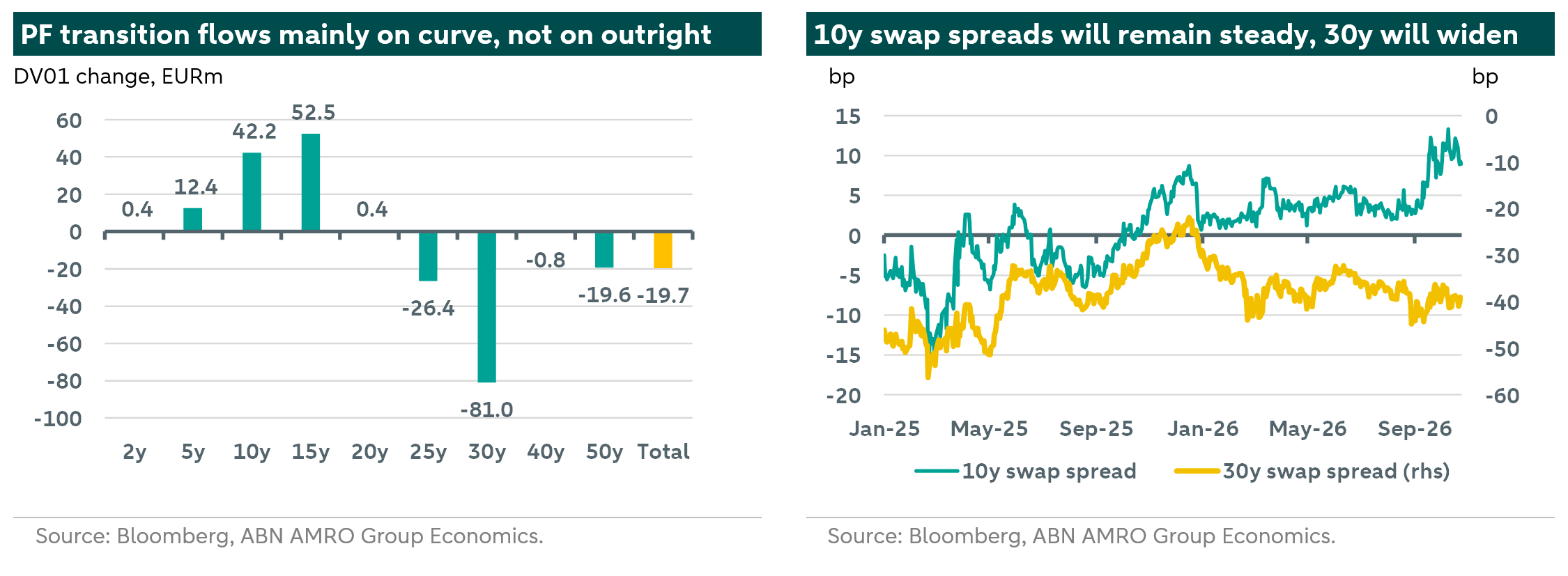
Market positioning has since changed. The outbreak of war in Iran in March prompted many investors to unwind their steepener positions, and the 10s30s swap curve flattened further in September. With considerably less scope for offsetting flows, we expect the next wave of the pension transition to have a greater market impact, particularly at the 30-year point. As the overview in the next page shows, we expect total repositioning on the 10s30s curve to amount to around EUR 110mn in DV01 terms. Dutch pension funds’ dominant position at the 30-year point, combined with lower demand for 30-year receivers even after the transition flows have been completed, leads us to expect the 30-year swap spread to widen. The continued increase in 30-year Bund issuance will partly temper this widening. Still, part of the pension transition’s impact has yet to be absorbed and should affect swaps more directly than Bunds, supporting 30Y swap-spread widening even as additional Bund supply restrains it.
Conclusion and curve outlook
Overall, we expect lower front-end yields alongside curve steepening and relative spread changes further out, although the drivers differ across markets. In Bunds, the expected decline in 2Y yields as markets start to price in ECB cuts supports further 2s10s steepening. Further out, however, the directional view is less clear: more limited downside in 10Y yields and increasing term-premium pressures at the ultra-long end support 10s30s steepening and greater upward yield pressure at 30Y relative to shorter-duration Bunds.
Within EGBs, relative spread dynamics should differ from the absolute direction of rates. At the front end, 2Y DSLs offer attractive carry and roll and relatively low spread volatility. Further out, 10–15Y SPGBs offer attractive carry and roll, while relatively benign Spanish supply should support spread tightening. At the ultra-long end, the more favourable Dutch supply outlook relative to Germany should support further DSL–Bund spread tightening. Political and fiscal uncertainty and materially higher net issuance should keep OAT and OLO spreads under pressure, while BTPs face spread risks despite their more attractive carry.
In euro swaps, we expect EUR IRS 10s30s steepening, as the Dutch pension transition shifts receiving demand towards 10Y and away from 30Y. With fewer offsetting market positions than during the previous transition wave, these flows should have a greater impact, supporting more pronounced steepening in swaps than in Bunds.
In US Treasuries, we also expect steepening, but primarily in 2s10s as markets price eventual Fed easing. Elevated fiscal, refinancing and term-premium risks limit the scope for a sustained long-end rally.
Across markets, we expect greater US Treasury than German 2s10s steepening. The US offers greater scope for policy repricing: markets price in more Fed hikes and less subsequent easing than we expect. ECB pricing broadly matches our near-term hiking view, although not the subsequent cuts. Within the 10s30s segment, however, we expect greater steepening in Germany than in US Treasuries on a longer horizon, as higher German net issuance and continued Eurosystem runoff exert greater pressure on the ultra-long end, while broadly stable US net borrowing, potentially smaller long-end auctions and the Fed’s current balance sheet expansion temper direct US supply pressure.
ABN AMRO Rates forecast