Eurozone - Early signs of the German spending push
Q4 GDP surprised to the upside, driven partly by the usual suspects (Spain), but Germany was a notable contributor after years of tepid growth, while France was resilient in the face of budget uncertainty. We are seeing early signs of Germany’s spending push, particularly in defence-related factory orders. The strengthening domestic economy adds to our conviction of an on-hold ECB. Beyond near-term policy, the changing of the guard on the Governing Council will be key over the coming 1-2 years.


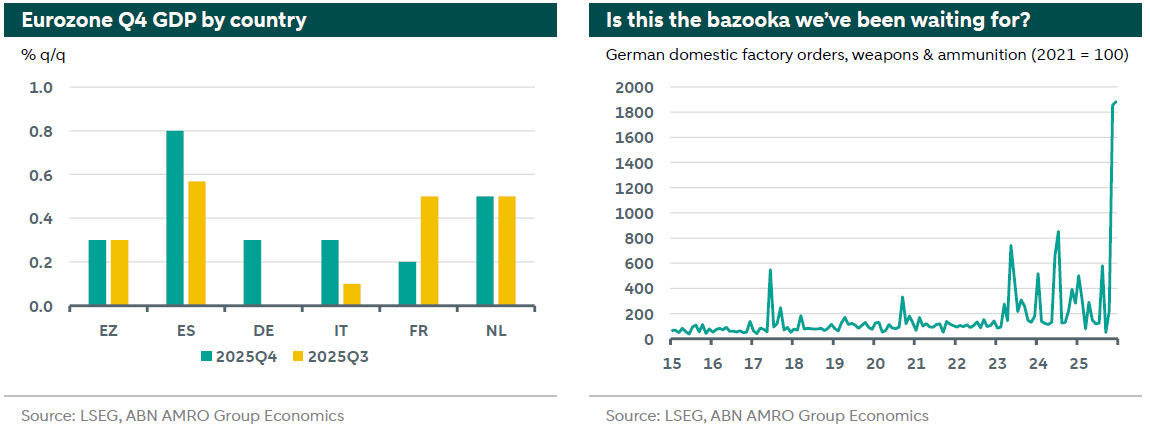
Eurozone GDP surprised to the upside in Q4 at 0.3% q/q, above our (0.1%) and consensus (0.2%) forecasts. Incoming data had already suggested strength in the domestic economy, but we expected net exports to have been more of a drag. Full details for the eurozone aggregate will be released next week with the 3rd estimate, but piecing together the details from individual countries suggests that household consumption and government spending were significant drivers of growth in Q4, while net exports were indeed a drag in most countries – with some exceptions such as the Netherlands and France (the latter largely due to falling imports). Looking at country level data, GDP growth was particularly strong again in Spain (0.8% q/q), while France was surprisingly solid (0.2%) considering this came after an already very strong Q3 (0.5%). This suggests the private sector appeared to shrug off the uncertainty surrounding the 2026 budget wrangles.
All told, the eurozone economy continues to be resilient in the face of extraordinary uncertainty and US tariffs. We expect the latter to continue to weigh on exports over the coming months, keeping a lid on headline GDP growth, but we expect the domestic economy to continue to firm this year on the back of reduced caution on the part of households and businesses and rising German government spending. Indeed, Germany contributed notably to the upside surprise in eurozone Q4 GDP, with the German economy expanding by 0.3% q/q, up from 0.2% q/q in the preliminary estimate of Destatis. While German industry is not out of the woods yet, factory orders unexpectedly strengthened further in December following a jump in November, with orders growth accelerating to 13% y/y from 10.6% in November. The details showed domestic orders leading the surge, particularly (and not so surprisingly perhaps) in defence-related sectors such as weapons and ammunition – where orders were up a whopping 569% y/y in December.
The strengthening domestic economy adds to our conviction that the ECB will keep policy on hold for the foreseeable future, despite the current inflation undershoot (which we expect to be short-lived), and euro strength (which is largely dollar-driven rather than in the trade-weighted exchange rate). Beyond near term rates, important news for medium term ECB policy is that Governing Council President Lagarde looks likely to step down ahead of the end of her term in October 2027, according to reports from the FT. The two main frontrunners appear to be former Spanish central bank governor (and current head of the BIS) Pablo Hernandez de Cos, alongside former Dutch central bank governor Klaas Knot. Whether Lagarde leaves early or not, the ECB is set to see significant changes in the makeup of the Governing Council over the coming 1-2 years, with Vice Chair de Guindos and French central bank governor Villeroy stepping down on 31 May, while chief economist Philip Lane and Isabelle Schnabel set to leave next year (in May and December respectively). See our note here for more.