Global Monthly - The Hormuz stand-off
The Iran conflict has morphed from a hot war to an economic one, with both sides using the Hormuz chokepoint as negotiation leverage. Energy supply disruptions are bigger than ever, but market worries have subsided, with peace efforts given the benefit of the doubt. We make only incremental forecast adjustments this month, keeping our core view that severe energy disruptions persist to end-May. We also update our more positive and negative scenarios for the conflict.


Global View: Still searching for a durable off-ramp
The Iran conflict clearly continues to dominate the near-term outlook, but although physical energy supply disruptions are bigger than ever, energy prices have fallen back, with the mood music in markets shifting once the US and Iran agreed a (just extended) ceasefire. As we wrote when the ceasefire was announced, developments so far remain in line with our base case, which does not take a view on the conflict itself but rather the extent and timing of the end of severe energy supply disruptions (to end-May). Given this, we refrain from making further material changes to our base case for growth, inflation and central banks this month, but we do make some incremental adjustments that take account of fiscal policy measures and evolving central bank reaction functions. Most notably, it has become clear that the ECB won’t be ready to hike at next week’s Governing Council meeting, though we think it will be ready to do so at the June meeting. In light of the continued uncertainty – and the likely fragility of any peace deal that may or may not materialise over the coming days – we also update our thinking on alternative scenarios to our base case, including touching on what a realistic worst case scenario could look like. Noteworthy is that a more positive scenario would still see inflation staying above target for sometime yet, while even in the most negative scenario, we still would not expect the inflation impact in Europe to be anywhere near as large as in the 2022-23 energy crisis. Significant demand destruction in emerging markets in response to high energy prices is likely to happen long before recessionary forces would take hold in advanced economies. As such, we continue to see a recession only in the most negative scenario, and even then, confined to Europe rather than the US.
Incremental updates to our base case
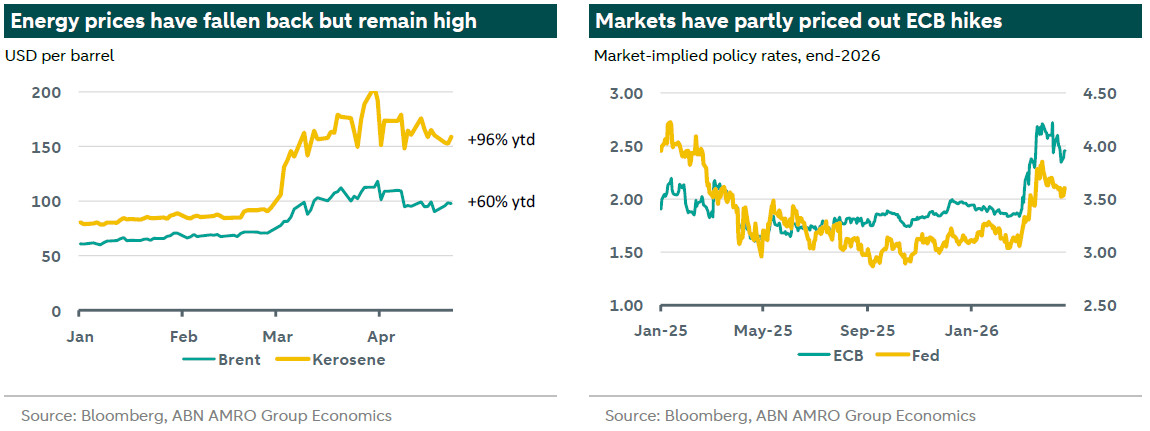
Our base case continues to assume that severe energy supply disruptions last until the end of May. This keeps energy prices at elevated levels for some time yet, with Brent crude oil prices expected to average $100 per barrel over the course of Q2, before gradually moving lower through the year. While the prospect of a longer term peace deal between Iran and the US has pushed energy prices lower, and led to a pullback in pricing for central bank rate hikes, we note that in terms of energy supply, the situation has actually worsened compared to a month ago, due to the US blockade on Iranian crude exports. Iranian crude had been the only source of energy supply still making its way through the Strait until recently. suggest the blockade has not been watertight, but the supply situation is still on-net worse than it was. Meanwhile, though the US has extended (seemingly unilaterally) the ceasefire indefinitely, negotiations themselves on Iran’s nuclear enrichment look to have stalled. Both the US and Iran are now essentially in a standoff over the Strait of Hormuz, using access to the chokepoint as leverage in their nuclear negotiations. Put another way, the war seems to have morphed from a hot war to an economic one. On the positive side, it has become clear that neither side wants to restart military action. On the other hand, there is no clear path yet to a durable peace agreement, with a lot of mistrust on both sides. Even if a deal is struck in the coming days, meanwhile, it could well be a fragile one.
While current events remain consistent with our base case, we have made some incremental adjustments to our forecasts this month, mainly in the eurozone and to the ECB view (see eurozone for more). Though Governing Council members are clearly guiding against an April hike, they have also largely expressed comfort with market pricing for two rate hikes over the coming months. We are therefore pushing rate hikes out – to June and July rather than April and June – but we do still see them happening in our base case.
What if a peace deal is reached soon, and what if it is durable?
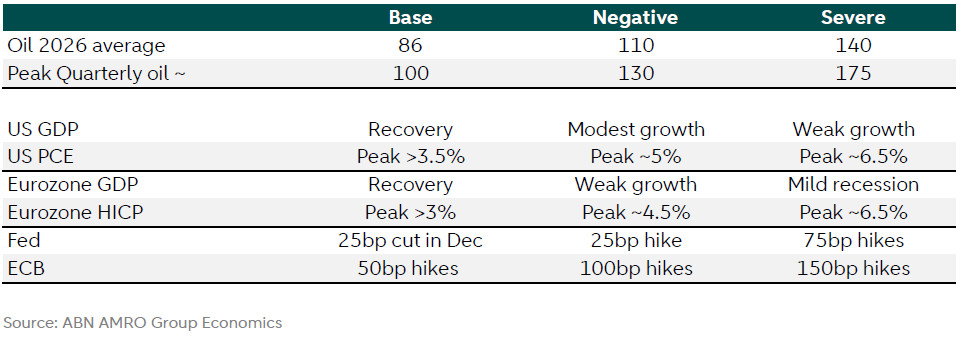
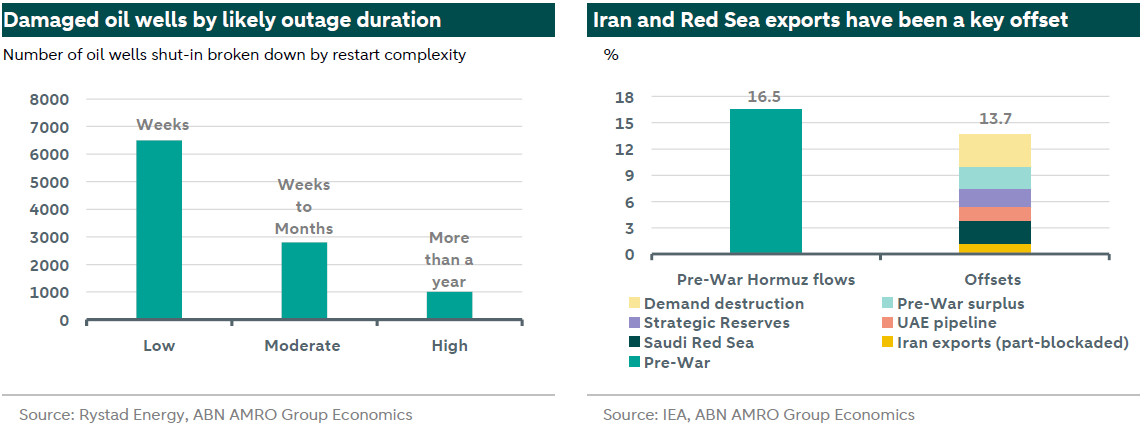
What of alternative scenarios? We start with a more positive scenario, where a deal is struck in the coming days and the Strait of Hormuz is completely reopened. Instead of holding around current elevated levels for a time, energy prices could normalise more rapidly – with Brent crude perhaps falling more quickly to around $80-85 per barrel for a time. However, we think there are limits to this, and markets could well overshoot to the downside before rebounding as the scale of the residual supply shock becomes clear. First, even with a full re-opening of Hormuz, it would take time for shippers to fully trust that the peace deal is durable and that Hormuz really has safely re-opened (especially in light of the stop-start manner that this has gone in recent weeks). Second, energy output would also take months – in some cases years – to be restored back to pre-war levels. Coming alongside the need to replenish depleted stocks of downstream refined products, particularly diesel and jet fuel, tightness in the energy market would likely persist for a while yet. See the table below for a summary of current infrastructure damage.
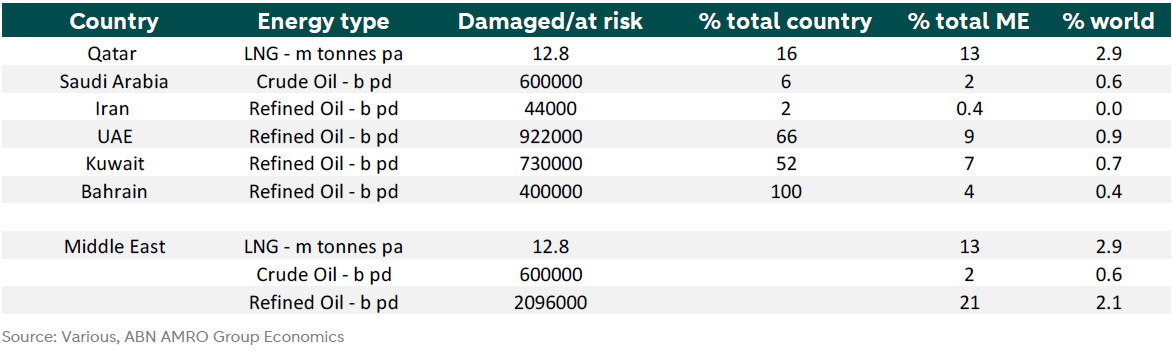
Adding to probably still somewhat elevated risk premium in the early stages of any peace deal, this will likely put a floor under energy prices, which are likely to remain meaningfully higher than before the war broke out. Even in a positive scenario, then, we would expect for instance inflation in the eurozone to stay above the ECB’s target for much of the remainder of this year. While the ECB might then be more minded to look through the shock, there would still be a risk to inflation expectations that could prompt action.
What about more negative scenarios?
What if the conflict ends up re-escalating? And what could a realistic worst-case scenario look like? Below we outline how more negative scenarios could pan out. A key take is that while there negative scenarios would be much worse than our base case in terms of outcomes, the scale of the inflation shock would still be much smaller than we saw in 2022-23.
Negative scenario
In this scenario, vessel traffic through the Strait of Hormuz remains well-below normal levels for a prolonged period – for the remainder of this year. There is more damage to energy infrastructure. Brent crude prices jump to an average of around $130 per barrel over Q2-Q3, and on an intraday basis prices could spike as high as $150. European gas prices would jump to an average €120 per megawatt hour by Q4 with intraday spikes up to €180/MWh. Some energy rationing in Europe would be needed, particularly of jet fuel, leading to more meaningful disruption of activity. Inflation would peak at 4.5-5%, the ECB would hike rates by 100bp to take the deposit rate to 3%, while the Fed would also probably be pushed to hike in this scenario. Growth would be weaker than our base case but we would still expect advanced economies to avoid a recession.
Severe (reasonable worst-case) scenario
The energy supply blockade extends from Hormuz to the Red Sea, choking off a key offset to the current supply disruptions. At the same time, damage to energy infrastructure is even more severe and widespread, making largescale quick restarts more difficult, even once the conflict subsides. Brent crude prices jump to an average of around $175 per barrel over Q2-Q3, and stay at very elevated levels for longer. Inflation would peak around 6.5%, and the combination of energy rationing, the confidence shock and central bank tightening would push the eurozone into a mild recession. The US would still avoid a recession but growth would be very weak. The ECB would be expected to hike yet further, by 150bp in total, taking the deposit rate to 3.5%, while the Fed would hike 75bp taking the upper bound of the fed funds rate to 4.5%.