Global Monthly - Will the bond sell-off derail the economy?

The global economy has shrugged off repeated shocks, but rising bond yields are emerging as a new challenge to the expansion. Bond markets are mostly pricing higher neutral rates, with fiscal concerns adding to yield increases in France, Belgium and the UK. Higher rates may slow the expansion, but they are unlikely to derail the US or eurozone economies on their own. The growth impact will be bigger in fiscally vulnerable economies, with France facing the twin challenge of consolidation and bigger rate rises. Markets may be overestimating how long policy rates will stay elevated, leaving room for bond yields to fall back next year. Regional updates: Rising yields temper rate hike pace in the Eurozone. We raise our growth forecast in the Netherlands following a strong H1. In the US, narrower inflation reduces the urgency of the Fed to hike. Growth gains momentum in China helped by targeted fiscal support


Taking on all comers
The global economy has remained robust this year despite an array of shocks. Consensus estimates of economic growth have been revised up over the last few months as economic data surprises have been persistently positive. This reflects a combination of the shocks not being large enough to derail the economy, the agility that various sectors have shown in adapting to new conditions as well as the powerful support of several structural investment cycles, not least AI (see here). It feels just like a strong man at a village square challenging and subsequently beating all comers, while the villagers gather around cheering. Certainly markets have continued to cheer, as company earnings expectations have seen ongoing upward revisions. No one apparently can knock this guy down. But maybe now there is a new challenger, a new risk. The latest potential shock the global economy is facing is the recent surge in government bond yields, which have seen an acceleration of the rise that started earlier in the year. This has led to questions of whether the bond sell-off is now a real threat to the economic expansion, or whether the rise is actually just a function of the expansion.
Rising bond yields reflect changing r* expectations
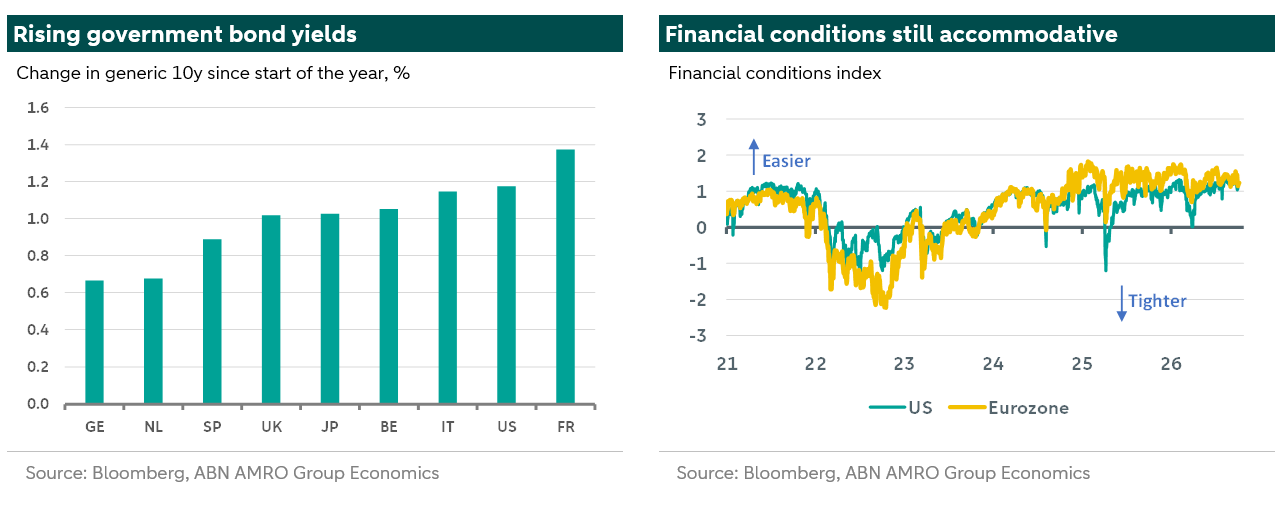
The rise in government bond yields since the start of the year has been a phenomenon seen across advanced economies. The extent has differed however. For the 10 year, it varies from 140bp for France and 120bp for the US, to just around 70bp for Germany. Our model estimates suggest that around 90% of the change in German and US yields is due to changes in monetary policy expectations, with the remainder coming from relatively modest rises in term premia. In addition, inflation expectations have been rather stable. This suggests that what we may well be seeing is markets re-evaluating where they think real interest rates will settle over the coming years.
Fiscal risks important in some cases
Over and above that, term premia have been rising more significantly in countries with fiscal challenges (with the exception then of the US), with estimated rises in the UK (around 30bp), Belgium, Italy and Japan (around 50bp) and most of all France (around 80bp). So the basic story seems to be that markets are mainly re-evaluating where the real neutral or equilibrium rate is (also known as r*), while we are also seeing some pricing in of fiscal risks and sometimes political uncertainty for some countries. We do not see much pricing of fiscal challenges and rising bond supply in US 10 year yields, however this is entirely different in the long-end of the curve. The 30y term premium has risen by around 50bp since the start of the year and it is now at the highest levels for more than twenty years. So, even reserve currency status does not mean your bonds are fully immune in a situation of surging bond supply. In addition, hyperscaler bond supply has become a significant new force competing with Treasury securities, especially at the longer end of the curve.
Impact of higher rates might be less than it was
What impact will rising yields have on economic growth? The rise in yields mainly reflects a shift in monetary policy expectations. So, one way to get an idea of the scale of the likely impact, is model estimates of the impact of a 100bp policy rate increase on economic growth. Fed estimates suggest that 100bp increase in the Fed funds rate reduces economic growth by around 0.4-05 percent after 18 months (see and ). The various models used by the ECB shows economic growth effects in a wide range 0.3-1.25 percent effect after around two years (see ). However, the impact of the ECB’s rate hike cycle that kicked off in 2022 suggest that the impact on the economy was at the lower end of that range, which is more in line with the Fed’s estimates for the US economy. A 0.5 percentage point impact on economic growth over a year or two would not derail the US or eurozone economies.
Higher yields are partly reflecting optimism on economy
In addition, the current context also suggests a relatively benign impact. First of all, the rise in real interest rates reflects optimism on the economy, i.e. it is reacting to better growth outcomes than previously expected. Second, partly because of this, higher yields have not had a significant impact on risky assets, which has left overall financial conditions in the economy accommodative. In terms of our economic forecasts, we think financial markets might be pricing in a higher and more sustained peak in interest rates than will likely materialise. We therefore expect bond yields to go down again next year, which further limits the impact on our own growth projections of the current rise in yields. Still, overall, higher rates will have some dampening effect, and this was reflected in the downgrades to our growth forecasts in our update note last month (see here).
Impact likely more negative for Les Misérables
Of course, as discussed above, for some countries, the rise in yields is much more than an upward adjustment of real rates due to economic resilience. Rates have risen over and above that effect in a number of economies, not least France (but also Italy, Japan, Belgium and the UK). Their yields have also risen more than other countries due to fiscal risks, so one would also expect the growth impacts to be greater in those economies than on average. In addition, rising debt service costs will add to existing vulnerabilities, potentially pushing these governments towards more fiscal consolidation. Budget cuts might then ease market worries, but they would also then have an additional dampening effect on economic growth. A prime example is France, where the minority government has announced a EUR 54bn fiscal effort (1.7% of GDP) with the goal of containing the deficit to 5% of GDP for 2027. Fiscal consolidation is likely to be considerably diluted, but we do expect a 2027 budget to be pushed through in some form this year and this will likely dampen growth. With the debt service burden continuing to rise, the French government has to run just to stand still (see our recent note on France here).