The Netherlands - A tailored support package
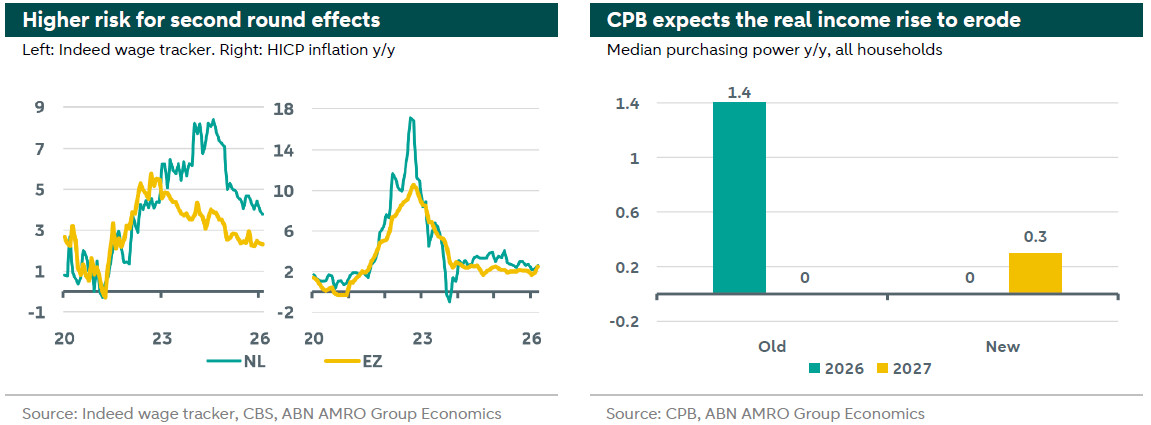
While downside risks have clearly increased, we expect Q1 GDP to come in at 0.4% q/q. The Dutch cabinet has proposed various measures to support households and companies. The risk of second round effects on wages and inflation is bigger for the Netherlands. Rather than rising, the new bout of inflation will mean purchasing power stagnates in 2026.


On the 30th of April, Q1 GDP will be published, which we expect to come in at 0.4% q/q. While the conflict in the Middle-East that erupted on the 28th of February has a substantial impact on consumer confidence and producer confidence (producer prices and delivery times both increased) the growth impact is expected to be more limited in the near term than say the energy shock of 2022 was. Amongst others due to solid underlying economic momentum at the start of the year and resilience, with prudence of recent years – reflected by an elevated savings rate – being a source of strength going forward. Risks to our Q1 forecast are clearly tilted to the downside. Additionally, as the impact of the conflict in the Middle East on growth is expected to peak in the middle of 2026, we will likely lower our growth forecast and these effects will also weigh on the 2027 growth figure.
This week, the Dutch cabinet has proposed various measures to support households and companies. Rather than a fuel tax cut, it is a tailored package which includes for instance travel expense reimbursement for employees, an energy emergency fund for vulnerable households, extra funding for isolation of houses, and reducing the motor vehicle tax. Still, all in all it is a small package, to allow for further stepping up of support later on. The proposed package is fully funded, for instance by raising levies on alcohol. It does however mean that the price difference with neighbouring countries, which have reduced petrol prices, remains large. For instance, the price difference with Belgium can amount to 55 cents per liter. We studied the effects on fuel-tourism and concluded that households living in the border region now fill up an average of 4 to 5 liters extra per week in Belgium.
The rise in energy prices was already visible in the March HICP inflation figure, which edged up to 2.6%. Energy prices will reach households in various ways. Directly and quickly through petrol payments, and slower through energy bills, which show a gradual effect since the majority of households are in a fixed price and are therefore not yet affected. The indirect hit comes through energy being an input for numerous production processes, raising price pressures in energy-intensive goods and services. As such we expect a broadening of inflationary pressures in the coming months. For the Netherlands, the risk of second-round effects on wages and inflation expectations is higher due to: (1) the elevated starting point of inflation; before the conflict erupted, inflation was still above the targeted 2%, (2) higher wage growth; with CLA-wage growth at an elevated 4.6% in March the Dutch economy is still digesting second-round effects of the 2022 energy shock, (3) a still tight labour market; unemployment edged down again to 4% in March, and (4) relatively low gas storage supplies. Additionally, as the cabinet has opted for a more tailored package than a fuel tax cut, this does mean that the divergence with the eurozone aggregate inflation figure becomes larger (see eurozone).