UK Budget: Don’t rock the boat

Newly appointed Chancellor of the Exchequer, John Healey, is unlikely to rock the boat when he delivers his first budget this Wednesday. Rising debt-servicing costs, with Gilt yields near multi-decade highs, are eroding the Chancellor’s fiscal headroom… but the UK’s high inflation means wage growth is likely to be a crucial offset, making room for a potential positive surprise. We expect the Chancellor to prioritise rebuilding fiscal headroom, while balancing targeted tax rises with limited cost-of-living support. Our base case sees Healey erring on the upper end of credible headroom estimates of around £18-24bn. Below £14bn, the Chancellor risks a negative bond market reaction. Headroom above £24bn is likely to result in a positive market reaction. Macro & rates implications likely limited: we expect solid growth, elevated inflation, and two BoE hikes over the coming months.


Adrian Quinn
Economist Intern
Almost a model student… for now
With France currently stealing the limelight in government bond markets, incoming UK Chancellor Healey will not want to rock the boat when he presents his annual Budget on Wednesday. We expect a broadly market/macro-neutral announcement. The UK has already done much of the fiscal heavy lifting needed to put government debt back on a sustainable trajectory, and as we will describe in this note, there might even be room for a positive surprise given the cautious assumptions of the OBR, the UK’s budget watchdog. The government still faces challenges, however. There is likely to have been some deterioration in the buffer against meeting the UK’s fiscal rules, and the new Chancellor’s fiscal credibility will be measured by how much he chooses to rebuild that buffer. Healey will also have to balance targeted tax rises against some limited cost-of-living relief for households.
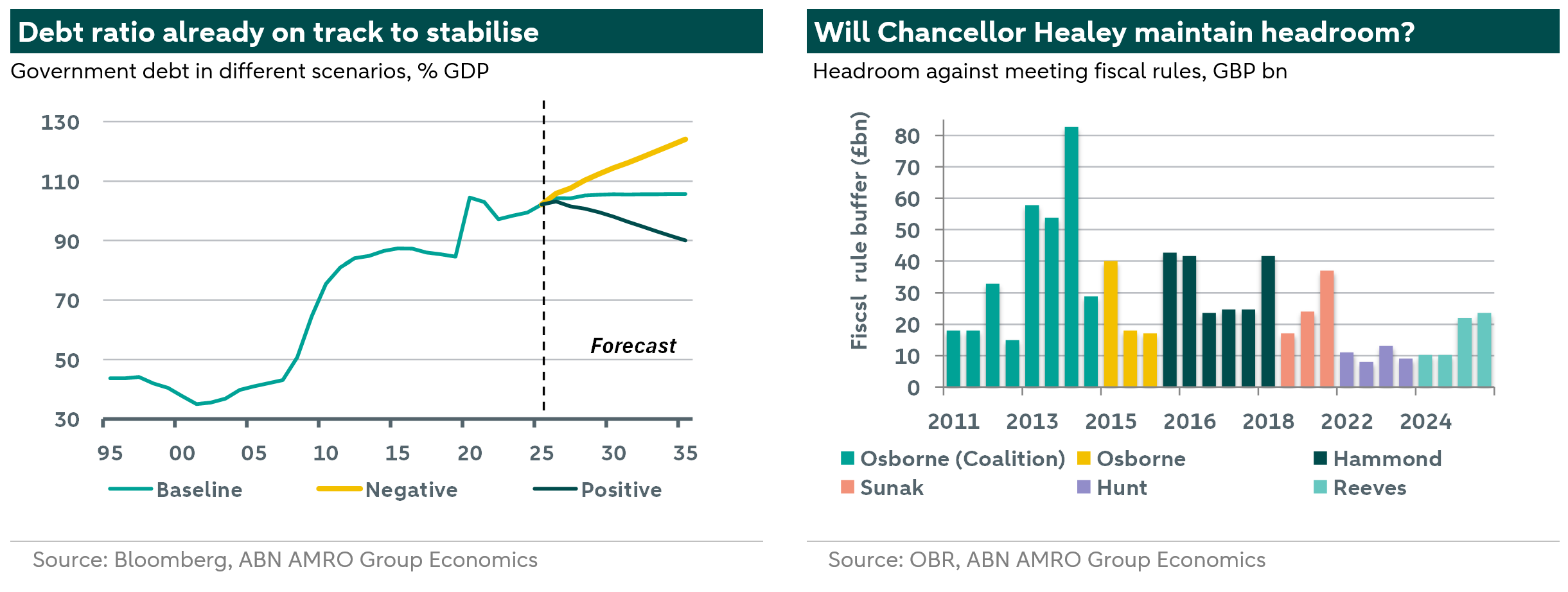
Following the Liz Truss debacle of 2023, The UK has emerged as something of a model student on fiscal consolidation. The primary deficit is expected to narrow from 4.0% of GDP in 2024 to 1.2% in 2026, an improvement of almost 3 percentage points in just two years. This has been driven by the withdrawal of temporary support measures following the 2022-23 energy crisis, frozen personal tax thresholds and last year’s increase in employer National Insurance contributions. The overall budget deficit (including interest payments) is expected to narrow to around 3.8% of GDP this year, and 3.1% in 2027 – well off its recent peak of 6.1% GDP in 2024. This is despite an ongoing rise in interest costs. The debt ratio itself is likely to fall slightly to around 102% of GDP this year, from 102.3% in 2025, helped by relatively high nominal GDP growth. While the criticism can still be levelled that further fiscal consolidation is more backloaded, the progress in bringing down deficits so far is also clear. In the medium term our baseline continues to see a broad stabilisation in the debt ratio – though risks now look tilted to a more positive scenario where the UK achieves a slight decline in the debt ratio, consistent with the UK’s fiscal rules.
Resilient economy – and even inflation – has helped
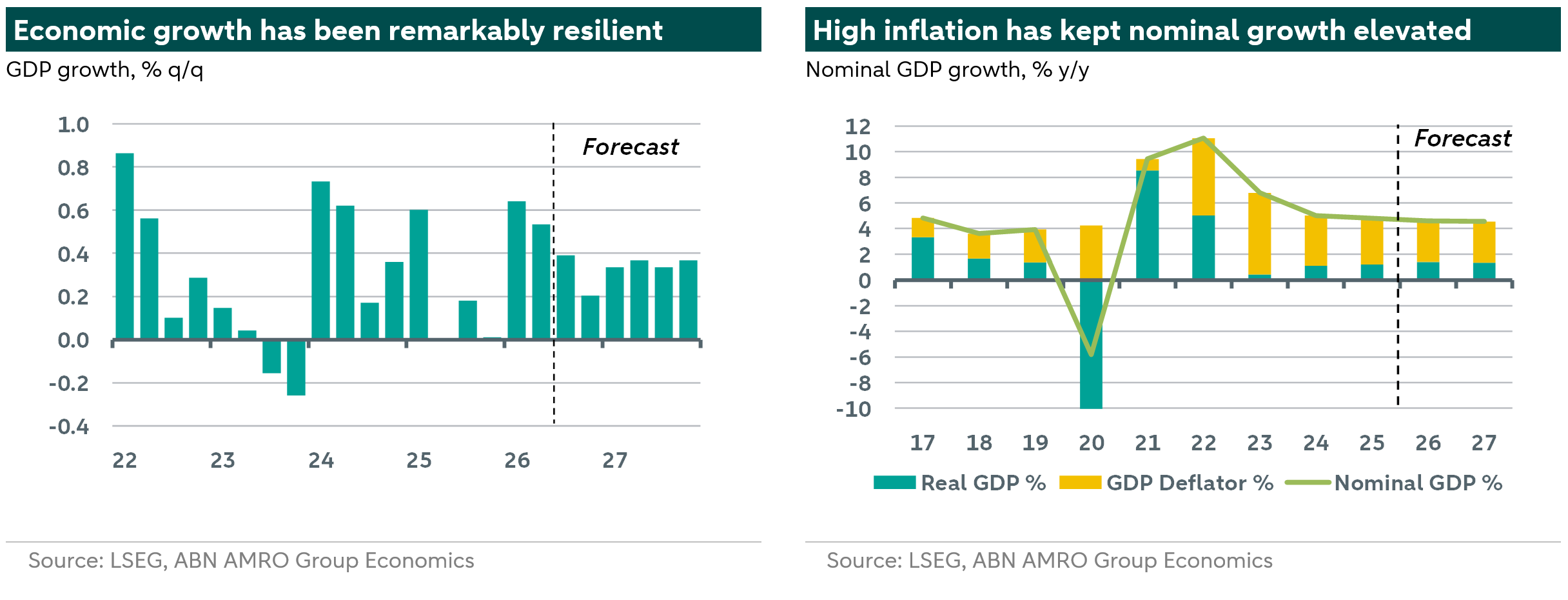
Despite facing the same challenges that many of its global counterparts are experiencing – surging bond yields, prolonged inflation, and fiscal tightening – the UK economy has been remarkably resilient this year. On the output side, services, particularly professional and ICT, have been important contributors to growth. Added to solid growth in investment (we suspect linked to AI capex) and an uptick in private consumption – reflecting a decline in consumer caution – we expect the economy to expand by 1.4% this year, and by the same amount in 2027. This is 0.4pp higher than our growth expectation at the beginning of this year. Still, while showing resilience, the energy shock and higher interest rates will likely become a bigger headwind next year, constraining real incomes and dampening domestic demand.
Inflation, long a bugbear for the UK economy, has if anything been a net positive for fiscal health. While it puts upward pressure on welfare spending and has pushed interest rates higher, it has also led to higher wage and nominal GDP growth. The former is particularly important given that one of the government’s main fiscal levers has been the freezing of income tax thresholds. This has led to some 22% of UK taxpayers now paying a higher rate of income tax, compared with 15% when the threshold freeze was first implemented in 2021. This figure is likely to rise to around 25% by the time the threshold freeze is set to end in 2030/31.
But inflation poses challenges for spending commitments…
Still, while inflation is a clear positive for revenues, it does pose its challenges. Aside from higher inflation-linked welfare spending, it also erodes real departmental budgets. The IFS has estimated that to avoid these real term cuts, while meeting defence and health care commitments, could require £35bn in some combination of tax increases, benefit reductions or additional spending restraint over the forecast period. Defence is a particularly contentious point for Healey, as he resigned as Defence Secretary earlier this year, arguing that the Defence Investment Plan was not sufficient to meet the 3% of GDP ambition for 2030. To raise the 2.7% of GDP pledge to 3% would require an additional £11bn in defence spending in 2030-31. To cover healthcare commitments and to avoid real cuts in other departments, the IFS estimates an additional £9bn will be needed in 2030-31. We do not expect the government to meet this entire requirement in this Budget. Difficult though it may be for the Chancellor, we suspect he may have to water down the defence spending goal, for instance, while protecting healthcare spending. Protecting health and expanding defence while relying on large, unspecified savings elsewhere would risk undermining the credibility of the government’s medium-term spending plans.
…while also demanding cost-of-living relief measures…
PM Andy Burnham has relied more on vibes than real policy action for its current honeymoon-like popularity in the opinion polls. He has been much better at expressing empathy for the public’s struggles with cost of living pressures than his predecessor Keir Starmer. But vibes can only take you so far, and with inflation rising again, Healey is under pressure to deliver some cost-effective but visible measures in the budget. We expect these to be symbolic and piecemeal rather than something that moves the macro needle – in stark contrast to the very generous fiscal responses during the pandemic and energy crisis. The government has temporarily removed VAT from domestic electricity bills for six months from October 2026, saving a typical household around £25. This offsets less than half of this month’s £60 increase in the annual energy price cap. Much bigger rises in energy bills are still to come, given the doubling in wholesale gas and electricity prices over the past few months, and the lagged pass-through of this due to the Ofgem price cap. The Chancellor is expected to provide a package to help with higher winter fuel bills, while also cancelling planned increases to fuel duty. He is also expected to announce the “Your First Home” scheme, a successor to Help to Buy offering government equity loans of 20% and requiring a deposit of just 2.5% on eligible new-build homes. While the scheme exposes the government to some risk in the housing market, it should be broadly fiscally neutral over its lifetime and could even generate a positive return, as the previous Help to Buy scheme has done on loans redeemed to date.
…likely paid for with targeted tax rises
On the revenue side, major tax rises are unlikely given the significant rises of recent years, and Burnham’s recommitment to the 2024 Labour Manifesto. This ruled out any increases in the main taxes – namely income tax, VAT or employee National Insurance. Corporation tax also should not see any increase, given the pledge to freeze it at its current rate of 25% until the end of the parliament. More likely are some targeted tax rises. The most likely measure is an increase in the surcharge on bank profits, a move which is politically easy given that banks have profited from recent rises in interest rates. Capital gains tax has also been the subject of much focus. Although the Chancellor has reportedly ruled out a radical proposal to equalise capital gains with income tax rates, a more modest rise is still possible. The government may also be considering stronger VAT enforcement in the online economy to help finance business-rates relief for selected high-street firms, without formally increasing VAT or another headline tax rate. Still, much is uncertain and there is room for surprises given Healey’s apparent success hitherto in preventing leaks to the media.
A headroom headache? We see room for a positive surprise
The key focus for markets is going to be on one number: headroom. This is the buffer the chancellor maintains to avoid breaching its self-imposed fiscal rules (see Box). Headroom has been perilously low in recent years as the UK came under increasing fiscal pressure, though Healey’s predecessor Rachel Reeves worked hard to rebuild it. Up until recently, headroom was forecast to decline sharply on the back of the jump in interest rates we have seen this year, from £24bn to around £13bn. While there is still likely to have been a significant decline in headroom, we see room for a positive surprise, and this is linked to the Office for Budget Responsibility’s (OBR) wage growth assumption. In its report, the IFS recently pointed to the rather pessimistic wage growth assumptions underpinning the OBR’s forecasts: in the medium term, it expects wage growth to drop to just 2.2%, well below both the historic average (3.4%) and the past 10 year average (4.1%). With inflation of c2% and productivity growth of c1%, we would peg a cautious long-run wage growth assumption closer to 3% than 2%, and indeed the Bank of England forecasts wage growth of 3.1% in the medium term. Under this – in our view realistic – assumption, headroom actually increases to £38bn.
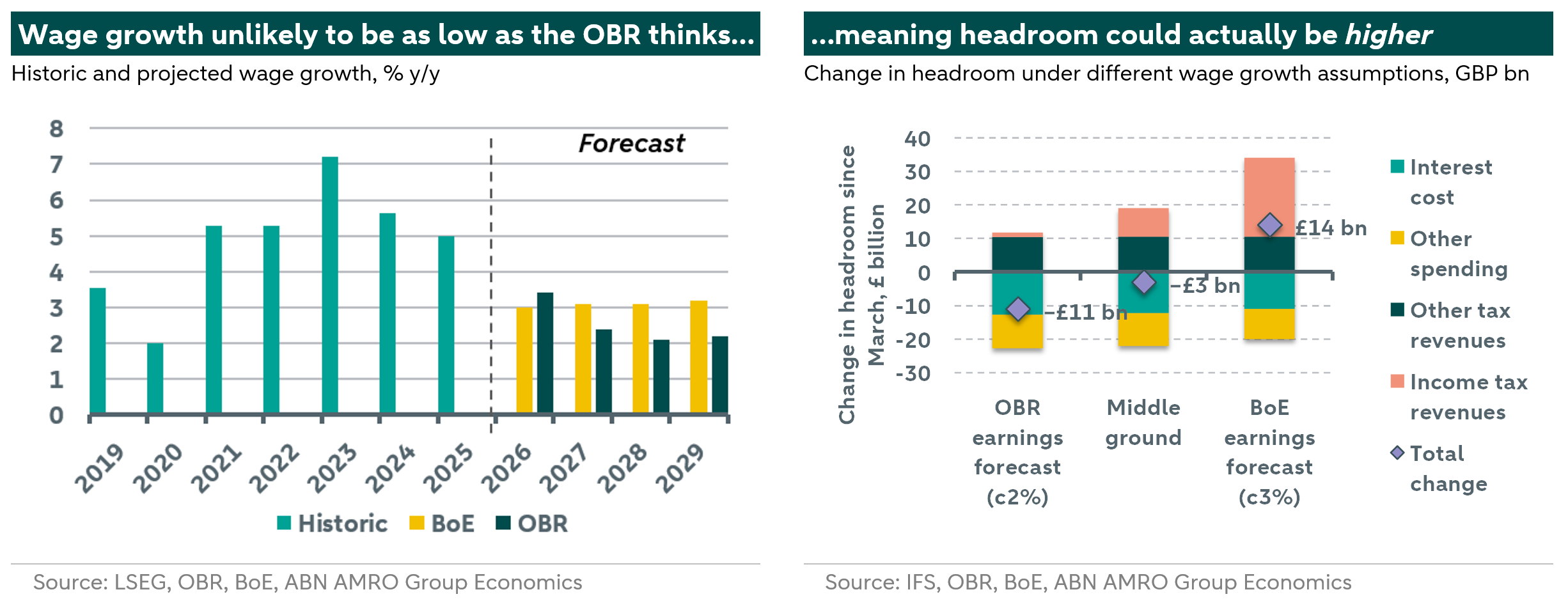
We doubt the OBR will completely alter its view on wage growth in a single forecasting round, but there is room for it to raise its forecasts, particularly given the prolonged energy shock and the likely room for spillovers this has to wage growth (even though we see this spillover to be much smaller than the previous energy shock). This therefore creates room for a positive surprise in the OBR’s ex-ante (i.e. pre-budget measures) headroom estimate, which would give the chancellor some extra fiscal space either to avoid some tax rises, or for more generous cost-of-living measures. If the OBR ultimately does not raise its wage growth assumptions, we would probably view their forecasts as unduly cautious.
Market response will hinge on post-measures headroom
Ultimately, markets will be most focused on the size and credibility of the headroom that remains after the Chancellor’s budget decisions have been accounted for. Given the sensitivity in bond markets right now, our base case sees Healey erring on the upper end of credible headroom estimates of around £18-24bn, i.e. something not too far from Rachel Reeves’ last budget. The lower bound of a satisfactory figure for markets is probably around the £14-15bn mark. Anything below that, and the Chancellor risks a negative bond market reaction. Anything close to or above Reeves’ £24bn is likely to result in a positive market reaction. While much of the rise in gilt yields reflects the global repricing of interest rates, insufficient headroom could add a UK-specific fiscal risk premium on top of this.
Limited macro implications; BoE still to hike rates
Our base case of a cautious and fiscally neutral Budget means that its macro implications are likely to be limited. Targeted household support will aim to cushion the real-income impact of the energy shock, while selective and modest revenue measures are unlikely to have a dampening impact on an economy with solid growth momentum. Inflation is expected to stay elevated – we see a peak above 4% by early 2027 – but the budget is likely to be neutral on that front. As for rates, we continue to expect the BoE to hike twice over the coming months to get ahead of a de-anchoring of inflation expectations, ultimately taking Bank Rate to 4.25% by February.
Box: The UK’s Fiscal Rules
The British government has operated fiscal rules since 1997, although successive governments have repeatedly altered their design. The current framework was introduced by former Chancellor Rachel Reeves at the October 2024 Budget. It contains two principal rules, both assessed by the OBR using its economic and fiscal forecasts.
The primary rule, known as the Stability Rule, requires the current budget to be in balance or surplus by the third year of the rolling forecast. In effect, borrowing may finance investment, but not day-to-day spending.
The Investment Rule requires public sector net financial liabilities, or PSNFL, to be falling as a share of GDP between the second and third years of the forecast. PSNFL is broader than conventional public sector net debt because it incorporates a wider range of financial assets and liabilities, including student loans, funded pension obligations and government equity holdings.
Compliance is measured using the concept of fiscal headroom: the margin between the forecast and the point at which a rule would be breached. Headroom should therefore be understood as a measure of fiscal resilience, rather than a pot of money available to fund new policies. It can increase or be eroded without any change in government policy, reflecting changes in nominal growth, tax revenues, gilt yields or spending projections. Unless otherwise stated, references to headroom generally mean headroom against the Stability Rule.
Simply complying with the fiscal rules is therefore unlikely to be sufficient to reassure investors. If headroom is small, markets are likely to focus more closely on the credibility of the underlying assumptions, the deliverability of future spending restraint and the government's willingness to respond if the outlook deteriorates. Establishing a current-budget buffer that markets judge sufficiently robust to withstand adverse shocks is therefore important for fiscal credibility.