US - A race against the clock
Warsh’s Jackson Hole speech increased the perceived odds of a September hike. The broader FOMC still seems divided. The speed of progress on the disinflation process is key. The labour market muddles along, with weak hiring and employment caught by dwindling supply.

All eyes are on the September FOMC decision. The minutes and Warsh’s Jackson Hole speech revealed that the FOMC thought it wiser to await new information in the intermeeting period. Where do we stand? Before the summer, we argued we had reached ‘peak hawk’ data, the height of inflation, and surprisingly strong non-farm payrolls. It was indeed the peak. Despite continued high oil prices and no end in sight of the Hormuz closure, inflation has been coming down, and non-farm payrolls came in weak over the summer, even if they recovered somewhat in the latest report.
Non-farm payrolls remain incredibly volatile. As we had predicted, the two summer readings were weak, but the latest August figure was another blowout at 162k. We see a large probability that this figure will be revised down. Meanwhile, the unemployment rate continued to trend down, now standing at 4.1%. This decline is mostly caused by a marked decline in participation rather than a fundamentally tighter labour market, even though the latest report saw a slight uptick in participation again. The latest report broke the trend of falling employment, showing a substantial increase, narrowing the gap between non-farm payrolls jobs and total employment growth. Beyond the latest figure, the annual benchmark revision removed 79k of the 165k jobs created in the year through March. Overall, this does not drastically alter the view, similar to how last year’s massive downward revision had no material impact on the assessment of the labour market. The labour market remains in its curious balance. Chairman Warsh sees it as consistent with full employment. The bigger focus is inflation.
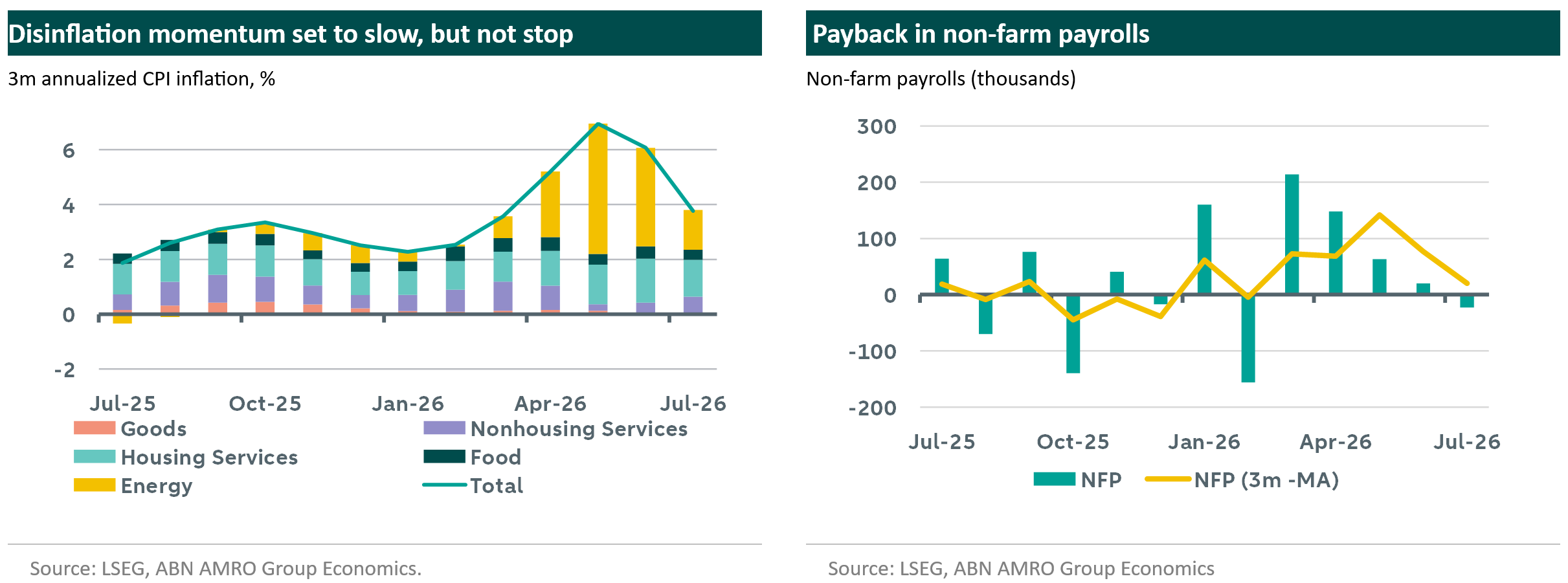
PCE inflation came in slightly above expectations, leading the y/y rate to remain stuck, which could be construed as an argument to raise rates. But what is the trajectory? Energy and food inflation remain elevated, while other categories are closer to historic patterns and consistent with the 2% target. Still, we broadly expect disinflation to continue, though at a less rapid pace than in recent months. Base effects will push inflation markedly down, even in range of target by Q2 2027, before rebounding somewhat again. We expect the y/y headline CPI and PCE inflation to stay flat, while both core measures continue to soften. Beyond that, the BEA will reveal the impact of a change in methodology for PCE, which affects the way portfolio management fees, legal services and computer software and accessories drive PCE inflation. The BLS has been unclear about details, but consensus is that it will push today’s inflation rate down by about 0.2pp. Concretely, the FOMC will have access to August CPI and PPI data. An upward surprise in (core) CPI, or a resurgence of PPI pressures, would likely be both sufficient and necessary to push the majority of the FOMC to hike.
Our view is that markets are overestimating the probability of a September hike, and our base case remains that there is no majority support for a rate hike. The FOMC therefore continues to hold in September, and beyond. We expect the policy rate to remain at current levels for an extended period of time, before gradually moving towards neutral next year. We are pushing back that easing slightly further and now see one cut in Q2, Q3 and Q4 each. While rates only seem marginally restrictive now, easing to the lower side of neutral will provide some support when the pace of private sector stimulus, i.e. the AI buildout eases off a bit. Still, there is a distinct possibility of a hike in September, which would put us on a different path, reminiscent of the Matterhorn or Table mountain debate of the previous hiking cycle. That would signal a Fed that is keen to get inflation down more quickly, implying more than a single hike. We’d see at least one more hike in December, and a gradual easing by the end of next year, when inflation should have sufficiently eased.