Energy: Green growth, with red figures: the EU remains a net importer of clean tech

Demand for clean technologies (also known as ‘clean tech’) from the European Union (EU) is set to rise sharply in the coming years. This is due to not only the EU’s ambition to meet its climate targets, but also to its drive to achieve greater energy security. It is highly likely that the acceleration in demand for clean tech will lead to a further increase in trade flows in clean technologies between the EU and its current trading partners. This analysis focuses on trade flows in clean technologies between the EU and countries outside the EU. We do not only highlight the balance of imports and exports of clean technologies in the EU-27 in relation to countries outside the EU-27, but also show which countries are the EU-27’s most important trading partners. The analysis also examines the impact of recent geopolitical conflicts on trade flows: that impact the region’s energy security. Finally, we assess the feasibility of the EU’s clean tech targets for clean technologies for 2030.

Since 2017, the EU has been importing over 460% more clean tech, driven by climate targets, the energy crisis and military conflicts
As a result, the EU has been facing a structural trade deficit in clean tech since 2017, particularly in solar panels and batteries
China accounts for around 74% of European clean tech imports and thus remains the greatest strategic vulnerability
Cheaper Chinese solar panels and batteries are accelerating progress towards climate targets, but are putting pressure on EU industry and profit margins
For the EU, however, it remains a balancing act: achieving an affordable transition to sustainability, whilst at the same time improving the EU’s competitiveness and strategic independence
The biggest challenge for the EU is to scale up domestic clean tech production, innovation in clean technologies and the supply of raw materials and resources
EU trade in critical materials and clean technologies
The energy transition, the rapid roll-out of renewable energy and the ambition to enhance energy security have all contributed to a thriving trade in clean technologies. As a result, in the period following the Paris Climate Agreement (from 2017 onwards), the EU’s imports of clean technologies from non-EU countries have increased by over 460%, or around 58% per year. This is illustrated in the figure on the left below with the green line. However, a more pronounced acceleration in EU imports of clean technologies began to take shape from 2019 onwards.
In 2022, the European Commission (EC) published its REPowerEU plan. The plan was a response to the Russian invasion of Ukraine and aimed to make the EU significantly less dependent on Russian fossil fuels by accelerating the transition to clean energy. As part of this plan, the EU imposed a binding target on EU Member States to scale up renewable energy to 42.5% of total final energy consumption by 2030, with the ambition of reaching 45%. As a result, imports of clean technologies into the EU have risen sharply, as shown in the figure on the left below with the green line.
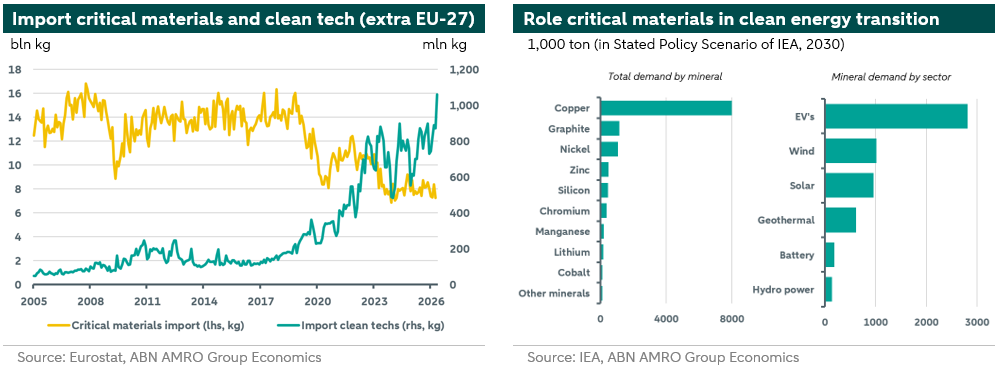
The sharp rise in imports of clean technologies is offset by a steep decline in imports of critical materials, as shown in the above left-hand-side figure with the yellow line. This decline is linked, amongst other things, to foreign export restrictions – particularly those imposed by China – and to the EU’s strategic shift towards processing and recycling more materials within Europe. As a result, imports of recycling machinery have risen more sharply. At the same time, European processing and production capacity came under pressure after 2022 due to higher energy costs and increasing international competition. See also our analysis on critical materials . EU policy, including the RESourceEU Action Plan and REPowerEU, has further strengthened the European approach to critical materials and recycling. Partly as a result, imports of recycling machinery increased by 45% between 2019 and 2025.
The production of clean technologies (such as electric vehicles (EVs), energy storage batteries, solar panels, wind turbines, heat pumps, hydropower technologies and hydrogen) requires large quantities of critical materials going forward. In terms of volume, copper is the most important of these, followed by graphite, nickel, zinc, silicon and chromium. The figures on the right below show the demand for critical materials and the total quantities required in the International Energy Agency’s (IEA) Stated Policy Scenario for 2030.
In the Sustainable Development Scenario of the IEA – which is designed entirely to meet the targets of the Paris Agreement – this demand for critical materials is almost twice as high as in the IEA Stated Policy Scenario. Most critical materials are primarily needed for the manufacture of electric vehicles (EVs), but wind turbines and solar panels also require relatively large quantities of critical materials. In a previous publication, we examined the supply and demand outlook for critical materials up to and including 2030 in greater detail; see .
EU trade deficit and dependence on imports in clean tech
Since 2017, the EU’s trade balance for clean technologies has shown a structural deficit in most years. Recent military conflicts involving regions rich in energy resources, such as Russia and the Middle East, have further increased demand for energy-saving, energy-efficient and renewable technologies.
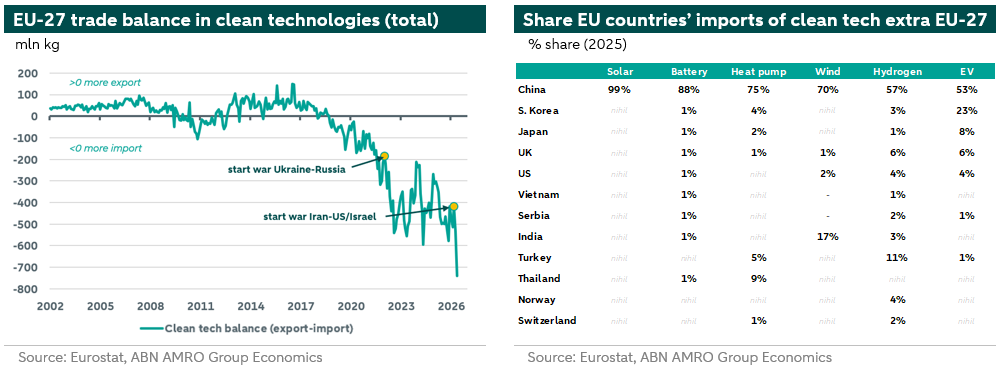
The geopolitical unrest has also stimulated imports of clean technologies. Demand for clean technologies in Europe is expected to continue to grow. This is not only due to the need to meet the climate targets that have been set, but above all because of the EU’s commitment to greater energy security and independence.
A high concentration of EU imports in the clean technology sector – with China accounting for around 74% of these imports, and particularly high figures for solar panels, batteries and heat pumps – creates economic vulnerability and a high supply risk for the EU. Imports of – in some cases – subsidised clean technologies create an uneven playing field for EU manufacturers. To address what they rgard as unfair competition, some EU leaders are adopting a tougher stance towards China regarding cheap imports. On balance, however, caution remains warranted due to divergent national economic interests and differing views on how to deal with China. We explore this in more depth in our Global Monthly; see . In addition, higher tariffs and trade barriers in the US have led to more Chinese clean technology entering the EU market. This, too, is leading to lower prices and pressure on margins for EU manufacturers. At the same time, low-cost imports also have a positive effect for buyers and consumers. This is because they reduce the costs of the energy transition and can lessen dependence on energy imports.
EU policy must strengthen production, innovation and diversification
However, the EU’s relatively high dependence on non-EU countries for both critical materials and clean technologies means that the risk of supply chain disruptions remains high. For example, (un)expected protectionist or trade-restrictive measures by key suppliers could still significantly disrupt supply chains in the EU. To further mitigate this risk, the EU would need to significantly invest in more production capacity for clean technologies in the coming years, whilst ensuring that trade flows in clean technologies remain open and accessible by diversifying its strategic trading partners. Other options include building up strategic stocks, promoting recycling, and concluding long-term supply contracts and trade agreements.
The figure on the left below shows that the EU imports more than it exports, particularly in the areas of solar panels and batteries. The trade balance for electric cars has been in deficit since the end of 2025. The EU imposes import duties on electric cars if they originate from countries outside the EU. The standard import tariff is 10%. In addition, the EU applies an anti-dumping policy against, for example, Chinese manufacturers. Electric vehicles in China are subsidised and are therefore considerably cheaper than their European equivalents. For this reason, an additional surcharge of up to more than 35% is applied on top of the standard 10% duty.
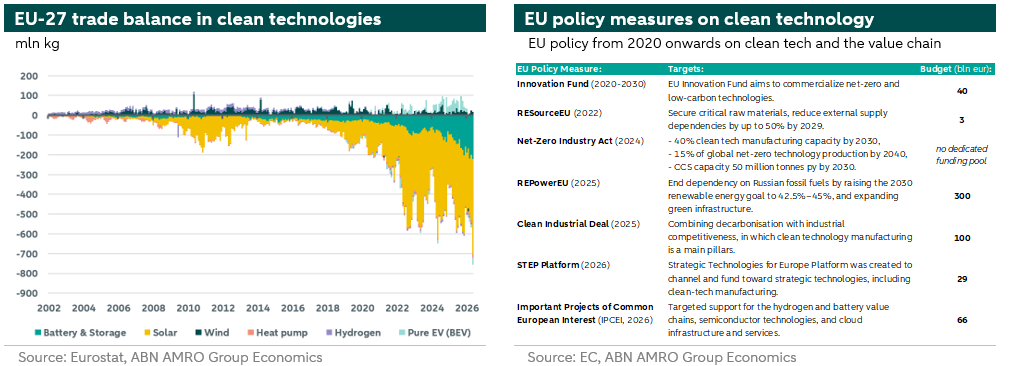
To safeguard the EU’s industrial sovereignty in the future, a wide range of EU policies offer protection to EU manufacturers. The table on the right above sets out the key measures. In addition, there are other EU initiatives providing financial support, such as the EIB de-risking programmes and the InvestEU guarantees. Furthermore, work is underway on the European Competitiveness Fund (ECF) for the EU budget for the period 2028–2034. This is a proposal worth EUR 409 billion, aimed at consolidating existing programmes, with a focus on the clean transition and decarbonisation, digital leadership (AI), defence autonomy, as well as on promoting healthcare and biotechnology.
In addition to all these financial support measures, the EC launched the Net-Zero Industry Act (NZIA) in 2024, setting out more concrete targets to actively drive clean tech innovation. The aim of this legislation is to ensure that, by 2030, at least 40% of the EU’s annual demand for clean technologies is produced within the EU. No budget has been allocated to the Act. The necessary investments can be financed, amongst other things, through the Clean Industrial Deal and the STEP Platform. A total of EUR 129 billion has been made available across these programmes to further support the production of and innovation in, amongst other things, clean technologies within the EU. The EU has made progress, but many clean tech sectors are not on track to meet the 40% NZIA target. The picture varies by technology.
EU clean tech production capacity
Since 2024, the global pipeline of production projects for most clean energy technologies has shrunk. This is primarily because sufficient production capacity is available globally. As a result, the economic viability of new projects becomes unfavourable. This applies to technologies such as solar energy and batteries. China is the dominant player in these areas.
Many clean technologies are also produced within the EU. Since 2020, the EU has been the largest investor in clean technology capacity after China. As a result, the NZIA target – to produce 40% of the EU’s clean tech requirements within the EU – has now been achieved for many clean technologies. This applies, for example, to heat pumps, wind turbines and electric vehicles. The EU produces these on a large scale itself. Compared with domestic demand, the EU has ample production capacity in these technologies and sometimes meets almost 100% of its annual requirements. According to Ember – a non-profit energy think tank – the EU can build almost twice as many wind turbines and electric cars annually as it needs itself.
The strength of EU industry in these sectors is also evident from the trend in EU exports. EU exports of clean technologies increased by 75% between 2020 and 2025, largely due to exports of electric vehicles and wind turbines. This means not only that domestic production capacity exceeds domestic demand for these technologies, but also that EU manufacturers hold a strong technological and industrial position in global markets. The main challenge is to maintain this position, as competitive pressure is also mounting in this area.
In terms of domestic production capacity, the EU lags particularly in the areas of solar panels and batteries, but also to some extent in carbon capture and storage (CCS) and electrolysers (to produce green hydrogen via the process of hydrogen electrolysis). In these technologies, the EU’s production capacity falls short of meeting domestic demand. Here too, China is the dominant player. The country accounts for around 90% of the EU’s total imports of solar panels and lithium-ion batteries for electric vehicles. China’s lead is substantial, making it impossible for the EU to close this gap.
EU targets for renewable capacity reflect ambition in clean tech
The EU has set specific targets for 2030 regarding wind and solar energy capacity. These targets are shown in the figures below, with the dark green line in the period 2025–2030. The EU’s ambition to expand renewable capacity to facilitate the energy transition and enhance energy security is directly linked to the level of imports of clean technologies and domestic production capacity in this sector.
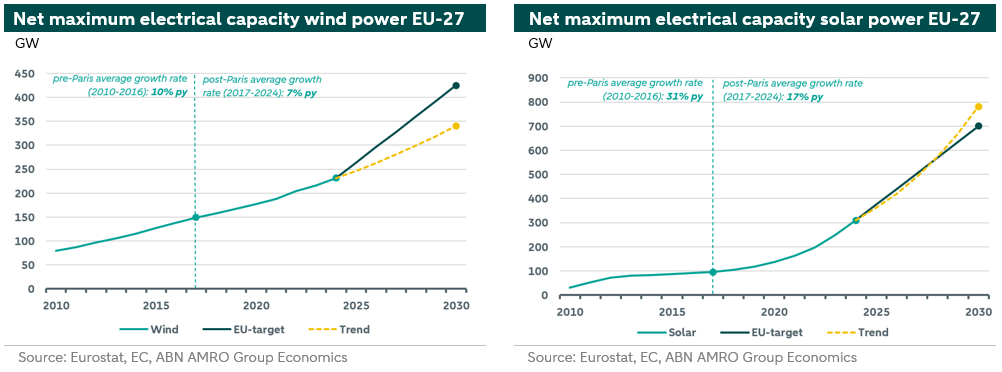
The EU aims to achieve a total cumulative wind energy capacity of 425 GW and a solar energy capacity of 700 GW by 2030. These targets are in line with the overarching goal of sourcing at least 42.5% of its energy consumption from renewable sources. We have made a forecast based on growth since 2017 – the year the Paris Agreement came into force. With an average annual growth rate of 7% for wind energy, the final target of 425 GW will not be met, falling short by 20%. With an average annual growth rate of 17% in solar energy capacity expansion, the target of 700 GW will be achieved, exceeding the target by 12%.
Within the EU, the development of new wind energy capacity is hampered by slow permit-granting processes, bottlenecks in the electricity grid and supply chain pressures. This is less of an issue for new solar energy capacity. Furthermore, new wind energy projects are more capital-intensive and carry greater risks. More time is spent assessing the economic viability of projects.
The EU remains heavily dependent on imports, particularly when it comes to solar panels and batteries. This is because only a small percentage of the EU’s demand for solar panels and batteries is met by domestic production. According to SolarPower Europe, the EU’s solar panel manufacturing sector currently accounts for just 1% of global production. And according to the European Automobile Manufacturers Association (ACEA), the EU has a share of around 7% in global battery cell production (2025). China is the world’s dominant manufacturer of both these clean technologies, and this is not set to change in the short term. Consequently, the EU’s dependence on imports in these areas remains high for the time being, particularly regarding China.
Conclusion
The clean tech sector brings together several pressing items on the EU agenda, such as climate policy, industrial policy, energy security, raw materials policy and geopolitics. The sector is therefore of crucial importance to the EU. By stimulating both the demand for and supply of clean tech, providing guidance on financing, streamlining licensing procedures and creating greater certainty regarding the supply of critical materials, the EU is laying a solid foundation. At the same time, however, the EU is vulnerable and remains dependent, for the time being, on China – a monopolist – particularly for imports of solar panels and batteries. Excessive reliance on imports in crucial parts of the clean technology supply chain is undesirable and threatens energy security in the EU. The biggest challenge for the EU is to scale up domestic clean-tech production, innovation and the supply of raw materials more significantly. This must be central to the EU’s strategy, because without additional investment in the clean-tech sector, faster licensing procedures and more supportive industrial policy, the EU risks remaining primarily a large market for foreign clean-tech rather than a leading producer.