Global Outlook - How resilient is resilience?

In this publication we present our economic outlook for the year ahead, while also adding our forecasts for 2028 for the first time. The global economy has expanded robustly despite many shocks over the past few years. We will explain why we think the economic expansion will continue, though we could once see more divergence between the US and the rest of the world, with Europe in particular falling behind. In addition, we explore a number of risks hanging over the global economy, which could potentially challenge the global economy’s remarkable record of resilience.


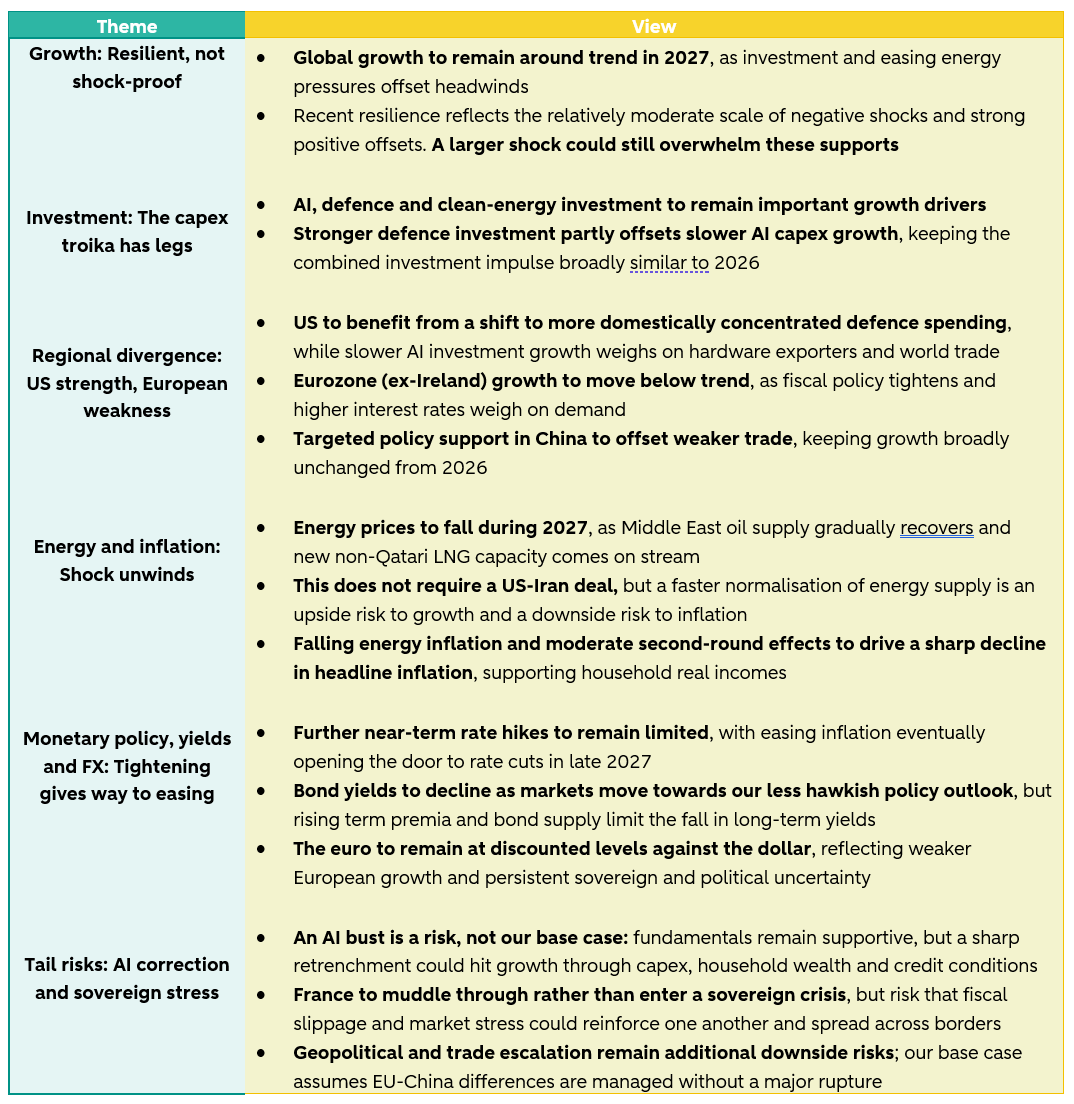
Global economic growth is seen continuing at around trend rates next year, but we see more divergence across regions
The US economy will be boosted by defence spending, with a somewhat slower AI capex impulse more visible elsewhere in the world
Europe is expected to lag behind, with economic growth below-trend on tighter fiscal policy, higher interest rates and political uncertainty
Resilience is not a given; so far shocks have not been big enough to derail the global economy, but an AI bust would likely do the trick
Regional updates: The eurozone economy is resilient, but bruised. Slower growth expected in 2027 on tighter fiscal & monetary policy
Growth to slow in the Netherlands, too, despite ongoing export strength
Germany’s recovery should continue, but remain driven by fiscal policy
In the US, the investment impulse is set to shift from AI to defence
Capex to support growth in China, but imbalances have worsened
Resilience has been the word du jour
Resilience has certainly been the defining word when it comes to the global economy, not only in 2026, but over the last few years. It was certainly the most used word at the recent World Bank and IMF Annual meetings (see here), and the general consensus is that it will characterise 2027 as well. Listing the shocks that the global economy has been exposed to over the recent past, which included energy shocks, tariffs, more broad geopolitical uncertainty, fiscal worries and rising interest rates, it is fair to say that the relatively positive economic outcomes have been a source of amazement.
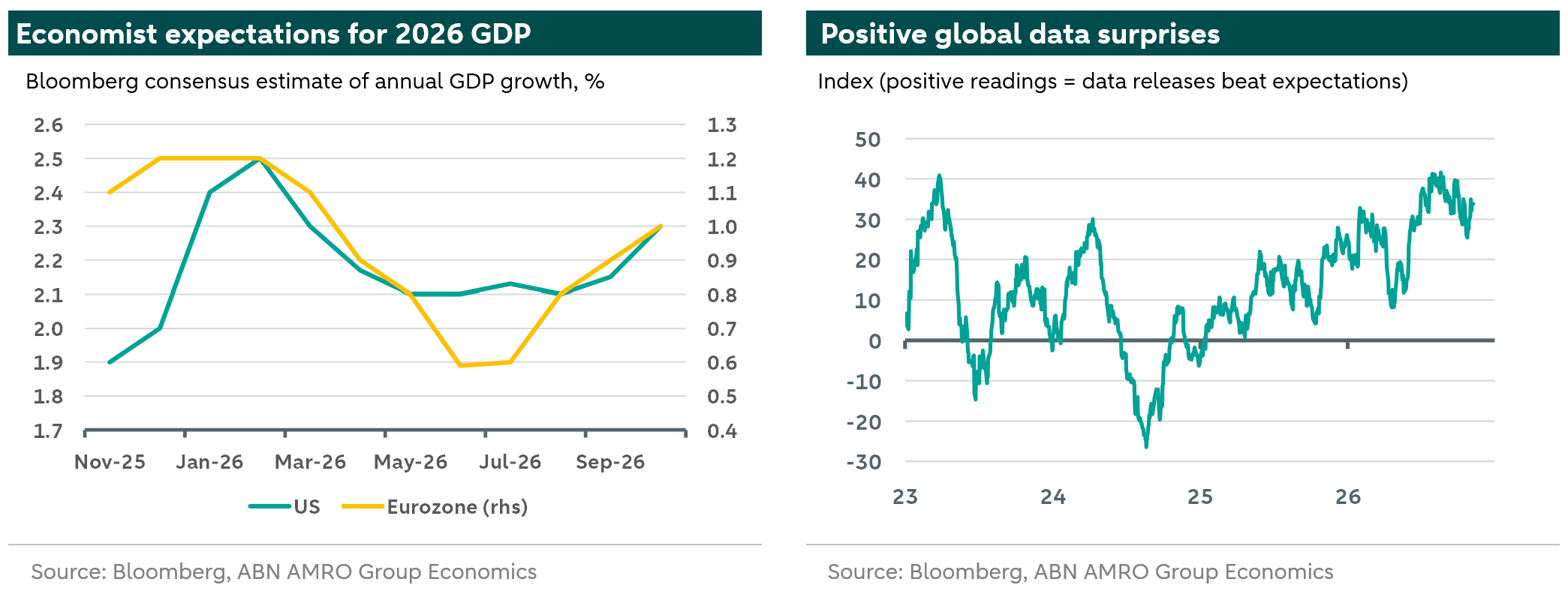
The IMF points out that its world economic forecasts have underestimated global growth three years in a row in the face of negative shocks. In the previous years, shocks had generally led to growth being overestimated. Similarly, economists have generally been upgrading their economic growth forecasts over the last few months as economic data have surprised positively following downward revisions after the war broke, while their equity analyst colleagues have been raising their expectations for corporate earnings. So what is going on? Is the global economy now shock proof? Unfortunately, the short answer is no.
Although the economy has shown an impressive ability to adjust to different conditions over the last few years, two other – potentially more transitory factors – have been more important. First, the scale of the shocks, although sometimes scary initially, turned out eventually to be relatively moderate. Take this year’s energy price shock. For reasons we have discussed in detail (see here), it has not been a particularly large one from a historical perspective, despite all the warnings of an energy crisis in the making. There is no guarantee that bigger shocks will not come along, as we discuss below.
Second, these shocks took place against the background of a troika of structural investment booms – in AI, defence and clean energy – which have supported global economic growth. Here, too, there have been recent doubts about the longevity of the AI capex boom in particular. Meanwhile, fiscal and financial conditions as well as healthy private sector balance sheets remained generally supportive of the economy. Rising equity prices boosted household wealth and hence consumer demand, especially in the US. So essentially, negative shocks have been offset by positive impulses.
Sustained expansion, supported by capex super cycle
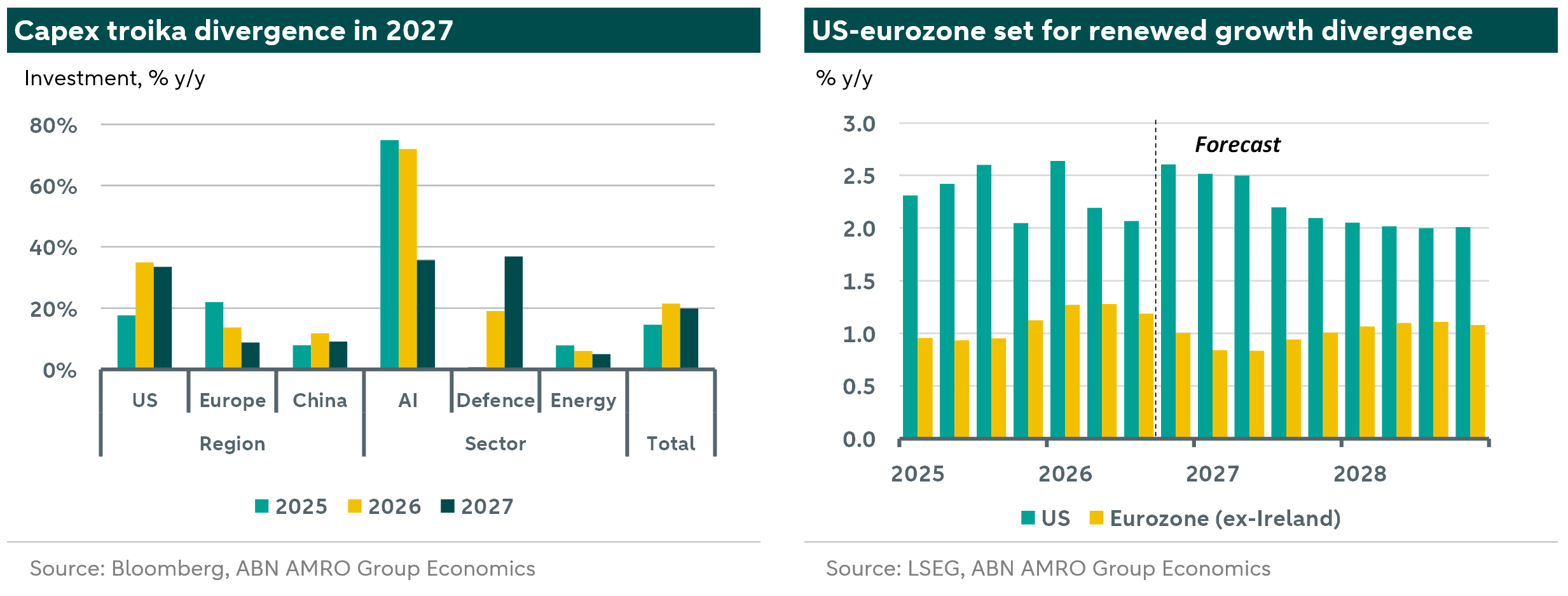
Our central view is that the global economic expansion will continue at around trend rates next year, but that there will be more divergence across regions. Let’s first start with big picture. We think that the global capex cycle has legs (see our recent note here). The capex troika amounted to an estimated USD 3.5 trillion across the US, China and the eurozone economies this year, or around 4.5% of the combined GDP of these economies. The aggregate growth impulse for these economies was 0.9% GDP and we expect a similar impulse next year. We estimate that AI capex will rise to USD 1.3 trillion next year on aggregate in these economies, and although this still implies a sharp slowdown from growth rates of around 70% y/y to 35% y/y, the higher base means the impulse to the global economy does not fall away too sharply. In addition, we expect higher investment in defence to offset this driven by the US, with military operations in Iran having created a more immediate need to replenish equipment and munitions.
Early energy shock unwind could be an upside risk
Second, we are projecting lower energy prices in the course of next year, and following the US election results, the risk now looks tilted to a more rapid normalisation in energy supply. Prior to the election, we had worried that president Trump would follow through on hints at a re-escalation of the conflict in Iran. Since then, we have been taken aback by the broader Republican turn against the conflict. Although Trump still has the power to re-escalate the conflict given his role as Commander in Chief, given the electoral incentive Republicans now have to distance themselves from Trump, he could run the risk of some senators joining Democrats in voting to impeach the president if he re-escalates without party support. This significantly raises the chance of a deal now being struck that could finally permanently re-open the Strait of Hormuz and enable a full normalisation of energy supply.
Our more cautious base case (which assumes no US-Iran deal) in any case sees Middle East oil supply gradually recovering, while new non-Qatari LNG capacity comes on stream. This should lead to a collapse in inflation during the course of next year. This supports the global economy in two ways. It will help a recovery in household disposable incomes during course of next year. In addition, together with moderate second round effects, it will keep central bank rate hikes moderate and it will eventually open the door for rates cuts by the end of 2027. As financial markets are pricing in a higher for longer scenario, this will also bring down bond yields, although the impact will be capped at the long end of the curve by rising term premia given rising bond supply.
Divergence between the US and the rest
The US will actually benefit from the shift in capex growth from AI to defence. This is because the direct impulse from AI capex does not necessarily fully land where the spending takes place, as capex tends to be very import-intensive. The countries where the equipment is manufactured benefit at least as much. For instance, according to the IMF, Taiwan and Korea source 62 percent of the net trade in computing hardware related to AI, while Malaysia, Mexico and the Netherlands are also significant net exporters. At the same time, the US and China are responsible for more than 75 percent of the net imports of AI-related computing hardware. This and rising prices is the reason why around half the growth in the value of world trade was related to AI hardware. Meanwhile, defence spending is almost exclusively domestic. So the net effect of this on US economic growth could actually be positive. In contrast, the lower AI capex impulse could well be visible in somewhat slower growth in the leading AI manufacturing economies as well as in world trade growth. In the case of China, ongoing targeted support is expected to offset the impact of weaker trade next year, so we expect economic growth to be close to last year’s rate.
Europe will lag behind
Although we expect the eurozone economy to continue to expand, we expect the pace to be rather lacklustre and to be on average at below-trend growth rates. First, fiscal policy will likely shift from being supportive to economic growth to being a drag. The German fiscal impulse moderates, European funds that have been in particular supporting projects in Southern Europe will dry up, while fiscally vulnerable countries such as France will be implementing austerity. This is partly reflected in the slowdown of the capex troika in Europe. Indeed, although Germany will continue to ramp up defence spending, high import dependence and limited fiscal capacity elsewhere continues to limit the growth impulse. Second, interest rate rises have been somewhat bigger in the eurozone than in the US, while long-term interest rates have even gone up a bit more because of fiscal risks and political uncertainty. Given the eurozone is more of a bank-based, rather than a capital market-based financial system, interest rate rises are more important for the financing conditions faced by companies and households. Europe’s lagging performance, and ongoing sovereign risks and political uncertainty in France and elsewhere (see below), should keep the euro at current discounted levels against the dollar next year.
License to shock
Although our central view is one of continued expansion, there are a number of clouds hanging over the horizon that could create shocks big enough to derail the global economy. The principal identifiable risks are 1) an AI crash, and 2) sovereign debt worries escalating in France (or elsewhere). We tackle these below in more detail, but beyond these, the past year taught us that there are also ‘unknown unknowns’, particularly when it comes to geopolitical risk. We did not expect a conflict in Iran to be a likely economic shock this time last year, and although efforts have been stepped up recently to bring about an end to the Russia-Ukraine war, barely a day goes by without headlines over hybrid warfare in Europe and the risk that the conflict could escalate to one with NATO. On the trade front, meanwhile, our base case (see here) is that the EU and China work through their differences in a far less explosive manner than the US did with China, but we cannot rule out a more serious escalation in trade tensions.
AI boom to die another day
Investor concerns about an AI bust have built over recent months. Attention initially focused on whether revenues could justify the enormous investment in compute capacity, before shifting to how that investment would be financed, with the sell-off in data centre bonds seen as a canary in the coal mine. More recently, the Democrats’ stunning Midterms victory has added a political dimension, raising the risk of tighter restrictions on data centres and frontier AI development. But investment can shift to more supportive states or potentially federal land, while Donald Trump retains a veto over federal AI legislation. The election may therefore slow the AI buildout, but is unlikely to derail the boom.
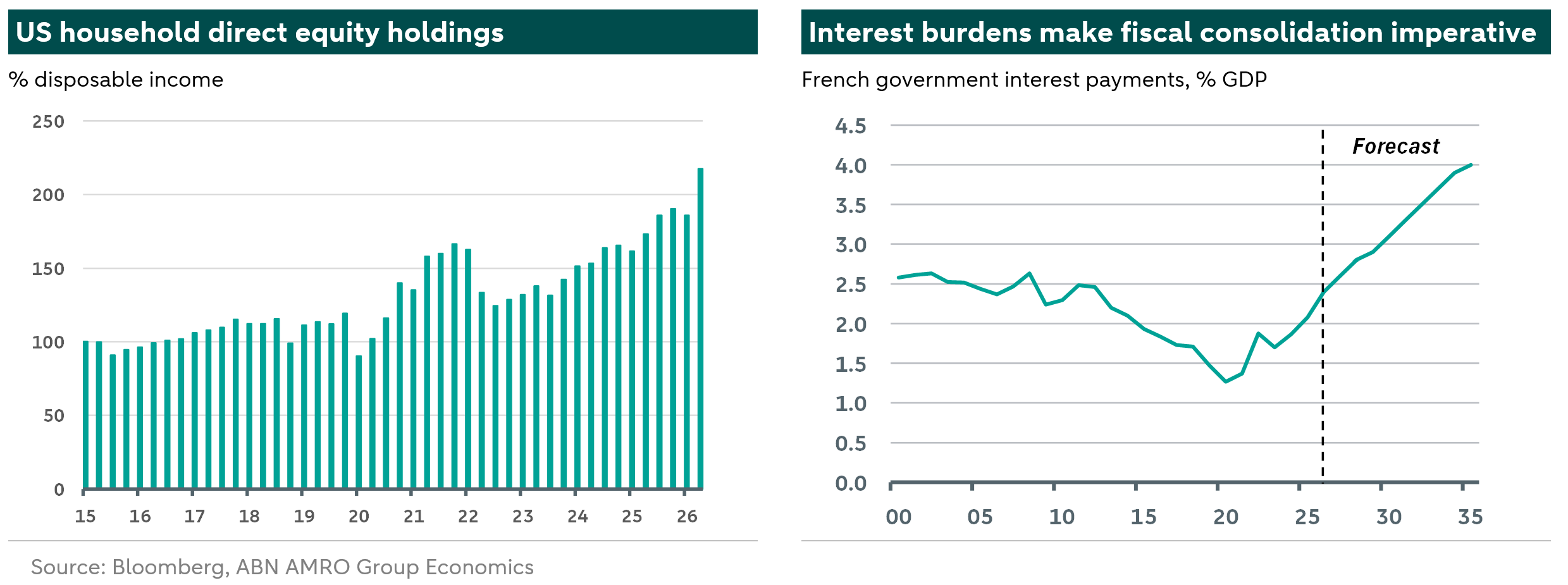
An AI bust would nevertheless hit the global economy hard. The sheer scale of AI capex means there is a long way down, while falling equity prices and wider credit spreads would tighten financial conditions and hit household wealth. A recent Fed paper (see ) estimates that, given today’s much larger household equity holdings, even a 25% fall in equity prices could trigger an outright contraction in consumer spending. This is therefore one shock that could seriously test the global economy’s resilience.
But is this the big one, or just a drill? Our view remains that the AI boom will die another day (see our note here for more details). A correction is likely at some point, as revenues and productivity gains ultimately need to justify spectacular investment spending. For now, fundamentals remain supportive: revenues are growing strongly, compute demand continues to outstrip supply, and GPU rental prices are still rising. Valuations are also far from the extremes seen ahead of the ICT bust. The boom may be entering a more challenging phase, but we do not think it is over yet.
From France with Risk
France is another potential source of a bigger shock, although our base case remains one of muddling through rather than crisis. France’s fiscal trajectory is troubling, but we expect a diluted 2027 budget to pass, while even a Marine Le Pen presidency need not trigger a crisis: market pressure, the constraints of office and, in our base case, the absence of an RN majority in the Assembly should encourage some ‘Meloni-isation’. The tail risk is that these constraints fail. An RN majority could enable fiscal slippage and confrontation with Europe to reinforce one another. If rising yields prompted defiance rather than moderation, pressure on banks, growth and the public finances could turn into a vicious cycle, eventually leading investors to price redenomination risk. France does not need to choose Frexit for this to become destabilising. Markets only need to stop treating it as unthinkable (see here for more).
France is not the only source of fiscal risk. Belgium is in a similarly difficult fiscal predicament, while Italy also faces risks from next year’s parliamentary elections. PM Meloni may need to rely on Futuro Nazionale, a more right-leaning coalition partner, to retain her majority, which could test Italy’s commitment to EU fiscal rules. And bond market stress has a habit of spreading indiscriminately once it gets going. As the IMF warned in its latest Fiscal Monitor, “the effects of fiscal indiscipline does not stop at the border.” The risk is not just that bond market stress escalates in a particular country, but that this triggers widespread contagion to other countries, leading to a broader crisis. We do not see signs of this yet, and in Europe at least, the potential deployment of the ECB’s TPI should help to prevent such a dynamic from taking hold. But this does not mean bond markets are immune to contagion. Lastly, against the background of rising debt service costs around the world, governments will face a fiscal squeeze and will have to make tough choices. For instance, although perhaps not an immediate issue, Europe’s currently debt-fuelled ramp up in defence spending will eventually have to be paid for by making difficult choices around taxes and spending. Whether markets force it or not, the fiscal reckoning cannot be put off forever. (Nick Kounis & Bill Diviney)
Informing our key judgement calls, we explored the following five themes in the lead up to this publication:
AI capex boom to die another day - 28 October 2026 - Rogier Quaedvlieg & Nick Kounis
Will China Shock 2.0 trigger an EU-China trade war? - 3 November 2026 - Arjen van Dijkuizen & Jan-Paul van de Kerke
Eurozone inflation: Another wave, but not a repeat of 2022 - 5 November 2026 - Aggie van Huisseling & Bill Diviney
AI and the neutral rate: Live and let rise - 5 November 2026 - Rogier Quaedvlieg & Nick Kounis
We need to talk about France - 6 November 2026 - Bill Diviney
In the below table, we summarise our key judgement calls and assumptions for macro and financial market developments in 2027.